


At Doctor Heat Pump, we help Las Vegas homeowners navigate one of the most common HVAC decisions: heat pump vs AC for desert climate cooling. With hundreds of installations across Las Vegas, Henderson, and North Las Vegas—including luxury high-rises like Waldorf Astoria and Veer Towers—we’ve seen how both systems perform in our extreme 115°F summer heat.
When it comes to staying cool in the Las Vegas heat, homeowners and business owners often ask: Do heat pumps cool as well as air conditioners? This heat pump vs AC debate is crucial in a desert climate where reliable cooling isn’t optional—it’s essential for survival and comfort.
The answer might surprise you: modern heat pumps match air conditioner cooling performance while delivering year-round heating capability that AC units simply can’t provide. Let’s break down the heat pump vs AC comparison to help you make the best decision for your comfort and energy efficiency.
How Heat Pumps and Air Conditioners Work
To understand the heat pump vs AC cooling debate, you need to know how each system operates.
Air Conditioner Operation
An air conditioner cools your home by absorbing indoor heat and transferring it outside using refrigerant and a compressor. The process is straightforward:
- Warm indoor air passes over evaporator coils containing cold refrigerant
- Refrigerant absorbs heat and evaporates into gas
- Compressor pressurizes the hot refrigerant gas
- Outdoor condenser coils release heat to outside air
- Refrigerant condenses back to liquid and cycles back inside
Air conditioners work in one direction only—cooling your home during hot months. They cannot provide heating.
Heat Pump Operation
A heat pump works identically to an air conditioner in cooling mode, using the same refrigeration cycle to transfer heat from inside to outside. The critical difference: a reversing valve allows heat pumps to switch functions seasonally.
In summer (cooling mode): Heat pumps operate exactly like air conditioners, removing heat from your home and releasing it outdoors.
In winter (heating mode): The reversing valve changes refrigerant flow direction. The system extracts warmth from outside air—even at 40°F—and transfers it indoors to heat your space.
This dual-function capability makes heat pumps efficient year-round climate control systems, while air conditioners require separate heating equipment.
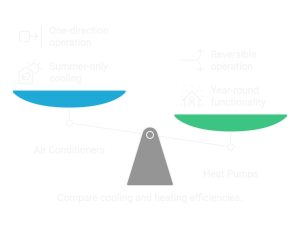
Energy Efficiency: Heat Pump vs AC Comparison
One of the biggest reasons people choose heat pumps over air conditioners is superior energy efficiency—not in cooling performance, but in providing both heating and cooling from a single system.
Cooling Efficiency: Heat Pump vs AC
When comparing heat pump vs AC cooling efficiency, modern systems achieve virtually identical performance. Both use the same refrigeration technology to cool your space.
SEER2 Ratings (Seasonal Energy Efficiency Ratio):
- High-efficiency heat pumps: 18-24 SEER2
- High-efficiency air conditioners: 18-24 SEER2
- Mid-tier heat pumps: 15-18 SEER2
- Mid-tier air conditioners: 15-18 SEER2
| System | SEER2 Rating | Cooling Efficiency |
|---|---|---|
| Heat Pump | 15-24 | High |
| Air Conditioner | 15-24 | High |
| Heat Pump (older) | 13-14 | Moderate |
| AC (older) | 13-14 | Moderate |
The verdict: In cooling-only comparison, heat pump vs AC efficiency is essentially equal when comparing systems with matching SEER2 ratings.
Overall Energy Efficiency: Where Heat Pumps Win
The heat pump vs AC efficiency advantage becomes clear when considering year-round operation. Air conditioners cool only, requiring separate heating systems (furnaces, electric heaters) that consume additional energy.
Heat pumps deliver both functions using a single, efficient system:
Cooling season (May-October in Las Vegas):
- Heat pump and AC perform identically at same SEER2 rating
- Both consume similar electricity for cooling
Heating season (November-April in Las Vegas):
- Heat pump operates at 300-400% efficiency (moves heat vs. generates it)
- AC sits idle; separate furnace/heater runs at 80-100% efficiency
Annual energy cost comparison:
- Heat pump: $800-1,200/year (combined heating + cooling)
- AC + Gas furnace: $1,000-1,500/year
- AC + Electric heat: $1,200-1,800/year
For Las Vegas residents, a heat pump provides significant energy savings over the complete year, especially when paired with proper insulation and smart thermostat controls.
Cooling Performance: Do Heat Pumps Cool as Well as Air Conditioners?
Las Vegas summers present the ultimate test for any cooling system, with temperatures consistently exceeding 110°F from June through August. The critical question in the heat pump vs AC debate: Can heat pumps handle extreme desert heat as effectively as dedicated air conditioners?
Performance in Normal Conditions (Up to 105°F)
Do heat pumps cool as well as air conditioners in typical hot weather? Absolutely yes. When outdoor temperatures stay below 105°F, heat pumps and air conditioners with matching SEER2 ratings deliver identical cooling performance:
- Same indoor temperature achievement
- Same humidity removal
- Same comfort levels
- Same energy consumption
There’s no measurable difference in cooling capability between a 20 SEER2 heat pump and a 20 SEER2 air conditioner in these conditions.
Performance in Extreme Heat (105-115°F)
When temperatures climb above 105°F—common in Las Vegas July and August—the heat pump vs AC comparison becomes more nuanced.
Heat pumps: Modern high-efficiency heat pumps maintain full cooling capacity up to 115-120°F outdoor temperature. However, efficiency drops slightly (10-15%) as the system works harder to transfer heat against the large indoor/outdoor temperature difference.
Air conditioners: Premium AC units designed specifically for extreme climates maintain peak efficiency slightly better in sustained 115°F+ conditions.
Real-world impact: For properly sized systems, both heat pumps and air conditioners keep Las Vegas homes comfortable even during peak summer heat. The performance difference is negligible for residential applications.
Sizing Matters More Than System Type
Whether you choose a heat pump vs AC, proper sizing proves more critical than system type for Las Vegas cooling performance. An undersized system of either type struggles in extreme heat; a properly sized system of either type performs excellently.
Professional load calculation accounts for:
- Home square footage and ceiling height
- Insulation levels and window quality
- Desert sun exposure and heat gain
- Occupancy and internal heat sources
Doctor Heat Pump performs detailed load calculations to ensure your heat pump or AC system handles Las Vegas’s demanding climate efficiently.
Year-Round Comfort: The Heat Pump vs AC Advantage
The most significant difference in the heat pump vs AC comparison isn’t cooling performance—it’s versatility. This advantage becomes especially valuable in Las Vegas’s varied climate.
Heat Pumps: Two Systems in One
One major advantage of choosing a heat pump vs AC is year-round climate control from a single system. Unlike air conditioners that only cool, heat pumps reverse their function to warm your home during cooler months.
While Las Vegas doesn’t experience harsh winters, nighttime temperatures regularly dip into the 30s and 40s from November through March. Daytime winter highs in the 50s and 60s still require heating for indoor comfort.
With a heat pump, you get:
- Summer cooling (May-October)
- Winter heating (November-April)
- Spring/fall temperature control (March-May, September-November)
- One system, one maintenance schedule, one investment
With an air conditioner, you need:
- AC for summer cooling
- Separate furnace or electric heater for winter
- Two systems to maintain and repair
- Higher combined equipment cost
| System Type | Cooling Function | Heating Function | Equipment Needed |
|---|---|---|---|
| Air Conditioner | Yes | No | AC + Separate heater |
| Heat Pump | Yes | Yes | Heat pump only |
Cost Comparison: Heat Pump vs AC Over 15 Years
When evaluating heat pump vs AC long-term value:
Air Conditioner + Gas Furnace:
- Equipment cost: $8,000-12,000
- Annual energy: $1,000-1,500
- 15-year total: $23,000-34,500
Heat Pump (all-in-one):
- Equipment cost: $9,000-14,000
- Annual energy: $800-1,200
- 15-year total: $21,000-32,000
Savings with heat pump: $2,000-5,000 over 15 years, plus simplified maintenance and single-system convenience.
The Benefits of Ductless Heat Pumps vs AC
For homeowners comparing heat pump vs AC options, ductless mini-split systems offer additional advantages over traditional ducted equipment.
Why Ductless Heat Pumps Outperform Ducted AC
Traditional air conditioner installations rely on ductwork that can waste 20-30% of cooled air through leaks, poor insulation, and friction losses. Ductless mini-split heat pumps eliminate this waste entirely by delivering conditioned air directly into rooms.
Ductless heat pump advantages over ducted AC:
Improved energy efficiency – Eliminating duct losses saves 20-30% on cooling costs compared to leaky ductwork
Better indoor air quality – No ducts means no dust, mold, or allergen accumulation in hidden ductwork
Flexible installation – Perfect for room additions, converted garages, high-rise condos, and homes without existing ducts
Zoned temperature control – Set different temperatures for different rooms based on usage and preferences
Quieter operation – Indoor units operate at whisper-quiet 19-25 decibels
For Las Vegas high-rises and homes without existing ductwork, ductless mini-split heat pumps provide superior performance compared to window AC units or expensive duct installation.
Ductless Heat Pump vs Central AC: Performance Comparison
| Feature | Ductless Heat Pump | Central AC + Ducts |
|---|---|---|
| Energy Efficiency | High (no duct loss) | Lower (20-30% duct loss) |
| Installation Cost | $3,000-12,000 | $8,000-15,000 (with duct install) |
| Heating Capability | Yes | No (requires separate system) |
| Zone Control | Yes (room-by-room) | No (whole-house only) |
| Air Quality | Excellent (no ducts) | Moderate (ducts collect dust) |
| Ideal For | High-rises, ductless homes | Homes with existing ducts |
Heat Pump vs AC: Extreme Climate Performance
Las Vegas’s extreme desert climate demands HVAC systems that perform reliably in challenging conditions year-round.
Summer Performance (May-October)
Temperatures: 95-115°F days, 75-90°F nights
Heat pump vs AC cooling performance:
- Both systems handle 100°F days easily with proper sizing
- Both maintain full capacity up to 115°F outdoor temperature
- Modern heat pumps match AC cooling even in extreme desert heat
- Energy consumption essentially identical at same SEER2 rating
Advantage: Tie—both perform excellently in Las Vegas summer heat
Winter Performance (November-April)
Temperatures: 35-50°F nights, 55-70°F days
Heat pump vs AC heating capability:
- Heat pump: Provides efficient heating at 250-350% efficiency in Las Vegas’s mild winters
- Air conditioner: Provides no heating; requires separate furnace or electric heater
Advantage: Heat pump—delivers efficient winter heating without additional equipment
Monsoon Season (July-September)
Conditions: High humidity spikes (10% to 60%+), dust storms, temperature swings
Heat pump vs AC dehumidification:
- Both systems dehumidify effectively during cooling operation
- Variable-speed models (heat pump or AC) provide superior humidity control
- Properly sized systems of either type handle monsoon humidity well
Advantage: Tie with variable-speed models; heat pump offers year-round moisture control
Dust and Outdoor Air Quality Considerations
Las Vegas’s dusty desert environment affects all outdoor HVAC equipment equally. Both heat pumps and air conditioners require:
- Monthly filter changes during dust season
- Regular outdoor coil cleaning (annually)
- Protection from blowing sand and debris
Advantage: Tie—both require similar desert-climate maintenance
Installation & Maintenance: Heat Pump vs AC Requirements
Proper installation and maintenance significantly impact system performance and lifespan, whether you choose a heat pump vs AC.
Installation Considerations
Heat Pump Installation:
- Requires refrigerant line installation (same as AC)
- Electrical connection to outdoor unit (same as AC)
- Thermostat wiring for heating + cooling modes
- Professional load calculation essential for desert climate
- Installation cost: $9,000-14,000 complete system
Air Conditioner Installation:
- Refrigerant line installation
- Electrical connection to outdoor unit
- Cooling-only thermostat wiring
- Separate heating system installation required
- Installation cost: $8,000-12,000 (AC + furnace combined)
Both systems require professional installation to ensure proper refrigerant charge, electrical connections, and optimal performance. Doctor Heat Pump provides expert installation with precise sizing for Las Vegas’s extreme climate.
Maintenance Requirements: Heat Pump vs AC
Regular Maintenance Tasks (Both Systems):
| Task | Recommended Frequency | Importance |
|---|---|---|
| Change Standard Filters | Every 1-3 months (monthly in dusty season) | Critical |
| Clean HEPA Filters | Every 6-12 months | High |
| Professional HVAC Tune-Up | Once yearly (before cooling season) | Critical |
| Outdoor Coil Cleaning | Annually (after dust season) | High |
| Refrigerant Level Check | Annually | Critical |
| Electrical Connection Inspection | Annually | High |
Heat Pump-Specific Maintenance:
- Reversing valve inspection (ensures heating mode works)
- Defrost cycle verification (rarely needed in Las Vegas)
- Both heating and cooling mode testing
Air Conditioner + Furnace Maintenance:
- Two separate systems requiring independent servicing
- Furnace requires additional maintenance (burner cleaning, gas line inspection)
- Higher combined maintenance costs
Maintenance cost comparison:
- Heat pump: $120-180/year (single system)
- AC + Furnace: $200-300/year (two systems)
Advantage: Heat pump—simpler maintenance, lower cost, single service appointment
Lifespan: Heat Pump vs AC Durability
- Heat pump lifespan: 15-20 years with proper maintenance
- Air conditioner lifespan: 15-20 years with proper maintenance
- Gas furnace lifespan: 15-20 years with proper maintenance
- Electric heater lifespan: 15-30 years (simple technology)
In the heat pump vs AC durability comparison, both cooling systems last similar lengths. However, heat pumps provide heating and cooling for their entire 15-20 year lifespan, while AC requires separate heating equipment that may fail independently.
Heat Pump vs AC: Which Is Right for Las Vegas Homes?
So, do heat pumps cool as well as air conditioners? Yes—heat pumps match air conditioner cooling performance while providing efficient year-round heating that AC units cannot deliver.
Choose a Heat Pump If:
- ✅ You want one system for both heating and cooling
- ✅ You’re building new construction or replacing both AC and furnace
- ✅ Energy efficiency and lower utility bills are priorities
- ✅ You prefer simplified maintenance (one system vs. two)
- ✅ You’re pursuing all-electric home efficiency
- ✅ You qualify for federal tax credits (up to $2,000 for heat pumps)
Choose an Air Conditioner If:
- ✅ You already have a functioning, efficient heating system you want to keep
- ✅ You’re only replacing a failed AC unit, not your heater
- ✅ Your existing ductwork and electrical are AC-specific
- ✅ Your budget allows AC now, heating system replacement later
- ✅ You have a specific high-efficiency AC model preference
Best Choice for Most Las Vegas Homeowners: Heat Pump
For the majority of Las Vegas homes and businesses, heat pumps provide superior value in the heat pump vs AC comparison. The ability to replace both your AC and heating system with a single efficient unit delivers:
- Lower total equipment cost (one system vs. two)
- Reduced annual energy bills (30-50% heating cost savings)
- Simplified maintenance schedule
- Qualification for federal tax credits
- Future-proof all-electric technology
- Excellent cooling performance equal to premium AC units
For Las Vegas families and businesses, the heat pump vs AC decision ultimately favors heat pumps for long-term value, efficiency, and year-round comfort. If you’re unsure which option best fits your home or business, we’re here to help.
FAQ: Heat Pump vs AC
Do heat pumps cool as well as air conditioners?
Yes, heat pumps cool as well as air conditioners with matching SEER2 ratings. In cooling mode, heat pumps use identical refrigeration technology to air conditioners, delivering the same cooling performance, energy efficiency, and comfort levels. Modern heat pumps maintain full cooling capacity even in Las Vegas’s 115°F summer heat.
Is a heat pump more efficient than AC?
In cooling-only comparison, heat pumps and air conditioners achieve equal efficiency at matching SEER2 ratings. However, heat pumps prove more efficient overall because they provide both heating (at 300-400% efficiency) and cooling from one system, while AC requires separate, less-efficient heating equipment.
Can heat pumps handle Las Vegas heat?
Absolutely. Modern heat pumps maintain full cooling capacity up to 115-120°F outdoor temperature—well above Las Vegas’s typical 110-115°F summer peaks. Properly sized heat pumps keep homes comfortable throughout even the hottest desert summers while using the same energy as comparable air conditioners.
What is the downside of a heat pump vs AC?
The primary downside: heat pumps cost $1,000-2,000 more upfront than air conditioners alone. However, this initial cost difference disappears when comparing total system costs (heat pump vs. AC + furnace). Heat pumps also provide both heating and cooling, while AC provides cooling only—requiring separate heating equipment.
How long do heat pumps last compared to AC?
Heat pumps and air conditioners last similar lengths—typically 15-20 years with proper maintenance in Las Vegas climate. The key difference: heat pumps provide both heating and cooling for their entire lifespan, while air conditioners require separate heating systems that may fail independently, potentially requiring earlier replacement.
Are heat pumps worth it in Las Vegas?
Yes, heat pumps are excellent for Las Vegas homes. They handle extreme summer heat as effectively as air conditioners while providing efficient heating during 40-60°F winter nights. Combined with federal tax credits (up to $2,000), 30-50% heating cost savings, and single-system convenience, heat pumps deliver superior long-term value for desert climate homes.
Do heat pumps use more electricity than AC in summer?
No. Heat pumps and air conditioners with matching SEER2 ratings consume identical electricity during summer cooling operation. Both use the same refrigeration cycle and compressor technology to cool your home. The heat pump’s reversing valve (used only for winter heating) doesn’t affect summer cooling efficiency.
Ready to Choose Between Heat Pump vs AC? Contact Doctor Heat Pump Today!
The heat pump vs AC debate clearly favors heat pumps for Las Vegas homes seeking year-round comfort, energy efficiency, and long-term value. As Las Vegas’s heat pump and air conditioning specialists, Doctor Heat Pump helps homeowners and businesses select the perfect cooling and heating solution for desert climate performance.
Contact Doctor Heat Pump today to discuss whether a heat pump or air conditioner best fits your home’s specific needs, budget, and comfort goals.
Call now at 702-467-7236 to schedule your free consultation and get expert recommendations for your Las Vegas cooling and heating system!
References
- U.S. Department of Energy – Heat Pump Systems vs Air Conditioners – https://www.energy.gov
- Energy Star Heat Pump and AC Efficiency Ratings – https://www.energystar.gov
- ASHRAE Climate Zone Performance Standards – https://www.ashrae.org
- Air Conditioning Contractors of America – Desert Climate Guidelines – https://www.acca.org