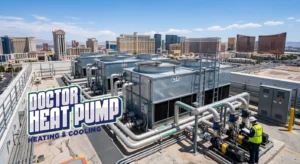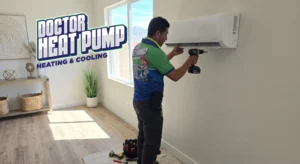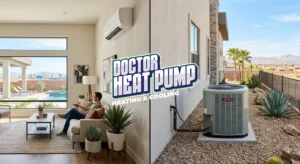


Commercial heat pump maintenance represents one of the most cost-effective investments building managers can make, yet many Las Vegas properties operate reactive maintenance programs addressing only failures rather than preventing them. At Doctor Heat Pump, we serve as the preferred service contractor for prestigious properties like Waldorf Astoria and Veer Towers, where comprehensive heat pump maintenance contracts ensure reliable comfort for residents while protecting substantial HVAC investments. Our experience managing maintenance programs for high-rise buildings, multi-family complexes, and commercial properties taught us that professional maintenance contracts deliver measurable returns through reduced energy costs, prevented emergency repairs, extended equipment life, and consistent tenant satisfaction.
Heat pump maintenance contracts provide building managers with predictable budgeting through fixed monthly or annual costs, priority service response when problems arise, systematic preventive maintenance preventing 70% to 80% of premature failures, and detailed documentation tracking system performance and maintenance history. This comprehensive guide explains what Las Vegas building managers should expect from commercial heat pump maintenance contracts, how to evaluate service providers, what maintenance activities prove essential, and how to calculate return on investment ensuring your maintenance program delivers maximum value.
Understanding Commercial Heat Pump Maintenance
Why Commercial Systems Require Professional Maintenance
Commercial heat pump systems work significantly harder than residential equipment, operating longer hours under higher loads serving multiple units or large spaces. According to U.S. Department of Energy maintenance guidelines, commercial HVAC systems without regular professional maintenance experience efficiency degradation of 5% to 10% annually, equipment lifespan reductions of 30% to 50%, and repair costs 3 to 5 times higher than properly maintained systems.
Las Vegas’s extreme desert climate amplifies maintenance importance. Summer temperatures exceeding 110°F stress equipment to maximum capacity for extended periods. Dust storms coat coils reducing heat transfer efficiency. Occasional monsoon humidity introduces moisture challenging drainage systems. Winter overnight temperature drops to 30°F require heating mode operation. This year-round demand with extreme temperature swings necessitates vigilant maintenance preventing failures that leave tenants uncomfortable and generate expensive emergency repair costs.
Professional heat pump maintenance contracts ensure systematic service addressing wear before failures occur. Technicians inspect, clean, test, and adjust equipment according to manufacturer specifications, identifying potential problems early when repairs cost hundreds rather than thousands. For additional service information, visit our heat pump maintenance services page.
Preventive vs. Reactive Maintenance Economics
Reactive maintenance responding only to failures costs 3 to 5 times more than preventive maintenance programs according to industry data. A building manager spending $15,000 annually on a comprehensive maintenance contract might face $45,000 to $75,000 in reactive repair costs without preventive programs, plus tenant dissatisfaction from repeated comfort disruptions.
Preventive maintenance identifies worn belts, dirty coils, low refrigerant, or failing components before they cause system failures. Replacing a $200 contactor during scheduled maintenance prevents a $2,500 emergency compressor replacement caused by electrical problems. Cleaning coils during routine service maintains efficiency preventing the 20% to 30% capacity loss and corresponding energy cost increases from neglected equipment.
According to ENERGY STAR commercial building benchmarks, buildings with comprehensive maintenance contracts consume 15% to 25% less energy than buildings with reactive maintenance approaches. For a 200-unit building spending $180,000 annually on HVAC energy, this efficiency advantage delivers $27,000 to $45,000 in annual savings, far exceeding typical maintenance contract costs of $15,000 to $35,000.
What Qualifies as Commercial Heat Pump Maintenance
Commercial heat pump maintenance encompasses systematic inspections, cleaning, testing, and adjustments performed by licensed HVAC technicians. Essential maintenance activities include coil cleaning removing dirt and debris that reduce heat transfer, refrigerant verification checking charge levels and leak testing, electrical inspection verifying connections, measuring voltage and amperage, filter replacement or cleaning maintaining proper airflow, lubrication of motors, bearings, and moving components, control calibration ensuring accurate temperature and pressure readings, condensate drain cleaning preventing water damage, and safety control testing verifying proper shutdown during fault conditions.
For water-source heat pump systems common in Las Vegas high-rises, maintenance additionally includes water loop flow verification, water treatment testing and adjustment preventing corrosion and scaling, and pump and valve inspection ensuring proper central plant operation. For detailed water-source system information, review our water-source heat pump guide.
Types of Commercial Maintenance Contracts
Basic Preventive Maintenance Agreements
Basic maintenance contracts provide scheduled preventive service without covering repair costs. These agreements typically include two to four annual service visits (semi-annual or quarterly), inspection and cleaning of all accessible components, filter replacement at each visit, refrigerant level verification without recharge costs, and written service reports documenting findings and recommendations.
Basic contracts cost $800 to $1,500 annually per heat pump unit depending on capacity and service frequency. For buildings with 50 water-source heat pump units, total annual investment ranges from $40,000 to $75,000. These contracts don’t cover repair parts or labor beyond routine maintenance, so building managers budget separately for unexpected repairs.
Basic agreements suit well-maintained newer equipment with low failure risk where building managers want systematic preventive service without comprehensive repair coverage. They provide predictable maintenance costs while allowing managers to self-insure against repairs or purchase separate extended warranties.
Comprehensive Full-Service Contracts
Comprehensive contracts bundle preventive maintenance with repair coverage including parts and labor for covered repairs. These agreements typically provide quarterly preventive maintenance visits, all parts and labor for covered repairs (exclusions may apply), priority emergency service response, extended service hours or 24/7 coverage, and performance guarantees ensuring system operation.
Comprehensive contracts cost $1,200 to $2,500 annually per unit depending on equipment age, coverage levels, and service response commitments. Total building costs range from $60,000 to $125,000 annually for 50-unit properties. While more expensive than basic contracts, comprehensive agreements eliminate surprise repair bills and provide complete budget predictability.
Building managers with aging equipment, limited maintenance staff, or desire for maximum budget certainty benefit most from comprehensive contracts. These agreements transfer repair risk to contractors who maintain equipment properly to minimize their repair costs, aligning incentives for optimal system care.
Customized Maintenance Programs
Large properties or buildings with unique requirements often negotiate customized maintenance programs blending preventive service, partial repair coverage, and specific performance commitments. Custom programs might include monthly inspections during peak seasons with quarterly service during moderate weather, tiered repair coverage where building pays first $500 per repair with contractor covering additional costs, dedicated technician assignment ensuring consistent service from familiar personnel, and energy performance guarantees with penalties if consumption exceeds targets.
Custom programs allow building managers to optimize contracts matching specific needs and budgets. Work with experienced contractors designing programs balancing cost control with appropriate service levels. According to Carrier’s commercial service guidelines, custom programs prove most effective for properties exceeding 100 units or buildings with diverse HVAC equipment requiring specialized expertise.
Essential Maintenance Activities and Frequency
Quarterly Preventive Maintenance Tasks
Commercial buildings in Las Vegas benefit from quarterly maintenance addressing seasonal demands and equipment wear from constant operation. Spring service (March-April) prepares systems for cooling season with refrigerant verification and adjustment, outdoor coil cleaning removing winter dust and debris, condensate drain treatment preventing algae growth, and thermostat calibration ensuring accurate temperature control.
Summer service (June-July) occurs during peak cooling demand with amp draw testing identifying struggling compressors, supply and return temperature verification confirming adequate cooling, visual inspection for unusual noise or vibration, and emergency contact information verification. Fall service (September-October) transitions systems toward heating with reversing valve operation testing for heat pumps, supplemental heating element testing where applicable, and heating mode performance verification. Winter service (December-January) maintains heating operation through cold periods with heat output verification, defrost cycle operation testing, and outdoor unit inspection for ice or debris accumulation.
Quarterly service costs $200 to $400 per unit per visit, totaling $800 to $1,600 annually for service alone before any repair costs. This investment proves worthwhile through prevented failures and maintained efficiency. For comprehensive maintenance guidance, see our commercial maintenance guidelines.
Annual Comprehensive Service
In addition to quarterly maintenance, annual comprehensive service provides detailed inspection and testing beyond routine visits. Annual service includes electrical connection tightening and testing, full refrigerant system leak check with electronic detectors, complete coil cleaning including chemical treatment if needed, motor and bearing lubrication, control circuit testing and calibration, safety control operation verification, and duct inspection checking for leaks or damage where applicable.
Annual comprehensive service requires 2 to 4 hours per unit compared to 45 to 90 minutes for quarterly visits. Schedule comprehensive service during moderate weather when equipment operates at partial capacity, allowing thorough testing without impacting tenant comfort. This detailed service identifies developing problems before they cause failures during extreme weather when you need systems most.
Water Treatment for Water-Source Systems
Buildings with water-source heat pump systems require specialized water treatment maintaining central loop water quality. Poor water treatment causes corrosion damaging piping and heat exchangers, scale buildup reducing heat transfer efficiency by 20% to 40%, biological growth creating fouling and potential health concerns, and pH imbalance accelerating component deterioration.
Professional water treatment programs include monthly testing of pH, conductivity, and chemical levels, chemical treatment adjustment maintaining proper balance, quarterly system flushing removing sediment, and annual complete water analysis verifying treatment effectiveness. Water treatment costs $5,000 to $15,000 annually for 200-unit buildings but prevents equipment damage costing tens of thousands in premature replacement.
According to Trane’s water-source system guidelines, proper water treatment extends heat pump life by 30% to 50% while maintaining peak efficiency. This represents one of the highest-return maintenance investments for water-source systems.
Evaluating Commercial Maintenance Contractors
Essential Contractor Qualifications
Select maintenance contractors with specific commercial HVAC experience and proven high-rise capabilities. Essential qualifications include Nevada contractor license with HVAC specialty classification, minimum $2 million general liability insurance coverage, workers compensation insurance for all technicians, manufacturer certifications for installed equipment brands, and proven commercial portfolio with references from similar properties.
For water-source systems, verify contractor experience with your specific equipment and central plant technology. Not all HVAC contractors understand water-source systems, and improper maintenance causes expensive problems. Request references from other buildings with similar systems confirming contractor expertise and service quality.
Service Response Commitments
Maintenance contracts should specify clear service response commitments including emergency response times (typically 2 to 4 hours), routine service request response (typically 24 to 48 hours), and scheduled maintenance visit windows. Premium contracts provide 24/7 emergency service with guaranteed response times, while basic agreements may offer business-hours service only.
For luxury residential buildings, rapid emergency response proves critical maintaining tenant satisfaction. One failed heat pump leaving a resident without cooling during 110°F weather creates immediate crisis requiring urgent resolution. Contractors offering 2-hour emergency response command premium pricing but provide essential rapid service when needed.
Performance Metrics and Reporting
Quality maintenance contracts include comprehensive reporting documenting service performed, findings and recommendations, equipment condition assessments, and performance trends over time. Monthly or quarterly reports should track energy consumption per unit, repair frequency and costs, response times for service requests, and tenant comfort complaints.
According to ENERGY STAR commercial maintenane standards, data-driven maintenance programs deliver 20% to 30% better results than programs lacking systematic tracking. Use performance data identifying underperforming equipment requiring attention, evaluating contractor service quality, justifying capital replacements when repair costs exceed replacement economics, and demonstrating value to property owners or HOA boards.
Cost Analysis and Budgeting
Typical Contract Pricing
Commercial heat pump maintenance contract pricing varies based on equipment type, system age, service frequency, coverage levels, and property characteristics. Typical ranges include basic preventive maintenance at $800 to $1,500 per unit annually, comprehensive full-service contracts from $1,200 to $2,500 per unit annually, and water treatment programs for water-source systems adding $5,000 to $15,000 annually for buildings with central plants.
For 200-unit buildings with water-source heat pumps, comprehensive maintenance budgets range from $240,000 to $500,000 annually depending on service levels selected. This represents significant investment but delivers measurable returns through energy savings, prevented repairs, and extended equipment life. For installation information, visit our heat pump installation services page.
Return on Investment Analysis
Calculate maintenance contract ROI by comparing comprehensive contract costs against reactive maintenance expenses plus energy savings from maintained efficiency. Consider this example for a 200-unit building:
Comprehensive maintenance contract costs $320,000 annually. Without preventive maintenance, the building experiences emergency repairs totaling $180,000 annually, energy consumption increases costing an additional $90,000 annually from efficiency degradation, and equipment replacement occurs at year 12 instead of year 18, increasing annualized capital costs by $50,000. Total annual cost without maintenance program reaches $320,000 in reactive repairs plus energy waste plus accelerated replacement.
The maintenance contract delivers break-even economics before considering reduced emergency disruption, improved tenant satisfaction, and avoided crisis management. Most buildings realize 20% to 40% lower total costs with comprehensive maintenance versus reactive approaches.
Multi-Year Contract Considerations
Many contractors offer discounted pricing for multi-year contract commitments, typically 3 to 5 years. Discounts range from 5% to 15% compared to annual agreements, providing budget stability over extended periods and contractor commitment ensuring service continuity. However, multi-year contracts reduce flexibility if service quality proves unsatisfactory or property ownership changes.
Negotiate performance clauses in multi-year agreements allowing contract termination or renegotiation if service fails to meet specified standards. Include annual pricing adjustments tied to inflation indices preventing excessive cost increases. Balance discount value against flexibility needs, considering property sale likelihood, contractor performance confidence, and budget constraints.
Contract Terms and Conditions
Coverage Inclusions and Exclusions
Read maintenance contracts carefully understanding what’s covered and what’s excluded. Typical inclusions cover scheduled preventive maintenance visits, routine parts like filters and belts, and refrigerant top-offs to specified amounts. Common exclusions include refrigerant leak repairs requiring system opening, electrical problems in building wiring beyond equipment, damage from improper building maintenance or tenant actions, and duct repairs beyond equipment connections.
Comprehensive contracts cover more repairs but still exclude certain situations. Clarify coverage boundaries before signing, particularly regarding refrigerant leak repairs (expensive common failures), electrical issues, control system problems, and central plant repairs for water-source systems. Negotiate critical coverage additions if standard contracts exclude items you want covered.
Service Level Agreements
Service Level Agreements (SLAs) specify measurable performance commitments including emergency response time maximums, scheduled maintenance completion windows, and uptime guarantees (percentage of time systems remain operational). Premium contracts might guarantee 2-hour emergency response, 99% uptime (systems operational 99% of time), and scheduled maintenance within 48-hour windows.
According to Lennox’s commercial service standards, SLAs protect building managers by providing recourse when contractors fail to meet commitments. Include financial penalties if contractors miss response time requirements or fall below uptime guarantees. These penalties compensate for inconvenience and tenant complaints resulting from poor service.
Contract Renewal and Termination
Review renewal terms understanding automatic renewal clauses, price adjustment mechanisms, and termination notice requirements. Many contracts renew automatically unless cancelled 30 to 90 days before expiration. Automatic renewal with predetermined price increases provides budget certainty but limits negotiation opportunities.
Prefer contracts with annual renewal allowing performance evaluation before committing to additional years. If accepting multi-year terms for pricing discounts, negotiate termination rights for unsatisfactory performance or property sale. Include provisions allowing early termination with 30 to 60 days notice under specified conditions.
Frequently Asked Questions
What does commercial heat pump maintenance include?
Commercial heat pump maintenance includes quarterly or semi-annual preventive service with coil cleaning, refrigerant verification, filter replacement, electrical inspection, lubrication, control calibration, and safety testing. Comprehensive contracts additionally cover repair parts and labor for specified failures. Water-source systems require water treatment maintaining central loop water quality.
How much do commercial maintenance contracts cost?
Basic preventive maintenance contracts cost $800 to $1,500 per unit annually while comprehensive full-service agreements range from $1,200 to $2,500 per unit annually. Buildings with 50 to 200 units should budget $40,000 to $500,000 annually depending on unit count and service levels. Water treatment for central plants adds $5,000 to $15,000 annually.
How often should commercial heat pumps receive maintenance?
Quarterly maintenance proves optimal for Las Vegas commercial properties addressing seasonal demands and constant operation wear. Minimum acceptable frequency is semi-annual service with spring pre-cooling season and fall pre-heating season visits. Monthly inspections during peak summer months provide additional assurance for critical properties prioritizing tenant comfort above all else.
Do maintenance contracts cover all repairs?
Basic preventive maintenance contracts don’t cover repairs beyond routine service. Comprehensive full-service contracts cover most repairs but typically exclude certain situations like tenant damage, electrical problems in building wiring, or extensive refrigerant leak repairs. Review specific contract terms understanding coverage boundaries before signing.
Should we choose basic or comprehensive maintenance contracts?
Comprehensive contracts suit aging equipment over 10 years old, buildings with limited maintenance staff, or properties prioritizing budget predictability over lowest cost. Basic contracts work for newer equipment under 7 years with low failure risk or buildings with qualified in-house maintenance staff handling minor repairs. Consider equipment age, failure risk tolerance, and staffing capabilities.
How do we evaluate maintenance contractor performance?
Track response times against contract commitments, equipment uptime percentages, repair frequency trends, energy consumption compared to baseline, and tenant comfort complaint volumes. Request monthly reports documenting service activities and performance metrics. Compare actual costs against contract terms ensuring you receive promised value.
Can we negotiate better maintenance contract terms?
Yes, particularly for large properties or multi-year commitments. Negotiate emergency response times, coverage additions, pricing discounts for multi-year terms, performance guarantees with financial penalties, and dedicated technician assignment. Contractors often accommodate reasonable requests securing long-term stable contracts.
What happens if our contractor provides poor service?
Document performance failures including missed response times, incomplete service, or repeated equipment failures. Reference contract SLAs and performance commitments demanding corrective action. If problems persist, invoke termination clauses cancelling contracts and selecting alternative providers. Include performance-based termination rights in all contracts protecting against unsatisfactory service.
Implementing Your Maintenance Program
Commercial heat pump maintenance contracts represent essential investments protecting HVAC equipment, maintaining tenant comfort, and controlling long-term operating costs. Building managers who view maintenance as discretionary expense rather than essential investment inevitably face higher total costs through emergency repairs, energy waste, and premature equipment replacement.
Work with experienced commercial HVAC contractors designing maintenance programs optimized for your specific building, equipment types, and budget realities. The right program provides systematic preventive service, predictable costs, and contractor accountability through measurable performance commitments.
Ready to implement a professional commercial heat pump maintenance program? Call Doctor Heat Pump today at 702-467-7236 or visit our contact page to discuss your building’s needs. We’ll design a maintenance program delivering maximum value while protecting your HVAC investment and ensuring consistent tenant comfort.
Trust the maintenance expertise serving Waldorf Astoria and Veer Towers. Experience the difference professional commercial maintenance makes for your property’s performance, costs, and tenant satisfaction.