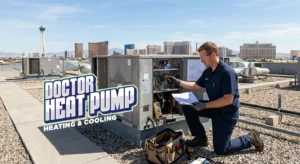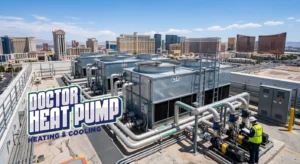


Choosing the best HVAC system for Las Vegas isn’t the same as choosing one for Seattle, Miami, or Chicago. Our extreme desert climate—with 115°F summer days, 40°F winter mornings, dust storms, and monsoon humidity spikes—demands specific system features that work in conditions most HVAC manufacturers never test for.
At Doctor Heat Pump, we’ve installed every type of HVAC system across Las Vegas, Henderson, and North Las Vegas. We’ve seen which systems thrive in extreme heat and which fail after three summers of punishing UV exposure and thermal cycling. This guide compares every HVAC option available to Las Vegas homeowners, helping you choose the best system for your home and budget.
Understanding Las Vegas’s Unique Desert Climate Challenges
Before comparing HVAC systems, you need to understand what makes Las Vegas climate so demanding on heating and cooling equipment.
Extreme Temperature Swings
Las Vegas experiences temperature extremes that stress HVAC systems:
Summer (May-October):
- Daytime highs: 105-118°F regularly
- Overnight lows: 75-85°F
- Temperature swings: 30-40°F daily
- Cooling season: 6+ months annually
Winter (November-March):
- Morning lows: 35-45°F
- Afternoon highs: 60-75°F
- Heating needs: Mornings and evenings only
- Cooling needs: Often by mid-afternoon
The best HVAC system for Las Vegas must handle both extreme heat and provide efficient heating during cool mornings—often switching between modes multiple times in a single day during shoulder seasons.
Desert Air Quality Issues
Dust and Sand: Las Vegas sits in a desert valley surrounded by mountains. Wind carries fine dust and sand particles that infiltrate outdoor HVAC equipment, clogging coils and degrading efficiency by 15-30% between seasonal maintenance visits.
Monsoon Season (July-September): Summer monsoons bring sudden humidity spikes from 10% to 60%+, heavy rain, and airborne debris. HVAC systems designed for consistently dry air can struggle with condensate drainage and moisture management during these brief but intense weather events.
UV Exposure and Material Degradation
The Mojave Desert receives intense UV radiation year-round. Outdoor HVAC components face:
- Direct sun exposure 300+ days annually
- UV degradation of plastics, wiring insulation, and coatings
- Surface temperatures on outdoor units reaching 140-150°F
- Accelerated aging compared to moderate climates
Budget HVAC systems installed in Las Vegas often fail at 8-10 years due to UV damage, while quality systems designed for harsh environments can operate 15-20+ years.
Energy Cost Implications
NV Energy residential rates create specific cost considerations:
Summer rates (June-September):
- Peak hours (1-7pm): $0.13-$0.18/kWh
- Off-peak: $0.08-$0.11/kWh
Winter rates:
- Standard: $0.08-$0.12/kWh
The best HVAC system for Las Vegas homeowners minimizes peak-hour electricity consumption during summer when rates and usage both spike. A 3-ton AC unit running at peak hours can cost $8-12 daily just for cooling—$240-360 monthly during July and August.
Complete HVAC System Comparison for Las Vegas Homes
Let’s compare every HVAC option available, evaluating each for Las Vegas’s specific climate challenges.
Heat Pumps (Our Recommendation for Most Homes)
How They Work: Heat pumps provide both heating and cooling using refrigerant to transfer heat rather than generate it. In summer, they remove heat from your home. In winter, they extract heat from outdoor air (yes, even 40°F air contains heat energy) and move it inside.
Why Heat Pumps Excel in Las Vegas:
The best HVAC system for Las Vegas desert climate leverages our mild winters. Heat pumps provide efficient heating without natural gas infrastructure, making them ideal for new construction and electric-only homes. During summer, modern heat pumps operate as efficiently as the best air conditioners.
Efficiency Ratings:
- SEER2: 16-24 (cooling efficiency)
- HSPF2: 8-13 (heating efficiency)
- Top models maintain efficiency to 115°F outdoor temps
Best Applications:
- New construction homes
- Homes without natural gas service
- Properties seeking to eliminate gas appliances
- Homeowners prioritizing year-round efficiency
- Homes pursuing solar integration
Cost Breakdown:
- Equipment + Installation: $6,500-$14,000 (complete system)
- Monthly summer cooling: $120-200 (2,000 sq ft home)
- Monthly winter heating: $40-80 (mild Las Vegas winters)
- Lifespan: 15-20 years with proper maintenance
Pros:
- Single system handles heating and cooling
- Highest efficiency for year-round operation
- No natural gas required
- Qualifies for federal tax credits (up to $2,000 in 2026)
- Works with solar panels to eliminate utility bills
- Quieter operation than traditional AC
Cons:
- Higher upfront cost than basic AC + furnace
- Heating efficiency drops below 25°F (rarely an issue in Las Vegas)
- Requires proper sizing for extreme summer heat
- Not all contractors experienced with heat pump installation
Doctor Heat Pump Insight: We’ve seen heat pumps outperform traditional AC + furnace systems in Las Vegas homes consistently. The efficiency gains during our 6-month cooling season combined with cheap winter heating make heat pumps the best HVAC system for most Las Vegas homeowners.
Air Conditioner + Gas Furnace (Traditional System)
How It Works: Separate AC unit for cooling, natural gas furnace for heating. This traditional split system has dominated Las Vegas HVAC for decades.
Why It Works in Las Vegas: Natural gas remains cheaper than electricity for heating in most Nevada markets. During Las Vegas’s mild winters, a gas furnace provides quick, powerful heat on cold mornings. The AC handles our extreme summers.
Efficiency Ratings:
- AC SEER2: 14-20
- Furnace AFUE: 80-96%
Best Applications:
- Homes with existing natural gas service
- Replacement systems in older homes
- Budget-conscious installations
- Homeowners comfortable with gas appliances
Cost Breakdown:
- Equipment + Installation: $5,500-$11,000
- Monthly summer cooling: $130-220 (same as heat pump)
- Monthly winter heating: $30-60 (natural gas)
- Lifespan: AC 12-15 years, Furnace 15-20 years
Pros:
- Lower upfront cost than heat pumps
- Familiar technology (most contractors experienced)
- Gas heating works in any temperature
- Fast heating when needed
- Separate systems provide redundancy
Cons:
- Requires natural gas service and infrastructure
- Two systems to maintain (AC and furnace)
- Furnace typically operates only 2-3 months annually in Las Vegas
- Gas appliances require CO monitoring
- Less efficient than heat pumps for overall operation
- No federal tax credits for standard efficiency
Doctor Heat Pump Insight: For homes already connected to natural gas, AC + furnace remains a solid choice. However, the increasing efficiency of modern heat pumps makes them competitive even when factoring in cheap natural gas heating.
Dual Fuel Systems (Heat Pump + Gas Furnace Backup)
How It Works: Heat pump handles both cooling and mild-weather heating. When temperatures drop below a set point (typically 30-35°F), the system automatically switches to gas furnace backup. In Las Vegas, this switchover might happen 5-10 days per year.
Why It Works in Las Vegas: Dual fuel systems provide the best of both worlds—heat pump efficiency for 355+ days annually, with gas furnace reliability during rare cold snaps. This represents the best HVAC system for Las Vegas homeowners who want maximum flexibility and efficiency.
Efficiency Ratings:
- Heat Pump SEER2/HSPF2: 16-22 / 9-13
- Furnace AFUE: 90-96%
Best Applications:
- High-performance new construction
- Luxury homes seeking best-in-class comfort
- Homeowners maximizing efficiency across all conditions
- Properties with existing gas service adding heat pumps
Cost Breakdown:
- Equipment + Installation: $8,500-$16,000
- Monthly summer cooling: $120-200
- Monthly winter heating: $35-75 (mostly heat pump, occasional gas)
- Lifespan: 15-20 years
Pros:
- Maximum efficiency in all weather conditions
- Gas backup for extreme cold (rarely needed)
- Qualifies for federal heat pump tax credits
- Ultimate comfort and flexibility
- Heat pump handles 95%+ of annual operation
Cons:
- Highest upfront cost of all options
- Requires both gas service and advanced controls
- More complex installation
- Two heating systems to maintain
Doctor Heat Pump Insight: Dual fuel makes sense for luxury homes and performance-focused homeowners. However, given Las Vegas’s mild winters, most homeowners won’t benefit enough from gas backup to justify the premium cost over a heat pump alone.
Ductless Mini-Split Systems
How They Work: Individual indoor units in each room connect to outdoor compressor(s). No ductwork required. Can function as heat pumps (heating and cooling) or cooling-only.
Why They Work in Las Vegas: Ductless systems eliminate duct losses (20-30% of energy in typical systems) and provide room-by-room zoning. Perfect for homes without existing ductwork, room additions, and converted garages.
Efficiency Ratings:
- SEER2: 18-28 (highest in category)
- HSPF2: 10-14 (heat pump models)
Best Applications:
- Homes without existing ductwork
- Room additions and converted spaces
- Multi-generational homes needing zone control
- Garages and workshops requiring climate control
- Supplemental cooling for problem rooms
Cost Breakdown:
- Single-zone system: $3,500-$6,500
- Multi-zone (3-4 rooms): $8,000-$15,000
- Monthly costs: Similar to ducted systems (lower if used for zoning)
- Lifespan: 15-20 years
Pros:
- Highest efficiency ratings available
- No ductwork required
- Individual room control
- Quiet indoor operation
- Perfect for room additions
- Works as heating and cooling
Cons:
- Indoor wall units visible in rooms
- Higher cost per room than central systems
- Not ideal for whole-home cooling (aesthetics)
- Requires outdoor space for condensers
Doctor Heat Pump Insight: We install ductless systems frequently in Las Vegas for specific applications—converted garages, casitas, room additions. For whole-home comfort, central systems usually provide better value and aesthetics.
Evaporative Coolers (Swamp Coolers)
How They Work: Water evaporates to cool air, which is blown into the home. Only provides cooling (no heating). Works best in dry climates.
Why They Work (Somewhat) in Las Vegas: Las Vegas’s dry summer air (10-20% humidity) allows evaporative cooling to function. However, monsoon season (July-September) brings humidity that severely reduces effectiveness.
Efficiency:
- Electricity cost: 75% less than AC
- Effectiveness: Drops dramatically above 30% humidity
- Cooling capacity: Can lower temps 15-25°F when working optimally
Best Applications:
- Open-air workshops and garages
- Covered patios and outdoor spaces
- Temporary or supplemental cooling
- Extremely budget-constrained situations
Cost Breakdown:
- Equipment + Installation: $1,500-$4,500
- Monthly summer cooling: $30-60 (electricity + water)
- Lifespan: 8-12 years
Pros:
- Lowest operating costs
- Simple technology
- Adds moisture to dry desert air
- Environmentally friendly (no refrigerants)
Cons:
- Cooling-only (no heating)
- Ineffective during monsoon humidity
- Requires water supply and drainage
- Constant maintenance (pads, water treatment)
- Can’t maintain consistent indoor temperature
- Opens windows required for operation
- Poor air filtration
Doctor Heat Pump Insight: We don’t recommend evaporative coolers for primary home cooling in Las Vegas. While they work during dry months, monsoon season renders them nearly useless. The best HVAC system should work reliably year-round.
Packaged HVAC Systems
How They Work: All components (compressor, air handler, heating element or furnace) housed in single outdoor cabinet. Common in older Las Vegas homes and mobile homes.
Efficiency Ratings:
- SEER2: 14-17 (typically lower than split systems)
- Heating: Heat pump or electric resistance
Best Applications:
- Mobile and manufactured homes
- Older homes with exterior closets
- Roof-mounted installations
- Space-constrained properties
Cost Breakdown:
- Equipment + Installation: $4,500-$8,500
- Operating costs: Similar to split systems of same SEER rating
- Lifespan: 12-15 years
Pros:
- All-in-one installation
- Saves indoor space
- Factory-assembled (fewer installation variables)
Cons:
- Generally lower efficiency than split systems
- Entire system exposed to desert elements
- UV degradation affects all components simultaneously
- Less residential options than split systems
Doctor Heat Pump Insight: For homes requiring packaged systems, modern units work adequately. However, given the choice, split systems offer better efficiency, longer lifespan, and more options.
Best HVAC System Recommendations by Home Type
New Construction Homes
Recommended: Heat Pump (ducted central system)
New Las Vegas homes should install the best HVAC system available—modern heat pumps provide year-round efficiency without natural gas dependency. Pair with spray foam insulation and proper HVAC sizing (don’t oversize!) for maximum comfort and minimum operating costs.
Many new developments don’t include natural gas infrastructure, making heat pumps the obvious choice. Work with your builder to specify 18+ SEER2 systems.
Existing Homes with Natural Gas
Recommended: Heat Pump OR AC + Gas Furnace
The decision comes down to priorities:
Choose Heat Pump if:
- You want to eliminate gas appliances
- You’re adding solar panels
- You prioritize year-round efficiency
- You want to future-proof (avoiding fossil fuels)
Choose AC + Gas Furnace if:
- You want lowest upfront cost
- You prefer familiar, proven technology
- You have other gas appliances (water heater, range)
- You want contractor choice flexibility
Homes Without Ductwork
Recommended: Ductless Mini-Split Heat Pumps
Adding ductwork to existing homes costs $5,000-$12,000+ and sacrifices closet/storage space. Ductless systems provide efficient heating and cooling without construction disruption.
For whole-home coverage, plan 1 indoor unit per 400-600 sq ft. A 2,000 sq ft home needs 4-5 zones for complete coverage.
Extreme Budget Constraints
Recommended: Basic AC + Electric Furnace
If budget is paramount, a 14 SEER2 air conditioner with electric resistance heat provides functional heating and cooling for minimum investment. Plan to upgrade to a heat pump when budget allows—many homeowners replace just the outdoor unit to convert AC to heat pump functionality.
Not Recommended: Evaporative coolers as primary cooling. The operational headaches and monsoon-season failures aren’t worth the cost savings.
Luxury/High-Performance Homes
Recommended: Premium Heat Pump or Dual Fuel System
Luxury Las Vegas homes should install 20+ SEER2 heat pumps with advanced features:
- Variable-speed compressors
- Smart thermostats with geofencing
- Whole-home dehumidification
- Advanced air filtration (MERV 13-16)
- Zoned ductwork for room-by-room control
Consider dual fuel systems if you want absolute peak performance and backup redundancy.
Cost Comparison: 15-Year Total Ownership
Let’s compare what each system actually costs over 15 years for a typical 2,000 sq ft Las Vegas home:
Heat Pump System
- Installation: $10,000
- 15-year energy (cooling): $27,000
- 15-year energy (heating): $9,000
- Maintenance (15 years): $3,000
- Major repairs: $1,500
- Total 15-Year Cost: $50,500
AC + Gas Furnace
- Installation: $8,000
- 15-year energy (cooling): $29,000
- 15-year energy (heating): $6,750
- Maintenance (15 years): $3,500
- Major repairs: $2,000
- Total 15-Year Cost: $49,250
Dual Fuel System
- Installation: $12,000
- 15-year energy (cooling): $25,500
- 15-year energy (heating): $7,500
- Maintenance (15 years): $4,000
- Major repairs: $2,000
- Total 15-Year Cost: $51,000
Ductless Mini-Split (4 zones)
- Installation: $11,500
- 15-year energy (cooling): $24,000
- 15-year energy (heating): $8,000
- Maintenance (15 years): $2,500
- Major repairs: $1,500
- Total 15-Year Cost: $47,500
Key Insight: The best HVAC system isn’t always the cheapest upfront. Heat pumps and AC + furnace systems cost nearly the same over 15 years when factoring in energy costs. Ductless systems offer the lowest total cost but work best for specific applications.
Las Vegas HVAC System Sizing Guidelines
The biggest mistake in Las Vegas HVAC installations is oversizing. Contractors often size equipment for the hottest day of the year, resulting in systems that short-cycle and waste energy 95% of the time.
Proper Sizing for Las Vegas Climate
Cooling Capacity:
- Well-insulated modern homes: 500-600 sq ft per ton
- Average insulation: 400-500 sq ft per ton
- Poor insulation or west-facing: 350-450 sq ft per ton
Example: A 2,000 sq ft home with average insulation needs approximately 4-5 tons of cooling capacity, NOT the 6-7 tons some contractors propose.
Why Oversizing Hurts Performance
Oversized HVAC systems in Las Vegas:
- Short-cycle (run briefly, shut off, restart frequently)
- Never run long enough to remove humidity
- Waste energy on startup surges
- Wear out components faster
- Create uncomfortable temperature swings
- Cost more to install
The best HVAC system for your Las Vegas home is properly sized using Manual J load calculations, not rule-of-thumb guesses.
Federal Tax Credits and Rebates (2026)
Federal Tax Credits
Heat Pumps:
- Up to $2,000 tax credit for 16+ SEER2 systems
- Instant rebate of $8,000 for income-qualified households
- Must be installed by December 31, 2026
Central AC:
- Up to $600 tax credit for 16+ SEER2 systems
Gas Furnaces:
- No tax credits for standard efficiency
- $600 credit for 97+ AFUE condensing furnaces
NV Energy Rebates
Check current NV Energy rebate programs for:
- High-efficiency heat pump rebates ($200-400)
- AC system rebates ($75-150)
- Smart thermostat rebates ($50-100)
Rebates change annually—verify current offerings before purchase.
Maintenance Requirements by System Type
Heat Pumps
- Frequency: Twice annually (spring and fall)
- Tasks: Filter changes, coil cleaning, refrigerant check
- Annual Cost: $150-300
- Las Vegas Specific: Coil cleaning critical due to dust
AC + Gas Furnace
- Frequency: Twice annually (AC in spring, furnace in fall)
- Tasks: Filter changes, coil cleaning, heat exchanger inspection, gas pressure test
- Annual Cost: $200-350 (two separate services)
- Las Vegas Specific: Furnace sees minimal use but still needs annual safety inspection
Ductless Mini-Splits
- Frequency: Twice annually
- Tasks: Filter cleaning (DIY monthly), professional coil cleaning and refrigerant check
- Annual Cost: $120-250
- Las Vegas Specific: Filters accumulate dust quickly—monthly cleaning essential
All HVAC systems in Las Vegas benefit from professional maintenance contracts that include priority service and discounted repairs.
FAQ: Best HVAC System for Las Vegas
What is the best HVAC system for Las Vegas homes?
For most Las Vegas homeowners, modern heat pumps represent the best HVAC system choice. They provide efficient cooling during our 6-month summer season and inexpensive heating during mild winters. Heat pumps qualify for federal tax credits up to $2,000 and work excellently with solar panels for homeowners pursuing energy independence.
Homes with existing natural gas service can achieve similar efficiency with AC + gas furnace systems at slightly lower upfront cost.
Do heat pumps work in 115°F Las Vegas heat?
Yes. Modern heat pumps maintain full cooling capacity and efficiency in Las Vegas’s extreme summer temperatures. Quality systems rated for desert climates operate effectively up to 125°F outdoor temperature. At Doctor Heat Pump, we’ve installed hundreds of heat pump systems across Las Vegas that perform flawlessly during July and August heat waves.
The key is proper sizing and selecting models specifically rated for extreme heat operation—not all heat pumps handle desert conditions equally.
Is natural gas cheaper than electricity for heating in Las Vegas?
Currently, yes. Natural gas costs approximately 30-40% less than electricity for heating on a per-BTU basis. However, Las Vegas’s mild winters mean you’ll spend only $150-300 annually on heating regardless of system type.
Heat pumps close this gap through superior efficiency. While gas might cost $200/winter and heat pump electricity costs $280/winter, the heat pump saves $300-500 annually on cooling costs compared to traditional AC systems—making heat pumps more economical overall.
How long do HVAC systems last in Las Vegas?
Las Vegas’s extreme UV exposure and temperature cycling reduce HVAC lifespan compared to moderate climates:
- Heat Pumps: 15-20 years with maintenance
- Air Conditioners: 12-15 years
- Gas Furnaces: 15-20 years (minimal use extends life)
- Ductless Mini-Splits: 15-20 years
Budget systems and deferred maintenance can reduce these numbers by 30-50%. The best HVAC system for Las Vegas longevity includes UV-resistant components and annual professional maintenance.
Should I get a heat pump or AC and furnace?
Choose a heat pump if:
- Your home lacks natural gas service
- You want a single system for heating and cooling
- You’re installing solar panels now or in the future
- You want to maximize federal tax credits
- You prefer avoiding fossil fuel appliances
Choose AC + furnace if:
- You want the lowest upfront cost
- Your home already has natural gas service
- You prefer traditional, proven technology
- You have other gas appliances (water heater, range)
Both options work excellently in Las Vegas. The best HVAC system for your specific home depends on existing infrastructure and personal priorities.
What size HVAC system do I need for Las Vegas?
Las Vegas homes typically need:
- 1,200-1,500 sq ft homes: 2.5-3 tons
- 1,500-2,000 sq ft homes: 3-4 tons
- 2,000-2,500 sq ft homes: 4-5 tons
- 2,500-3,000 sq ft homes: 5-6 tons
These estimates assume average insulation and typical Las Vegas construction. Homes with poor insulation, extensive west-facing windows, or cathedral ceilings require additional capacity.
Proper sizing requires a Manual J load calculation—never rely on rules of thumb or “square footage divided by 500.” Oversized systems waste energy and reduce comfort.
Are ductless mini-splits good for Las Vegas?
Yes, ductless mini-splits work excellently in Las Vegas for specific applications:
- Homes without existing ductwork
- Room additions and converted garages
- Supplemental cooling for problematic rooms
- Multi-generational homes needing zone control
Ductless systems achieve the highest efficiency ratings available (up to 28 SEER2) and eliminate duct losses. However, for whole-home applications, visible indoor wall units in every room create aesthetic concerns that make central ducted systems more appealing to most homeowners.
Get Expert HVAC System Recommendations
Choosing the best HVAC system for your Las Vegas home requires understanding your specific needs, existing infrastructure, and long-term goals. The wrong choice costs thousands in wasted energy over system lifespan.
At Doctor Heat Pump, we’ve installed every type of HVAC system across Las Vegas, Henderson, and North Las Vegas. We help homeowners evaluate their options objectively, considering:
- Existing home infrastructure (gas service, ductwork, electrical capacity)
- Energy efficiency priorities
- Budget constraints (upfront and long-term)
- Comfort preferences (zoning, humidity control, air quality)
- Future plans (solar panels, home additions)
We offer:
- Free in-home assessments and Manual J load calculations
- Side-by-side system comparisons with 15-year cost analysis
- Expert heat pump installation for Las Vegas climate
- Manufacturer-certified technicians (Lennox, Carrier, Trane, Daikin)
- Comprehensive warranties and maintenance plans
Whether you’re building new construction, replacing a failed system, or upgrading for efficiency, we’ll help you choose the best HVAC system for your specific situation.
Contact Doctor Heat Pump at 702-467-7236 for your free HVAC consultation.
References
- U.S. Department of Energy – Heat Pump Systems – https://www.energy.gov
- Energy Star HVAC Guidance – https://www.energystar.gov
- Lennox Residential Systems – https://www.lennox.com
- Carrier Residential HVAC – https://www.carrier.com
- Trane Residential Products – https://www.trane.com
- Daikin Comfort – https://www.daikincomfort.com