

Your heat pump keeps you comfortable through Las Vegas’s extreme temperatures, but excessive noise disrupts sleep, bothers neighbors, and signals potential mechanical problems. Whether you’re dealing with a constant hum, periodic rattling, or loud startup sounds, understanding noise sources and reduction solutions helps you restore peace and quiet.
At Doctor Heat Pump, we receive frequent calls about noisy heat pumps in Las Vegas. Some noise issues resolve with simple DIY fixes like vibration pads or filter changes. Others indicate serious mechanical problems requiring professional heat pump repair—ignoring these warning signs leads to expensive component failures and complete system breakdowns.
This guide explains common heat pump noise sources, DIY reduction techniques, when noise indicates needed heat pump repair, and how to choose quieter systems when replacement becomes necessary.
Common Heat Pump Noise Sources
Understanding where noise originates helps you determine appropriate solutions and whether professional heat pump repair is necessary.
Outdoor Condenser Unit Noise
Normal operating sounds:
- Low hum (40-60 dB typical)
- Periodic fan cycling
- Refrigerant flow (gentle whooshing)
Problem sounds indicating heat pump repair needs:
- Grinding: Failed motor bearings or compressor damage
- Squealing: Worn fan motor or belt issues
- Banging/clanking: Loose components or debris in fan
- Rattling: Loose panels, mounting bolts, or internal components
- Buzzing: Electrical issues or failing capacitor
Las Vegas context: Desert dust accelerates bearing wear. UV exposure degrades fan blades. Extreme temperature cycling (120°F days, 70°F nights) stresses compressor mounts. These factors make Las Vegas heat pumps noisier over time than systems in moderate climates.
Indoor Air Handler Noise
Normal sounds:
- Gentle air movement through vents
- Soft blower motor hum
- Occasional expansion/contraction clicks
Problem sounds requiring heat pump repair:
- Whistling: Ductwork air leaks or undersized returns
- Banging at startup/shutdown: Loose ductwork or expanding metal
- Constant vibration: Loose mounting or unbalanced blower wheel
- Screeching: Dry blower motor bearings
- Thumping: Objects in ductwork or damaged blower wheel
Refrigerant Line Noise
Normal sounds:
- Quiet whooshing during operation
- Brief hissing during mode changes
Problem sounds needing professional attention:
- Loud hissing: Refrigerant leak (requires immediate heat pump repair)
- Gurgling/bubbling: Low refrigerant charge or refrigerant line restriction
- Vibration transmission: Improper line support causing wall/floor vibration
DIY Heat Pump Noise Reduction Solutions
Try these fixes before calling for professional heat pump repair—many noise problems resolve with simple adjustments.
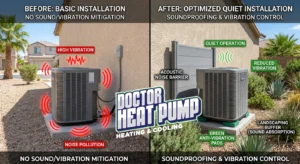
Solution 1: Anti-Vibration Pads (Outdoor Unit)
Problem solved: Reduces vibration transmission from outdoor unit to concrete pad, deck, or ground—often cuts perceived noise by 30-50%.
What you need:
- Heavy-duty rubber or composite anti-vibration pads (rated for HVAC equipment)
- 4 pads minimum (one per corner)
- Level
Installation steps:
- Turn off power to outdoor unit at breaker
- Carefully lift one corner of unit (use proper lifting technique or get help)
- Slide anti-vibration pad under corner
- Repeat for remaining three corners
- Verify unit sits level
- Restore power and test operation
Cost: $40-$80 for quality pads
Effectiveness: Excellent for vibration noise, minimal impact on mechanical noise
Las Vegas consideration: Choose UV-resistant pads—cheap rubber deteriorates rapidly in desert sun. Premium composite pads last 10+ years.
Solution 2: Outdoor Unit Sound Barrier
Problem solved: Blocks noise transmission to neighbors, patios, or nearby windows—can reduce perceived noise by 40-60% in targeted direction.
Options:
Fence/Wall Barrier:
- Privacy fence or block wall 6+ feet from unit
- Solid construction (no gaps)
- Minimum 6 feet tall
- L-shaped configuration works best (two sides)
Acoustic Fence Panels:
- Specialty sound-dampening outdoor panels
- Install 3-6 feet from unit
- Leave adequate clearance for airflow (minimum 2 feet on all sides)
Natural Barriers:
- Dense shrubs or small trees
- Planted 4-6 feet from unit
- Drought-tolerant species for Las Vegas (Texas sage, oleander)
- Takes 2-3 years to provide significant noise reduction
Cost:
- DIY fence: $200-$600
- Acoustic panels: $300-$800
- Landscaping: $150-$400
Critical warning: Never restrict airflow to outdoor unit—inadequate clearance causes overheating, reduced efficiency, and expensive heat pump repair. Maintain 2-foot minimum clearance on all sides.
Solution 3: Tighten Loose Components
Problem solved: Eliminates rattling, buzzing, and vibration noise from loose panels, mounting bolts, and access covers.
What to check:
Outdoor unit:
- Sheet metal access panels (hand-tighten or use screwdriver)
- Top fan grille (if removable)
- Mounting bolts to concrete pad
- Refrigerant line supports
Indoor air handler:
- Access panel screws
- Blower compartment door
- Filter slot cover
- Return air grille mounting
Tools needed:
- Screwdriver set (Phillips and flathead)
- Small wrench or socket set
- 10-15 minutes
Cost: Free (if you have basic tools)
Effectiveness: Eliminates specific rattling noises; doesn’t reduce mechanical noise
Solution 4: Replace or Clean Dirty Air Filter
Problem solved: Dirty filters restrict airflow, forcing blower motor to work harder and create more noise. Las Vegas dust clogs filters rapidly.
When to replace:
- Monthly during heavy-use months (May-October)
- Every 2 months during light-use periods
- Immediately if visibly dirty or clogged
How dirty filters increase noise:
- Blower motor strains (louder operation)
- Increased air velocity through smaller openings (whistling)
- System works harder overall (more vibration)
Cost: $3-$15 per filter (depending on MERV rating)
Effectiveness: Moderate noise reduction plus major efficiency improvement
Las Vegas filter reality: Standard 3-month filters last 30-45 days here. Consider upgrading to MERV 11 or washable filters for better dust management.
Solution 5: Insulate Ductwork
Problem solved: Reduces sound transmission through ductwork and minimizes expansion/contraction noise.
Where to insulate:
- Exposed ductwork in attics, garages, or crawlspaces
- Metal duct sections that produce banging sounds
- Return air ducts (often louder than supply ducts)
Insulation options:
- Duct wrap insulation (R-6 or R-8)
- Acoustic duct liner (specialty product for sound dampening)
- Flexible duct replacement (quieter than rigid metal)
DIY vs professional: Simple duct wrap: DIY project Acoustic liner or duct replacement: Requires professional installation
Cost:
- DIY duct wrap: $100-$300
- Professional acoustic treatment: $400-$1,200
When Noise Indicates Needed Heat Pump Repair
Some noises signal mechanical problems requiring professional heat pump repair. Ignoring these sounds leads to component failure and expensive repairs.
Grinding or Squealing Sounds
What it indicates:
- Failed compressor bearings (grinding)
- Worn fan motor bearings (squealing)
- Damaged fan belt (if applicable)
Why it needs heat pump repair: Bearings don’t heal themselves—they progressively worsen until catastrophic failure. A $300 motor bearing replacement becomes a $2,500 compressor replacement if ignored.
Urgency: High—schedule heat pump repair within 2-3 days
Loud Banging or Clanking
What it indicates:
- Loose compressor or fan assembly
- Debris in outdoor fan
- Broken fan blade
- Loose refrigerant line hitting cabinet
Why it needs heat pump repair: Loose components damage surrounding parts through repeated impacts. Debris can destroy fan motors. Broken blades create dangerous imbalance.
Urgency: Immediate—turn off system and call for emergency heat pump repair
Constant Loud Humming or Buzzing
What it indicates:
- Failed capacitor (starting capacitor or run capacitor)
- Electrical relay problems
- Compressor struggling to start
Why it needs heat pump repair: Failed capacitors prevent proper compressor operation, causing overheating and permanent damage. A $150 capacitor replacement prevents $2,000-$3,000 compressor replacement.
Urgency: High—schedule heat pump repair within 24-48 hours
Hissing or Bubbling Sounds
What it indicates:
- Refrigerant leak (hissing)
- Low refrigerant charge (bubbling/gurgling)
- Refrigerant line restriction
Why it needs heat pump repair: Low refrigerant damages compressors, reduces efficiency, and indicates system leak requiring professional location and repair. Heat pump repair for refrigerant leaks requires EPA-certified technicians.
Urgency: Moderate to High—schedule heat pump repair within 3-5 days
Unusual Startup or Shutdown Noises
What it indicates:
- Hard start (compressor struggling)
- Reversing valve issues
- Expansion valve problems
- Refrigerant flow restrictions
Why it needs heat pump repair: Hard starting stresses electrical components and shortens compressor life. Reversing valve issues prevent heating mode operation in winter.
Urgency: Moderate—schedule heat pump repair within 1-2 weeks
Professional Heat Pump Noise Reduction Services
Some noise reduction solutions require professional heat pump repair expertise and specialized equipment.
Compressor Sound Blanket Installation
What it is: Insulated wrap specifically designed for heat pump compressors—reduces compressor noise by 5-10 decibels.
Installation requirements:
- Must allow proper airflow and heat dissipation
- Cannot contact hot surfaces
- Requires professional installation to avoid warranty issues
Cost: $200-$400 installed
Effectiveness: Excellent for compressor noise specifically; doesn’t reduce fan noise
Las Vegas consideration: Ensure blanket doesn’t restrict airflow or trap heat—critical in 115°F ambient temperatures.
Vibration Isolation Mounting
What it is: Professional installation of spring isolators or rubber mounts between heat pump and mounting surface—eliminates vibration transmission to building structure.
When needed:
- Heat pump mounted on roof or elevated platform
- Vibration noise travels through walls/floors
- Outdoor unit on deck or balcony (high-rise applications)
Cost: $300-$700 installed
Effectiveness: Excellent for vibration noise, transforming noisy installations into quiet operation
Ductwork Modification
What it is: Professional redesign or replacement of undersized, poorly designed, or improperly installed ductwork that creates airflow noise.
Common fixes:
- Increase return air duct size (eliminates whistling)
- Add flex duct sections (reduces vibration transmission)
- Install acoustic duct liner
- Seal air leaks with mastic
Cost: $500-$2,500 depending on scope
Effectiveness: Excellent for airflow and duct-transmitted noise
Fan Motor or Compressor Replacement
When noise indicates component failure: Sometimes noise reduction means replacing the failing component rather than attempting to quiet it.
Component replacement costs:
- Fan motor: $400-$800 installed
- Compressor: $1,800-$3,500 installed
- Blower motor: $500-$900 installed
Repair vs replacement decision: If heat pump is 12+ years old and requires expensive compressor replacement, full system replacement often makes more financial sense. New systems are quieter, more efficient, and include warranties.
Choosing Quiet Heat Pumps for Las Vegas
If your current heat pump requires major heat pump repair or is nearing end of life, replacement with a quieter model might be the best solution.
Sound Ratings to Look For
Outdoor unit sound levels:
- Budget systems: 65-75 dB (fairly loud)
- Mid-tier systems: 55-65 dB (moderate)
- Premium systems: 45-55 dB (quiet)
- Ultra-premium: Under 45 dB (very quiet)
For reference:
- 50 dB: Quiet office environment
- 60 dB: Normal conversation
- 70 dB: Vacuum cleaner
Las Vegas recommendation: Target 55 dB or lower for residential installations—especially important if outdoor unit is near bedrooms, patios, or close to neighbors.
Variable-Speed Inverter Systems (Quietest Option)
Why they’re quieter: Variable-speed compressors run at lower speeds most of the time (40-60% capacity), producing significantly less noise than single-stage systems running at 100% constantly.
Sound advantage:
- 30-40% quieter than single-stage systems
- Gradual ramp-up/down (no loud startup noise)
- Smoother operation (less vibration)
Top quiet brands for Las Vegas:
- Mitsubishi Electric: Industry-leading quiet operation (under 45 dB)
- Daikin: Excellent inverter technology with low noise
- Lennox: Premium variable-speed models (48-52 dB range)
- Carrier Infinity: Quiet operation with sound-dampening features
Cost premium: $2,000-$4,000 more than standard systems
Worth it? Absolutely for bedroom windows, noise-sensitive locations, or close quarters with neighbors.
Ductless Mini-Splits (Alternative Quiet Solution)
For room additions, renovations, or supplemental cooling, ductless mini-split systems offer exceptional quiet operation.
Indoor unit noise:
- 19-35 dB at low speed (quieter than a whisper)
- 35-45 dB at high speed
Outdoor unit noise:
- Premium brands: 40-50 dB
- Budget brands: 55-65 dB
Quiet advantage: No outdoor unit near every room—single outdoor unit can be placed away from bedrooms and living areas.
Las Vegas Climate Impact on Heat Pump Noise
Desert conditions create unique noise challenges requiring specific solutions.
UV Degradation and Noise
What happens: Intense Las Vegas UV radiation makes plastic components brittle. As they age:
- Fan blades crack (creating imbalance and vibration)
- Grommets harden (losing vibration dampening properties)
- Electrical housings crack (creating buzzing/rattling)
Solution: Regular inspection and proactive component replacement before failure. Quality heat pumps use UV-resistant materials lasting 15-20+ years.
Thermal Cycling Stress
What happens: 50-70°F daily temperature swings cause repeated expansion/contraction:
- Mounting bolts loosen (creating rattling)
- Panels develop gaps (buzzing noise)
- Ductwork connections separate (air leaks and whistling)
Solution: Annual professional inspection includes retightening all fasteners—prevents progressive noise increase.
Dust Accumulation
What happens: Fine desert dust coats fan blades and motors:
- Unbalanced fan blades (vibration noise)
- Increased motor resistance (louder operation)
- Bearing contamination (grinding sounds)
Solution: Professional coil and fan cleaning twice annually maintains quiet operation and prevents premature mechanical wear requiring heat pump repair.
Preventive Maintenance for Quiet Operation
Regular heat pump maintenance prevents most noise problems before they develop.
What Professional Maintenance Includes
Noise-prevention tasks:
- Lubricate motor bearings (prevents squealing)
- Tighten electrical connections (eliminates buzzing)
- Clean fan blades (prevents imbalance vibration)
- Check refrigerant charge (prevents compressor strain)
- Inspect and tighten mounting hardware
- Test capacitors (prevents hard start noise)
Cost: $120-$180 per service visit
Frequency: Twice annually (spring and fall) in Las Vegas
ROI: Prevents 70-80% of noise-related heat pump repair calls and extends equipment lifespan by 5-8 years.
FAQ: Heat Pump Noise and Repair
How loud should a heat pump be?
Modern heat pumps typically operate at 45-65 dB outdoors and 30-50 dB indoors. Premium variable-speed systems run quieter (40-50 dB outdoors) while budget single-stage systems are louder (60-70 dB). If your heat pump suddenly becomes noticeably louder, it indicates a problem requiring heat pump repair—normal aging doesn’t dramatically increase noise levels.
Can a noisy heat pump be fixed?
Yes, most noisy heat pumps can be repaired. Loose components, worn bearings, dirty filters, and unbalanced fans all have straightforward heat pump repair solutions. However, some noises (grinding compressor, severe motor bearing failure) indicate component replacement needs. A professional heat pump repair technician can diagnose whether repair or replacement makes financial sense.
Why is my heat pump so loud all of a sudden?
Sudden noise increases indicate mechanical problems: failed bearings (grinding/squealing), loose components (rattling), failing capacitor (loud humming), or refrigerant issues (hissing/gurgling). This requires professional heat pump repair diagnosis—sudden noise changes don’t resolve on their own and worsen over time, leading to component failure.
How do I make my outdoor heat pump quieter?
Install anti-vibration pads under the unit ($40-80), add sound barriers like fencing 6+ feet from unit ($200-600), ensure no loose components creating rattling, and maintain 2-foot clearance for proper airflow. For mechanical noise (compressor, fan motor), professional solutions include compressor sound blankets ($200-400) or component replacement during heat pump repair.
Is heat pump noise a sign of failure?
Some noises are normal (gentle hum, quiet whooshing) while others indicate impending failure. Grinding, squealing, loud banging, constant buzzing, or hissing all signal problems requiring heat pump repair. Ignoring these sounds leads to complete component failure and emergency replacement—early heat pump repair intervention costs far less than delayed emergency service.
Do variable-speed heat pumps run quieter?
Yes, variable-speed inverter heat pumps run 30-40% quieter than single-stage systems because they operate at lower speeds most of the time. They ramp up/down gradually (no loud startup noise) and produce less vibration. Premium brands like Mitsubishi Electric, Daikin, and Lennox achieve under 50 dB operation—quieter than normal conversation.
How much does heat pump repair cost for noise problems?
Heat pump repair costs for noise issues vary: tightening loose components ($80-150 service call), replacing fan motor ($400-800), capacitor replacement ($150-300), compressor replacement ($1,800-3,500), or anti-vibration pad installation ($100-250). Professional diagnosis ($80-150) identifies the exact problem before quoting repair costs.
Get Professional Heat Pump Repair for Noise Problems
Excessive heat pump noise disrupts your home comfort and often signals mechanical problems that worsen over time. While some DIY solutions reduce noise effectively, many situations require professional heat pump repair expertise to prevent expensive component failures.
At Doctor Heat Pump, we diagnose and repair noisy heat pumps throughout Las Vegas, Henderson, and North Las Vegas. Our technicians identify whether your noise indicates simple fixes like loose panels or serious problems requiring immediate heat pump repair like failing compressors or motor bearings.
We offer:
- Comprehensive noise diagnosis ($80-150, applied to repair if approved)
- Same-day heat pump repair service for urgent noise problems
- Vibration reduction solutions and sound barrier installation
- Component replacement (motors, compressors, fans)
- Quiet system replacement options when repair isn’t cost-effective
- Preventive maintenance to prevent noise problems
Don’t let noisy heat pump operation disrupt your sleep or disturb neighbors. We’ll diagnose the problem accurately and provide honest recommendations—whether simple adjustment, affordable heat pump repair, or system replacement guidance.
Contact Doctor Heat Pump at 702-467-7236 for professional heat pump noise diagnosis and repair.
References
- U.S. Department of Energy – Heat Pump Maintenance – https://www.energy.gov
- ASHRAE Sound Rating Standards – https://www.ashrae.org
- Energy Star Quiet HVAC Systems – https://www.energystar.gov
- Air-Conditioning, Heating & Refrigeration Institute Standards – https://www.ahri.org