

Energy efficiency isn’t just a selling point in Las Vegas — it’s a financial necessity. When your cooling system runs at full capacity for five to seven months of the year through sustained heat that regularly exceeds 110°F, the difference between an average-efficiency system and a high-efficiency one shows up clearly on your NV Energy bill every single month. At Doctor Heat Pump, we work with Las Vegas homeowners every day who are surprised to learn how much their equipment choice affects their long-term operating costs — and how much money a smarter system selection could save them.
This guide breaks down what energy-efficient hvac systems actually means in terms of ratings and real-world performance, which system types deliver the best efficiency in the Las Vegas desert climate specifically, and what to look for when you’re ready to upgrade.
Why HVAC Efficiency Matters More in Las Vegas Than Almost Anywhere Else
Most efficiency comparisons assume a moderate climate with a balanced mix of heating and cooling demand. Las Vegas is not that. The cooling season here is long, intense, and unforgiving — and it dominates the annual energy budget of virtually every household in the valley.
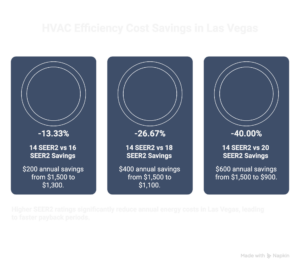
Consider the math. A household in a moderate climate might run their air conditioner for 1,200 hours per year. A Las Vegas household running their system through a typical summer easily logs 2,000 to 2,500 hours or more. At that usage level, an efficiency difference of just two or three SEER2 points translates to hundreds of dollars per year in energy costs — compounded over the 15-to-20-year life of the equipment.
The upfront cost difference between a standard-efficiency system and a high-efficiency system is real. But in Las Vegas, the payback period on that investment is shorter than almost anywhere else in the country — because the system runs so much more that the efficiency savings accumulate faster.
Understanding HVAC Efficiency Ratings
Before comparing systems, it helps to understand what the ratings actually measure.
SEER2 (Seasonal Energy Efficiency Ratio 2) SEER2 is the primary efficiency rating for air conditioning and heat pump cooling performance. It measures how much cooling output a system delivers per unit of electrical energy consumed over an entire cooling season. Higher SEER2 means lower energy consumption for the same cooling output. As of January 2023, the Southwest region — including Nevada — requires a minimum SEER2 of 14.3 for new split system installations.
EER2 (Energy Efficiency Ratio 2) EER2 measures efficiency at a specific peak operating condition — typically 95°F outdoor temperature. In Las Vegas, where peak conditions are sustained rather than occasional, EER2 is actually a more meaningful real-world metric than SEER2 for evaluating cooling performance. A system with a strong EER2 rating holds its efficiency better during the hottest days of summer.
HSPF2 (Heating Seasonal Performance Factor 2) HSPF2 applies to heat pumps and measures heating efficiency. Higher HSPF2 means more heat output per unit of electricity consumed during the heating season. In Las Vegas, where heating demand is relatively modest, HSPF2 matters less than SEER2 and EER2 in the overall efficiency calculation — but it still contributes to year-round operating costs.
AFUE (Annual Fuel Utilization Efficiency) AFUE applies to gas furnaces and measures what percentage of fuel is converted to usable heat. An 80% AFUE furnace loses 20% of its fuel to exhaust. A 96% AFUE furnace loses only 4%. In Las Vegas’s mild heating season, even a high-AFUE furnace is hard to justify over a heat pump on efficiency grounds alone.
The Most Energy-Efficient HVAC System Types for Las Vegas
Variable-Speed Heat Pumps
For Las Vegas, a variable-speed heat pump is the gold standard of energy-efficient hvac systems. Here’s why.
Traditional single-stage systems operate at one speed — full blast or off. Variable-speed systems adjust their output continuously to match the actual heating or cooling demand at any given moment. In practice, a variable-speed heat pump in Las Vegas spends most of its time running at 40% to 60% capacity rather than cycling between 100% and zero. This has several significant advantages:
- Lower energy consumption — running at partial capacity is dramatically more efficient than full-speed cycling
- Better humidity control — longer, slower run cycles remove more moisture from the air, which improves comfort
- Quieter operation — partial-speed operation is significantly quieter than full-speed cycling
- Longer equipment life — fewer hard starts and stops means less mechanical stress on the compressor
Lennox variable-speed heat pump systems — including the Lennox XP21 and XC21 series — are specifically designed for high-efficiency performance in extreme climates. Their SEER2 ratings reach into the low-to-mid 20s, which puts them among the most efficient residential systems available.
High-Efficiency Ductless Mini Split Systems
Ductless mini split systems eliminate one of the biggest sources of energy loss in traditional HVAC systems — ductwork. In a typical Las Vegas home with ducts running through a hot attic, duct losses can account for 20% to 30% of total cooling energy. A ductless system bypasses that loss entirely.
Modern high-efficiency mini splits from Lennox and other top manufacturers achieve SEER2 ratings of 20 or higher, making them among the most efficient cooling options available for the spaces they serve. They’re particularly well-suited for room additions, converted garages, detached casitas, and older Las Vegas homes where duct modification would be costly or impractical.
Dual-Fuel Systems
A dual-fuel system pairs a high-efficiency heat pump with a gas furnace backup. The heat pump handles cooling and mild-weather heating — where it’s most efficient — and the gas furnace kicks in only when temperatures drop low enough that the heat pump’s heating efficiency decreases relative to combustion heating.
In most Las Vegas winters, the dual-fuel system would run almost entirely in heat pump mode given the mild temperatures. The gas furnace provides a safety net for the occasional cold snap without sacrificing the efficiency advantages of heat pump operation during normal conditions.
Traditional High-Efficiency Central AC
For homeowners who want to keep a gas furnace for heating and simply upgrade the cooling side, a high-efficiency central AC system in the 17 to 20 SEER2 range delivers meaningful efficiency gains over baseline equipment. Paired with a high-efficiency furnace, this remains a solid option for Las Vegas homes — though the combined efficiency of a quality heat pump system typically outperforms the split-system approach over the long term.
How to Compare Energy-Efficient HVAC Systems for Your Specific Home
Efficiency ratings are useful comparisons, but they’re averages across standardized test conditions. Real-world efficiency in your specific Las Vegas home depends on several additional factors:
Home size and layout A system that’s improperly sized for your home — too large or too small — will underperform regardless of its rated efficiency. Oversized systems short cycle, which wastes energy and reduces humidity control. Undersized systems run constantly without reaching the set temperature. A proper Manual J load calculation before installation is non-negotiable.
Duct condition In Las Vegas homes with attic ductwork, duct leakage and heat gain through duct surfaces can significantly undercut the efficiency of even a high-SEER2 system. If your ducts haven’t been inspected recently, that’s worth including in a pre-replacement assessment.
Thermostat and controls A smart or programmable thermostat paired with a variable-speed system allows precise control that maximizes efficiency gains. Setting temperature schedules around occupancy patterns — even simple setbacks during work hours — compounds the savings from a high-efficiency system.
Installation quality This is the factor most homeowners underestimate. A high-efficiency system installed improperly — incorrect refrigerant charge, poor airflow setup, inadequate electrical connections — will never deliver its rated efficiency. Choosing an experienced, licensed Las Vegas HVAC contractor is just as important as choosing the right equipment.
Energy-Efficient HVAC Systems and Federal Tax Credits
Choosing a high-efficiency system doesn’t just lower your operating costs — it may also qualify you for the federal energy efficiency tax credit. In 2026, qualifying heat pump installations are eligible for a credit of up to $2,000, and qualifying central AC systems are eligible for up to $600.
The efficiency thresholds for tax credit eligibility are set by ENERGY STAR and updated periodically. When evaluating systems, look for the ENERGY STAR Most Efficient designation as a reliable indicator of both high performance and tax credit eligibility. See our full guide on the heat pump tax credit 2026 for complete details on how to qualify and claim the credit.
What Las Vegas Homeowners Should Ask Before Buying
When evaluating energy-efficient hvac systems with a contractor, these are the questions worth asking:
- What is the SEER2 and EER2 rating of the system you’re recommending?
- Does this system qualify for the federal energy efficiency tax credit?
- What SEER2 system does my home’s duct configuration and layout support?
- Will you perform a Manual J load calculation before recommending a system size?
- What efficiency gains can I realistically expect compared to my current system?
- Are there NV Energy rebates available for this system right now?
A contractor who can answer these questions clearly and specifically is a contractor who understands both the equipment and the local market. Be cautious of vague answers or pressure to decide quickly without a load calculation.
Why Doctor Heat Pump for Energy-Efficient HVAC in Las Vegas
Doctor Heat Pump is a local, family-owned HVAC company serving Las Vegas, Henderson, and North Las Vegas. We specialize in high-efficiency heat pump installation, AC replacement, and heat pump service — and we’ve built our reputation on honest recommendations and quality installations across the Las Vegas Valley.
We work primarily with Lennox systems because of their proven efficiency, reliability, and warranty coverage in high-heat desert climates. When you work with Doctor Heat Pump, you get a contractor who understands the Las Vegas climate, knows the equipment inside and out, and will recommend the system that’s actually right for your home — not just the one that’s easiest to sell.
Frequently Asked Questions
What is the most energy-efficient HVAC system for a Las Vegas home? For most Las Vegas homes, a variable-speed heat pump from a top-tier manufacturer like Lennox is the most energy-efficient option available. These systems achieve SEER2 ratings in the low-to-mid 20s and adjust their output continuously to match demand, delivering significantly lower energy consumption than single-stage systems.
Is a higher SEER2 always worth the extra cost in Las Vegas? In most cases, yes — more so than in moderate climates. Las Vegas’s long, intense cooling season means the energy savings from a higher-efficiency system accumulate faster. The payback period on a 20 SEER2 system vs. a 15 SEER2 system is considerably shorter in Las Vegas than in a city with a milder summer.
Do energy-efficient HVAC systems require more maintenance? Not more, but consistent maintenance is especially important for high-efficiency systems. Variable-speed systems in particular rely on clean coils, proper refrigerant charge, and unrestricted airflow to deliver their rated efficiency. An annual professional service visit protects both your efficiency gains and your equipment warranty.
Can I improve my current system’s efficiency without replacing it? Yes, to a degree. Replacing a dirty air filter, sealing duct leaks, adding attic insulation, and upgrading to a smart thermostat can all improve the effective efficiency of an existing system. However, these measures have limits — they can’t compensate for an aging system that’s lost significant mechanical efficiency. At some point replacement delivers better results than optimization.
What SEER2 rating should I look for when buying a new system in Las Vegas? At minimum, look for a system that meets or exceeds the Southwest regional minimum of 14.3 SEER2. For meaningful efficiency gains and tax credit eligibility, target 16 SEER2 or higher. If budget allows, a 18 to 20+ SEER2 variable-speed system delivers the best long-term value in the Las Vegas market.
Ready to Upgrade to a More Energy-Efficient HVAC System?
The Las Vegas climate makes high-efficiency HVAC one of the smartest home investments you can make. Lower monthly bills, better comfort, longer equipment life, and federal tax credit eligibility all point in the same direction — and the right system, properly installed, delivers on all of them.
Doctor Heat Pump is ready to help you find the right energy-efficient hvac system for your Las Vegas home. Call us at 702-467-7236 or contact us online to schedule a consultation. We’ll assess your home, explain your options clearly, and make sure you get a system that performs the way it should for years to come.
References
- U.S. Department of Energy — Energy Efficient Heating and Cooling
- ENERGY STAR — Most Efficient Certified Products
- Lennox — High-Efficiency Heat Pump and Air Conditioning Systems
- National Renewable Energy Laboratory — Building Energy Efficiency