
Running a commercial property in Las Vegas means dealing with one of the most demanding HVAC climates in the country. Your systems run harder, longer, and under more stress than nearly anywhere else in the United States. Yet commercial HVAC maintenance is one of the most consistently deferred line items in property management budgets — right up until a system fails during a 112°F July afternoon and the repair bill dwarfs what a full year of preventive service would have cost.
At Doctor Heat Pump, we work with commercial property managers across Las Vegas, Henderson, and North Las Vegas. We see the same pattern repeatedly. Properties that stay on a consistent maintenance schedule spend less, experience fewer emergencies, and keep tenants happier than properties that only call when something breaks. This guide covers what a complete commercial HVAC maintenance program should include, how often to schedule each task, and what Las Vegas-specific factors make consistent service especially critical here.
Why Commercial HVAC Maintenance Is Different in Las Vegas
Most commercial HVAC guidelines assume a moderate climate. Las Vegas is not moderate. A few specific conditions make consistent maintenance more important here than in most other markets.
Extreme cooling demand Commercial systems in Las Vegas often run at or near full capacity for five to seven months per year. That usage level accelerates wear on compressors, capacitors, belts, and bearings far faster than the same equipment would wear in a city with a shorter cooling season. Furthermore, components that are borderline in spring become failures by August — which is exactly when you least want a system down.
Desert dust and air quality Las Vegas dust storms deposit fine particulate matter on coils, filters, and mechanical components throughout the year. Dust-coated condenser coils lose their ability to reject heat efficiently. Clogged filters restrict airflow and force systems to work harder. Without regular cleaning, even a well-maintained system degrades quickly in the desert environment.
High utility costs NV Energy commercial rates make energy efficiency a meaningful budget line for most Las Vegas properties. A poorly maintained commercial HVAC system typically consumes 15% to 25% more energy than a properly serviced one. Over a full year of Las Vegas operation, that difference adds up to significant money — often enough to pay for multiple service visits.
Tenant and occupant expectations Whether you manage office space, retail, hospitality, or multi-unit residential, your tenants expect consistent comfort. A system failure in summer doesn’t just cost money — it costs tenant relationships and, in some cases, leases.
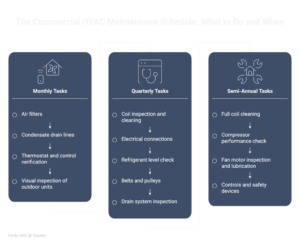
The Commercial HVAC Maintenance Schedule: What to Do and When
A complete commercial HVAC maintenance program includes tasks at different intervals throughout the year. Here’s a breakdown of what each interval should cover.
Monthly Tasks
Some maintenance tasks need attention every month — especially during the peak cooling season. Monthly checks catch fast-developing issues before they become failures.
Air filters Replace or clean air filters monthly during heavy use periods. Commercial systems move large volumes of air, and Las Vegas dust loads filters faster than most markets. A clogged filter reduces airflow, increases energy consumption, and stresses the blower motor. This is the single most impactful monthly task on the list.
Condensate drain lines Check condensate drain pans and drain lines monthly. Blocked drains cause water overflow that damages ceilings, walls, and equipment — and creates the humid conditions where mold can develop. In commercial buildings with multiple air handlers, a single blocked drain can cause significant property damage before anyone notices.
Thermostat and control verification Confirm that thermostats and building automation controls are reading correctly and responding as expected. A thermostat that’s reading two degrees high forces the system to run longer than necessary — a small error that multiplies across dozens of zones into a meaningful energy waste.
Visual inspection of outdoor units Walk the outdoor equipment monthly and look for obvious issues — debris accumulation around units, unusual sounds during operation, signs of refrigerant leaks, or physical damage. Catching a developing problem during a monthly walkthrough is far cheaper than catching it during an emergency service call.
Quarterly Tasks
Every three months, a more thorough inspection should cover the components that develop issues on a seasonal timescale.
Coil inspection and cleaning Inspect evaporator and condenser coils quarterly and clean as needed. In Las Vegas, condenser coils in particular accumulate dust and debris rapidly. A coil that’s 20% blocked with dust can reduce system efficiency by a comparable amount — forcing the system to run longer to achieve the same output.
Electrical connections Check and tighten all electrical connections quarterly. Vibration from normal operation loosens connections over time, and a loose connection creates resistance that generates heat, wastes energy, and can eventually cause component failure or electrical hazards.
Refrigerant level check Refrigerant doesn’t deplete in a properly sealed system — so low refrigerant always indicates a leak. Checking refrigerant levels quarterly catches slow leaks before they degrade system performance significantly. Addressing a small leak early is far less expensive than replacing a compressor that failed due to running low on refrigerant.
Belts and pulleys Inspect belts and pulleys on systems that use them quarterly. A worn belt that breaks mid-summer takes the system down immediately. Replacing a belt during a scheduled service visit costs a fraction of an emergency after-hours call.
Drain system inspection Beyond the monthly visual check, conduct a more thorough drain system inspection quarterly — including flushing drain lines with a cleaning solution to prevent algae and bacterial buildup that can cause blockages.
Semi-Annual Tasks
Twice a year — ideally in spring before the cooling season and in fall before the heating season — schedule a comprehensive professional service visit that covers the full system.
Full coil cleaning A thorough chemical coil cleaning twice per year goes beyond what quarterly inspections catch. Clean coils are the most direct path to maintaining system efficiency over time. In Las Vegas, this semi-annual cleaning is more important than in most markets because of the dust environment.
Compressor performance check Test compressor amp draw, starting components, and operating pressures to confirm the compressor is performing within spec. The compressor is the most expensive component in the system — catching early signs of wear allows for planned replacement rather than emergency failure.
Fan motor inspection and lubrication Inspect all fan motors, check bearings, and lubricate as required. Fan motors that run dry wear prematurely and eventually seize — a preventable failure with consistent service.
Controls and safety devices Test all safety controls, including high-pressure cutoffs, low-pressure switches, and freeze protection controls. These devices exist to prevent catastrophic equipment damage — but they only protect the system if they’re actually functional.
Full system performance test Measure supply and return air temperatures, airflow rates, and system pressures to confirm the system is delivering its rated capacity. A system that’s underperforming due to a developing issue shows up clearly in these measurements before it fails outright.
Heating system inspection If the property uses gas heating, the fall semi-annual visit should include heat exchanger inspection, burner cleaning, ignition system testing, and flue inspection. A cracked heat exchanger is a serious safety concern — annual inspection is the standard for detecting this issue.
Las Vegas-Specific Maintenance Priorities
Beyond the standard commercial HVAC maintenance schedule, a few Las Vegas-specific priorities deserve extra attention.
Rooftop unit protection Many Las Vegas commercial properties use rooftop package units. These units face extreme sun exposure and temperature cycling that accelerates wear on cabinet coatings, electrical components, and refrigerant lines. Annual inspection of unit cabinets, UV-protective coatings, and refrigerant line insulation is particularly important here.
Economizer maintenance Many commercial systems use economizers — dampers that bring in cool outdoor air during mild weather to reduce mechanical cooling load. In Las Vegas, economizers are useful during spring and fall but need regular calibration. A stuck-open economizer in summer brings in 110°F outdoor air, causing the system to work far harder than it should.
Cooling tower maintenance for water-source systems Properties with water-source heat pump systems require cooling tower maintenance as a critical part of the annual schedule. Scale buildup, biological contamination, and Legionella risk all require regular chemical treatment, mechanical cleaning, and water quality testing. This is non-negotiable from both a performance and a public health standpoint. For more detail on water-source systems specifically, see our guide on how water-source heat pumps work.
Duct inspection in high-use spaces High-traffic commercial spaces accumulate dust in ductwork faster than residential systems. Periodic duct inspection — and cleaning when warranted — maintains indoor air quality and system efficiency. This is especially relevant for hospitality properties, medical offices, and food service facilities.
The Cost of Skipping Commercial HVAC Maintenance
Numbers tell the story more clearly than general warnings. Here’s what deferred maintenance typically costs Las Vegas commercial properties compared to a consistent maintenance program:
| Cost Category | With Maintenance Program | Without Maintenance Program |
|---|---|---|
| Annual preventive service cost | $2,000 – $8,000 | $0 |
| Emergency repair frequency | 1–2 minor per year | 3–5+ per year |
| Average emergency repair cost | $500 – $1,500 | $1,500 – $6,000+ |
| Energy premium from poor maintenance | 5–10% above baseline | 15–25% above baseline |
| Equipment lifespan | 15–20 years | 10–14 years |
| Major system failure risk | Low | High |
The math isn’t complicated. Properties that invest in consistent commercial HVAC maintenance spend less overall, replace equipment less frequently, and avoid the tenant disruption and emergency call premiums that come with reactive-only approaches.
What to Look for in a Commercial HVAC Maintenance Partner
Not all commercial HVAC contractors approach maintenance the same way. When evaluating a maintenance provider for your Las Vegas property, look for these qualities:
Licensed and insured Commercial HVAC work in Nevada requires proper licensing. Verify that any contractor you work with holds a current Nevada contractor’s license and carries appropriate liability and workers’ compensation insurance.
Commercial-specific experience Residential HVAC experience doesn’t automatically translate to commercial competence. Ask specifically about experience with commercial systems, rooftop units, water-source heat pumps, and building automation systems — the equipment categories that define commercial HVAC in Las Vegas.
Written maintenance agreements A reputable commercial HVAC contractor provides written maintenance agreements that specify exactly what’s included at each service interval, response time commitments for emergency calls, and pricing for parts and labor. Verbal agreements aren’t sufficient for commercial property management.
Documentation and reporting Every service visit should generate a written report documenting what was inspected, what was found, what was corrected, and what needs follow-up attention. This documentation is essential for tracking equipment condition over time, managing capital planning, and supporting warranty claims.
Emergency response capability Las Vegas summer doesn’t take weekends off. Confirm that your maintenance partner offers emergency service outside of business hours and can commit to reasonable response times for commercial clients.
Why Las Vegas Property Managers Choose Doctor Heat Pump
Doctor Heat Pump is a local, family-owned HVAC company serving commercial and residential clients across Las Vegas, Henderson, and North Las Vegas. Our commercial experience includes heat pump service and maintenance at some of Las Vegas’s most recognized luxury properties — including the Waldorf Astoria and Veer Towers on the Strip.
We understand what Las Vegas commercial systems face. We know the dust, the heat, the rooftop conditions, and the tenant expectations that define commercial HVAC management in this market. When you work with Doctor Heat Pump for commercial maintenance, you get a contractor who treats your property’s systems with the same care they’d give their own — and who shows up with the experience to back it up.
Frequently Asked Questions
How often should commercial HVAC systems be serviced in Las Vegas? At minimum, twice per year — spring and fall — with monthly filter changes and quarterly check-ins during peak season. Given Las Vegas’s extreme cooling season, many commercial properties benefit from more frequent service during the summer months specifically.
What’s included in a commercial HVAC maintenance agreement? A complete agreement should include scheduled service visits at defined intervals, specific tasks performed at each visit, documentation and reporting after each visit, priority response for emergency calls, and clear pricing for parts and labor beyond routine maintenance.
How do I know if my commercial HVAC system needs replacement vs. continued maintenance? Age and repair history are the primary factors. Commercial systems typically last 15 to 20 years with proper maintenance. When repair costs start approaching 30% to 40% of replacement cost — or when a system experiences repeated failures in a short period — replacement becomes the more cost-effective path. Your maintenance contractor should be able to provide an honest assessment.
Can commercial HVAC maintenance reduce our energy bills? Yes, meaningfully. A well-maintained commercial system typically consumes 15% to 25% less energy than a neglected one. In a large Las Vegas commercial property with significant cooling loads, that difference represents real budget savings — often enough to offset the cost of the maintenance program itself.
Does Doctor Heat Pump service all commercial HVAC brands? Yes. While we work primarily with Lennox equipment for new installations, our commercial maintenance team services all major brands including Carrier, Trane, York, and others. We also have specific experience with water-source heat pump systems common in Las Vegas high-rise properties.
Ready to Build a Commercial HVAC Maintenance Program for Your Property?
Consistent commercial HVAC maintenance isn’t an optional extra — it’s the foundation of reliable, cost-effective building operations in the Las Vegas climate. The properties that stay ahead of maintenance spend less, experience fewer emergencies, and keep tenants comfortable even when it’s 115°F outside.
Doctor Heat Pump works with commercial property managers across Las Vegas, Henderson, and North Las Vegas to build maintenance programs that fit their properties and their budgets. Call us at 702-467-7236 or contact us online to schedule a consultation. Let’s build a program that keeps your systems running and your tenants happy — before the next Las Vegas summer arrives.
References
-
- U.S. Department of Energy — Commercial Building HVAC Systems
- ENERGY STAR — Commercial Heating and Cooling