

Replacing a heat pump in a Las Vegas condo involves unique challenges that single-family homeowners never face. At Doctor Heat Pump, we’ve completed hundreds of condo heat pump replacements across Las Vegas’s most prestigious towers including Waldorf Astoria and Veer Towers, and we understand the complexities of HOA approval processes, building access restrictions, water-source versus air-source system considerations, and the logistical challenges of delivering equipment to upper-level units. Your condo’s heat pump replacement requires specialized expertise that accounts for building-specific requirements, neighbor considerations, and regulations that simply don’t apply to traditional homes.
Whether you’re dealing with a failing system that needs immediate replacement, upgrading to more efficient technology, or planning proactively before your aging unit fails, this guide walks you through everything Las Vegas condo owners need to know about heat pump replacement. We’ll cover the differences between high-rise and ground-level systems, HOA approval requirements, cost considerations, system selection criteria, and the installation process so you can make informed decisions that keep you comfortable while protecting your property investment.
When to Replace Your Condo Heat Pump
Age and Expected Lifespan
Heat pumps in Las Vegas condos typically last 12 to 18 years depending on usage patterns, maintenance history, and system quality. Units running year-round in our extreme desert climate experience more wear than systems in moderate climates. According to manufacturer guidelines and data from the U.S. Department of Energy, once your heat pump reaches 12 to 15 years old, replacement often makes more financial sense than continued repairs, even if the system still functions.
Consider proactive replacement when your heat pump approaches 12 years old and you’re facing repair costs exceeding $1,500 to $2,000. At this age, major component failures like compressor or reversing valve problems signal that additional failures will follow quickly. Investing in repairs on an aging system often leads to more breakdowns within 12 to 24 months, ultimately costing more than new equipment.
For heat pump systems in luxury high-rise towers, many building managers and HOAs recommend coordinated replacement programs where multiple units replace systems simultaneously. This approach reduces per-unit installation costs through volume pricing, minimizes building disruption by consolidating access periods, and ensures consistent system performance across floors.
Performance Degradation Signs
Even well-maintained heat pumps gradually lose efficiency as components wear. Watch for these replacement indicators:
Declining cooling capacity where your unit struggles to maintain comfortable temperatures during summer despite running constantly suggests refrigerant leaks, compressor wear, or failing components. If your thermostat reads 78°F but you’re setting it to 72°F, your heat pump isn’t delivering adequate capacity.
Rising energy bills without corresponding usage increases indicate efficiency loss. Compare current electricity consumption to bills from three to five years ago during similar weather periods. Efficiency degradation of 20% to 30% is common in aging systems, translating to $40 to $80 monthly waste.
Increasing repair frequency signals approaching end-of-life. One repair per year is normal maintenance. Two to three repairs annually, especially involving different components, indicates systemic deterioration where replacement makes financial sense.
Noise Level Changes
Heat pumps naturally produce some operational noise, but significant noise increases suggest mechanical problems. New grinding, squealing, or rattling sounds indicate bearing failure, loose components, or compressor issues requiring immediate attention. In condo environments where noise travels through walls and floors to neighbors, excessive noise becomes a courtesy issue beyond just mechanical concern.
According to Carrier’s residential HVAC guidelines, modern variable-speed heat pumps operate 40% to 60% quieter than systems manufactured 10 to 15 years ago. If your aging unit disturbs neighbors or disrupts your own comfort, upgrading to contemporary quiet technology provides immediate quality-of-life improvements alongside efficiency gains.
High-Rise vs. Ground-Level Condo Systems
Water-Source Heat Pumps in High-Rise Buildings
Most luxury Las Vegas towers including Waldorf Astoria and Veer Towers use water-source heat pump systems where individual units connect to a central building water loop rather than exchanging heat with outdoor air. These systems offer substantial advantages for high-rise applications but involve different replacement considerations than conventional systems.
Water-source systems consist of a compact heat pump cabinet (typically 24 to 36 inches wide) that fits in utility closets and connects to the building’s water loop via two pipes carrying supply and return water. When replacing water-source units, you must match your new heat pump to the building’s water loop temperature range and pressure specifications. Installing incompatible equipment voids warranties and causes performance problems.
Replacement advantages for water-source systems include simpler installation since no outdoor equipment or refrigerant lines run through building exteriors, minimal disruption to neighbors because work occurs entirely within your unit, and consistent performance regardless of outdoor temperature since water loop temperatures remain moderate year-round. For detailed information on water-source technology, see our guide on water-source heat pumps for high-rise buildings.
Air-Source Systems in Low-Rise and Garden Condos
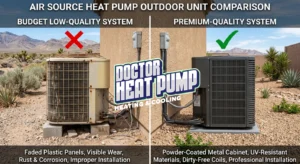
Ground-level and low-rise condos (typically three stories or less) often use conventional air-source heat pumps with outdoor condenser units placed on patios, balconies, or ground-level pads. These systems exchange heat with outdoor air like residential installations but must comply with HOA aesthetic and noise regulations.
Air-source replacement involves both indoor air handler and outdoor condenser units. You’ll need HOA approval for outdoor unit placement, especially if the replacement unit differs in size, appearance, or location from your existing equipment. Many HOAs require screening or specific placement to maintain building aesthetics, as outlined in Lennox’s residential installation standards.
Modern air-source heat pumps offer variable-speed technology that dramatically reduces noise compared to older single-speed units. If your existing outdoor unit disturbs neighbors or conflicts with patio usage, upgrading to premium quiet models addresses these concerns while improving efficiency. Current generation systems from manufacturers like Lennox, Carrier, and Trane operate at 55 to 65 decibels, comparable to normal conversation volume.
Mini-Split Systems for Flexible Solutions
Ductless mini-split systems provide excellent replacement options for condos without existing ductwork or where duct modifications aren’t feasible. These systems place compact outdoor units on balconies or building exteriors with small refrigerant lines connecting to wall-mounted or ceiling-recessed indoor units.
Mini-splits excel in split-level condos, converted lofts, or units with challenging layouts where ducted systems struggle with air distribution. Multi-zone configurations allow independent temperature control in bedrooms versus living areas, improving comfort and efficiency. Installation requires only three-inch diameter holes through exterior walls for refrigerant lines, minimizing structural impact compared to duct installation.
For comprehensive information on selecting the right system type for your condo layout, visit our condo heat pump selection guide.
HOA Requirements and Approval Process
Understanding Your HOA’s HVAC Policies
Every Las Vegas condo HOA maintains Covenants, Conditions, and Restrictions (CC&Rs) governing HVAC replacements. These policies exist to maintain building aesthetics, protect property values, ensure resident safety, and prevent installations that impact other units. Before contacting contractors, review your CC&Rs for HVAC-specific requirements.
Common HOA policies include required use of HOA-approved or licensed contractors, mandatory advance notice periods ranging from 30 to 90 days for planned replacements, specifications for equipment brands, efficiency ratings, or noise levels, restrictions on outdoor unit placement, appearance, or screening, and required inspections or certifications after installation.
Some HOAs maintain approved contractor lists or require that all HVAC work use the building’s preferred service provider. Others allow owner selection but mandate specific licensing, insurance coverage, or warranty requirements. According to ENERGY STAR commercial building guidelines, buildings with coordinated HVAC policies achieve 15% to 25% better long-term system performance through consistent installation standards and maintenance protocols.
Architectural Review Board Approval
Most condo HOAs require Architectural Review Board (ARB) approval for HVAC replacements, treating them as architectural modifications. Submit applications 60 to 90 days before planned installation to accommodate review timelines and potential revision requests.
Your ARB application should include detailed equipment specifications with make, model, dimensions, and efficiency ratings, installation plans showing equipment placement and any structural modifications, photos or renderings of outdoor equipment appearance and screening, contractor licensing and insurance documentation, and a project timeline with specific installation dates and estimated completion.
ARB reviews focus on aesthetic impact, noise levels affecting neighbors, structural integrity and building safety, and compliance with local building codes. Boards typically approve applications meeting published guidelines within two to four weeks. Prepare for potential revision requests regarding equipment placement, screening requirements, or installation timing to avoid peak resident traffic periods.
Emergency Replacement Exceptions
When heat pumps fail during extreme weather requiring emergency replacement, many HOAs allow expedited approval processes. However, “emergency” doesn’t excuse all procedures. You’ll still need minimum documentation including contractor license verification, equipment specifications, and temporary approval from building management or HOA president.
After emergency installation, submit full retroactive ARB application documenting the completed work within 30 to 60 days. Emergency installations not following proper retroactive approval risk HOA fines, required equipment removal, or liens against your unit. Even in emergencies, communicate with your HOA immediately and document all decisions and approvals.
System Selection for Condo Applications
Matching Your Building’s Infrastructure
For water-source systems, equipment compatibility with your building’s central plant is critical. Buildings operate water loops at specific temperature ranges, typically 60°F to 90°F for closed-loop systems or 55°F to 95°F for systems with supplemental heating and cooling. Your replacement heat pump must match these parameters.
Confirm your building’s water loop specifications with building management before selecting equipment. Installing units rated for different temperature ranges causes poor performance, excessive energy consumption, and potential equipment damage not covered by manufacturer warranties. Professional contractors experienced in high-rise work maintain relationships with building managers and access to specifications for major Las Vegas towers.
Capacity sizing proves equally important. Heat pump capacity requirements vary dramatically based on floor level, exposure, and window area. A 2-ton unit might adequately cool a mid-level interior unit while an identically sized corner unit on the top floor requires 3 tons due to solar heat gain and roof exposure.
Efficiency Considerations
Las Vegas’s extreme climate demands high-efficiency equipment for acceptable operating costs. Minimum recommended efficiency ratings include SEER2 16 or higher for cooling performance, HSPF2 9 or higher for heating efficiency, and EER 12 or higher for water-source systems.
These ratings aren’t just numbers but translate directly to monthly utility costs. A 3-ton heat pump operating at SEER2 16 costs approximately $120 to $150 monthly to cool a 1,200 square foot condo during peak summer. The same capacity at SEER2 20 reduces costs to $95 to $120, saving $25 to $30 monthly or $300 to $360 annually. According to Trane’s energy efficiency data, high-efficiency systems pay back their premium cost through energy savings within four to seven years in desert climates.
Premium features worth considering include variable-speed compressors that adjust capacity to match actual load requirements, improving efficiency during moderate weather when systems run at partial capacity 70% to 80% of operating hours. Two-stage or modulating systems provide better humidity control than single-speed units, important during Las Vegas’s brief humid periods during monsoon season. Smart thermostats with remote access and learning capabilities optimize schedules to your patterns while allowing adjustments from anywhere.
Noise Level Specifications
Condo living demands attention to noise impact on neighbors. Modern heat pumps operate significantly quieter than equipment from even five to ten years ago. Target these noise specifications: indoor air handlers below 35 decibels during normal operation, outdoor condensers below 60 decibels at ground level, and water-source cabinet units below 40 decibels.
For reference, 35 decibels approximates library quiet levels, 40 decibels equals soft background music, and 60 decibels matches normal conversation volume. If your existing system disturbs neighbors or yourself, prioritize noise ratings during equipment selection. Premium quiet models cost $500 to $1,200 more than standard equipment but deliver substantial quality-of-life improvements in shared-wall environments.
Installation Logistics and Considerations
Building Access and Scheduling
High-rise heat pump replacement requires coordination with building management regarding freight elevator reservations, loading dock access, and common area protection. Most buildings require contractors to reserve service elevators days or weeks in advance, use protective padding on elevator walls and floors, and restrict work to specific hours, typically 8 AM to 5 PM on weekdays.
Top-floor units face additional access challenges. Equipment and materials must travel significant vertical distances, increasing labor time and costs. Some luxury towers require after-hours installation to minimize resident disruption, adding premium labor charges. Plan for these logistics when budgeting and scheduling your replacement project.
Installation timelines vary by system type. Water-source heat pump replacements typically complete in one day for straightforward swaps where new equipment matches existing capacity and connections. Air-source system replacements take one to two days accounting for outdoor and indoor work. Mini-split installations range from one day for single-zone systems to two to three days for multi-zone configurations. For comprehensive installation information, see our Las Vegas heat pump installation guide.
Protecting Your Unit and Common Areas
Professional contractors protect your condo and building common areas during installation using floor coverings, corner guards, and elevator padding. Expect these standard practices: protective paper or plastic covering floors from entry to work areas, cardboard or foam protecting door frames, corners, and hallways, drop cloths protecting furniture and belongings near work areas, and HEPA filtration during cutting or drilling to contain dust.
For water-source replacements involving water loop disconnection, contractors shut off water flow to your unit, drain connections to prevent spills, and use drip pans and absorbent pads during line work. Any water damage from improper installation should be covered by contractor’s insurance. Verify adequate insurance coverage before authorizing work.
Neighbor Notification
Courtesy notification to adjacent neighbors prevents complaints and maintains relationships. Inform neighbors of planned installation timing, expected noise and disruption periods, and your contact information for concerns. Many HOAs require formal neighbor notification as part of the approval process.
Installation noise from removing old equipment, cutting or drilling for line penetrations, and testing new systems can be significant for several hours. If your installation requires weekend or evening work due to building restrictions, enhanced neighbor communication becomes even more critical.
Cost Breakdown and Budgeting
Equipment Costs by System Type
Heat pump replacement costs vary substantially based on system type, efficiency level, and condo-specific factors. Here are typical ranges for Las Vegas condos:
Water-source heat pumps range from $4,000 to $7,000 for standard efficiency models, $6,500 to $9,500 for high-efficiency units, and $8,000 to $12,000 for premium variable-speed systems.
Air-source heat pumps (complete system) range from $6,000 to $10,000 for standard efficiency, $9,000 to $14,000 for high-efficiency models, and $12,000 to $18,000 for premium quiet variable-speed units.
Ductless mini-split systems cost $3,500 to $6,000 for single-zone systems, $6,500 to $11,000 for two-zone configurations, and $10,000 to $16,000 for three or more zone systems.
These prices include equipment, standard installation labor, necessary permits and inspections, basic ductwork modifications if needed, and startup and testing. Prices assume straightforward replacements without major duct modifications, electrical upgrades, or structural work.
Additional Cost Factors
Several condo-specific factors can increase replacement costs beyond base equipment pricing. High-rise installation premiums of $500 to $1,500 cover additional labor for equipment transport, extended service elevator time, and longer material staging. After-hours or weekend installation requirements add 20% to 40% to labor costs when buildings restrict daytime work.
Electrical upgrades cost $800 to $2,500 if your unit’s electrical service requires updates for new equipment. Modern high-efficiency systems sometimes require different electrical configurations than older units. Ductwork modifications or replacement range from $1,500 to $4,500 depending on accessibility and scope. Concealed ductwork in condo ceilings complicates modifications compared to accessible attic installations.
Emergency replacement premiums during extreme weather add $500 to $1,500 to expedite procurement and installation. Contractors prioritize emergency work over scheduled jobs, justifying premium pricing. HOA fees or deposits range from $100 to $500 for some buildings requiring refundable deposits for common area access or potential damages.
Financing and Payment Options
For replacements costing $8,000 to $15,000, financing makes projects accessible without depleting savings. HVAC financing options include manufacturer financing programs offering 0% interest for 12 to 24 months, personal loans through banks or credit unions at 6% to 12% APR, home equity loans or HELOCs at 5% to 9% APR with potentially tax-deductible interest, and credit cards for smaller projects or to earn rewards points, though interest rates exceed other options.
Some contractors offer in-house financing or lease programs. Compare total costs including interest before selecting financing. Low monthly payments sometimes mask higher total costs over loan terms.
Federal Tax Credits and Rebates
Energy Efficient Home Improvement Credit
Heat pump replacements may qualify for federal tax credits up to $2,000 under the Energy Efficient Home Improvement Credit available through 2032. To qualify, your new system must meet minimum efficiency requirements: SEER2 16 or higher and HSPF2 9 or higher for air-source systems, or EER 12 or higher for water-source heat pumps.
This credit applies directly against your federal income tax liability for the installation year. If you owe $3,000 in federal taxes and claim the $2,000 heat pump credit, your tax bill reduces to $1,000. According to U.S. Department of Energy tax credit information, you cannot carry forward unused credits to subsequent years, so ensure sufficient tax liability to utilize the full credit amount.
Nevada Utility Rebates
NV Energy periodically offers rebates for high-efficiency heat pump installations. Rebate amounts vary by equipment efficiency and available program funding, typically ranging from $300 to $800 for qualifying systems. Check current rebate availability before purchasing equipment since programs change based on utility priorities and funding levels.
Combine federal tax credits with utility rebates for maximum savings. A $12,000 heat pump replacement with $2,000 federal credit and $500 utility rebate reduces net cost to $9,500, a savings of 21%. For more information, see our tax credits and rebates comparison.
Warranty and Service Considerations
Manufacturer Warranties
New heat pumps include comprehensive manufacturer warranties covering parts for 5 to 10 years typically, compressors specifically for 10 years commonly, and labor for 1 to 2 years in some cases. Premium brands sometimes offer extended warranties reaching 12 years on select components. Read warranty terms carefully because many require professional installation and annual maintenance to remain valid.
Register your equipment with the manufacturer within 90 days of installation to activate full warranty coverage. Some manufacturers provide only limited warranties for unregistered equipment. Keep all installation documentation, permits, and maintenance records to support future warranty claims.
Extended Warranties and Service Contracts
Consider extended warranty coverage beyond manufacturer terms for high-rise installations where service access proves more complex and expensive than single-family homes. Extended warranties typically cost $400 to $800 and extend coverage by three to five years beyond manufacturer warranties.
Service contracts covering annual maintenance plus priority emergency service range from $200 to $400 annually. For busy condo owners, these contracts provide convenience and ensure consistent maintenance that extends equipment life. Professional maintenance prevents 70% to 80% of common heat pump failures according to ENERGY STAR maintenance guidelines.
Service Access for Future Maintenance
When planning replacement, consider future service accessibility. Ensure clear access to:
- Service panels on heat pump cabinets
- Air filters for regular replacement
- Condensate drains for cleaning
- Outdoor units if applicable
Blocking access with furniture, storage, or later renovations complicates future service and increases costs. Maintain at least 24 inches of clearance on service sides of equipment for technician access during maintenance and repairs.
Choosing the Right Contractor
Essential Qualifications
Select contractors with specific high-rise and water-source system experience. Essential qualifications include Nevada contractor’s license with HVAC specialty classification, minimum $1 million general liability insurance, workers’ compensation coverage for all employees, manufacturer certifications for brands you’re considering, and experience with your specific building if you’re in a major Las Vegas tower.
Request references from other units in your building or similar high-rise properties. Contractors familiar with your building understand its systems, have existing relationships with building management, and navigate HOA requirements efficiently.
Red Flags to Avoid
Avoid contractors showing these warning signs: reluctance to provide license numbers or insurance certificates, significantly lower bids than competitors suggesting corners cut on labor or materials, pressure for immediate decisions without time to review proposals, inability to provide local references or previous high-rise work examples, and unwillingness to handle permit and HOA approval processes.
For significant investments like heat pump replacement, spending time on contractor selection prevents expensive mistakes and ensures quality installation protecting your investment for 15 to 20 years.
Questions to Ask Potential Contractors
Interview contractors using these key questions:
- How many water-source or high-rise heat pump replacements have you completed in the past year?
- Are you familiar with my building’s systems and HOA requirements?
- Who handles HOA applications and approval processes?
- What warranty do you provide on installation workmanship?
- How do you protect my unit and building common areas during installation?
- What is your process if problems arise after installation?
- Can you provide references from similar projects?
Contractors with extensive high-rise experience answer these questions confidently with specific examples. Vague responses or inability to address condo-specific concerns suggests insufficient experience for your project.
Frequently Asked Questions
How long does condo heat pump replacement take?
Water-source heat pump replacements typically complete in four to eight hours for straightforward swaps. Air-source systems require one to two days for indoor and outdoor work. Complex installations involving ductwork modifications or multi-zone systems may take two to three days. High-rise logistics like elevator scheduling and building access sometimes extend timelines beyond actual installation work.
Can I replace my heat pump with a different brand or capacity?
Usually yes, but verify compatibility with building systems first. Water-source replacements must match building water loop specifications regardless of brand. Capacity changes require new calculations confirming adequate heating and cooling for your unit. Increasing capacity may require electrical upgrades. Your HOA approval process should catch compatibility issues if you work with experienced contractors.
Do I need HOA approval for emergency replacement?
Yes, though processes differ for emergencies. Most HOAs allow expedited verbal approval from building management or board officers with formal application submitted within 30 days. Document all emergency communications and approvals to protect against later compliance disputes. Never assume emergency circumstances excuse all procedures.
What if my unit is different from others in the building?
Corner units, penthouses, and units with unique features often require different capacity or system configurations than standard units. Professional contractors evaluate your specific unit during estimates rather than assuming standard building configurations. Differences in window exposure, ceiling height, or floor level dramatically impact heating and cooling loads requiring individualized sizing.
Should I upgrade to higher efficiency when replacing?
Usually yes. Efficiency improvements of 20% to 40% compared to systems from 10 to 15 years ago provide monthly savings of $20 to $50 for typical Las Vegas condos. These savings compound over 15 to 20 year equipment life, totaling $3,600 to $12,000. High-efficiency equipment premium costs of $1,500 to $3,000 pay back within four to eight years through reduced utility bills.
Can I install smart thermostats with my new heat pump?
Most modern heat pumps integrate seamlessly with smart thermostats from Nest, Ecobee, and Honeywell. Verify compatibility between your selected heat pump and preferred thermostat before purchase. Smart thermostats cost $200 to $350 but deliver $150 to $250 annual savings through optimized scheduling and remote access preventing unnecessary heating and cooling of unoccupied units.
What maintenance does my new heat pump need?
Annual professional maintenance includes filter replacement (quarterly for high-use systems), coil cleaning for indoor and outdoor components, refrigerant level verification and adjustment, electrical connection inspection, control calibration, and condensate drain cleaning. Annual maintenance costs $150 to $250 but prevents 70% to 80% of premature failures while maintaining peak efficiency throughout equipment life.
How do I know if I should repair or replace my current system?
Consider replacement when your heat pump exceeds 12 years old, faces repair costs exceeding $1,500 to $2,000, requires second or third repair within 12 months, shows efficiency decline of 20%+ compared to historical bills, or produces noise disturbing you or neighbors. Major component failures like compressor or reversing valve problems in units over 10 years old typically warrant replacement rather than expensive repairs on aging equipment.
Planning Your Condo Heat Pump Replacement
Replacing your condo’s heat pump requires more planning and coordination than traditional home installations, but the process delivers reliable comfort and efficiency for 15 to 20 years. Understanding your building’s systems, HOA requirements, and condo-specific installation considerations ensures successful projects that meet regulations while maximizing comfort and property value.
Start planning replacements six to twelve months before expected need when possible. This timeline accommodates HOA approval processes, contractor selection and scheduling, and potential delays from permit requirements or equipment availability. Proactive planning prevents emergency replacements during extreme weather when options narrow and costs increase.
Ready to plan your condo heat pump replacement? Call Doctor Heat Pump today at 702-467-7236 or visit our contact page to schedule a consultation. We’ll evaluate your current system, verify building specifications, explain your options, and guide you through the entire replacement process from HOA approval through final installation.
Experience the peace of mind that comes from working with Las Vegas’s high-rise heat pump specialists. Let us handle the complexities while you enjoy reliable comfort in your condo.