

Doctor Heat Pump gets this question almost daily from Las Vegas homeowners evaluating their HVAC options: “Should I install a heat pump or stick with a traditional air conditioner?” The answer significantly impacts your comfort, energy bills, and long-term costs—especially in our extreme desert climate where temperatures swing from 115°F summer highs to 30°F winter lows.
Understanding the real differences between heat pumps and AC units requires looking beyond equipment sticker prices to consider total lifetime costs, energy efficiency, and how each system performs in Las Vegas’s unique climate conditions.
The short answer? For most Las Vegas homeowners, heat pumps deliver superior value despite higher initial costs. But the complete picture involves important nuances worth understanding before making this significant investment.
Understanding the Fundamental Difference
The key distinction between heat pumps and AC units comes down to versatility and year-round capability.
An air conditioner performs one function: removing heat from your indoor air and releasing it outdoors. During Las Vegas summers when you need cooling, AC units do this job efficiently. When winter arrives, your AC unit sits idle while a separate furnace heats your home.
A heat pump does everything an air conditioner does during cooling season—in fact, it uses identical technology and achieves the same cooling performance. The difference appears in winter when the heat pump reverses operation, extracting heat energy from outdoor air and moving it indoors to warm your home.
This reversibility makes heat pumps combination heating and cooling systems. You’re getting furnace and air conditioner functionality in a single unit, which creates significant advantages for Las Vegas homeowners who need both capabilities.
Initial Cost Comparison: Equipment and Installation
Understanding upfront costs helps you budget appropriately and evaluate financing options.
Air Conditioner Plus Furnace Costs
Installing a traditional cooling and heating system means purchasing two separate units. A quality air conditioner for a typical 1,800-2,000 square foot Las Vegas home costs $4,000-$7,000 including installation, depending on efficiency rating and brand.
Your furnace adds another $3,000-$5,500 for equipment and installation. Natural gas furnaces typically cost less to operate than electric models, but require existing gas service. Bringing gas lines to your property adds $2,000-$5,000 more.
Total costs for AC plus furnace range from $7,000-$12,500 for most Las Vegas homes. Higher efficiency equipment or complex installations push costs toward the upper end of this range.
Heat Pump System Costs
A complete heat pump installation handling both heating and cooling typically costs $8,000-$14,000 for the same size Las Vegas home. This appears more expensive initially, but remember—you’re comparing one system to two separate systems.
On a per-system basis, heat pumps actually cost less. You’re not paying for two separate installations, two sets of permits, or twice the labor. The higher equipment cost reflects the reversing valve and additional components needed for dual-mode operation.
High-efficiency heat pump models (18+ SEER2, 9+ HSPF2) approach $14,000-$16,000 installed, but these premium systems deliver maximum energy savings that recover the difference over time.
Incentives and Net Costs
Federal tax credits significantly affect heat pump economics. The Inflation Reduction Act offers up to $2,000 in tax credits for qualifying heat pump installations through December 31, 2025. Air conditioners and furnaces qualify for smaller credits that rarely exceed $600-$800 combined.
NV Energy rebates add another $300-$800 for high-efficiency heat pumps. These incentives stack with federal credits, reducing net heat pump costs by $2,300-$2,800 total.
After incentives, heat pump net costs ($5,200-$11,200) often equal or beat AC plus furnace combinations ($6,200-$11,700), especially when gas line installation is required.
Operating Costs: Where Heat Pumps Excel
Initial costs tell only part of the story. Operating expenses over 15-20 years typically exceed equipment costs several times over.
Cooling Season Economics
During Las Vegas’s extended cooling season (roughly March through November), heat pumps and air conditioners with identical SEER2 ratings cost exactly the same to operate. A 16 SEER2 heat pump cools just as efficiently as a 16 SEER2 air conditioner.
For a typical Las Vegas home running AC extensively 8-9 months yearly, annual cooling costs run $1,200-$1,800 at current NV Energy rates. Neither system has an advantage during cooling season when efficiency ratings are equal.
The cooling efficiency battle comes down to choosing high SEER2 ratings regardless of system type. Doctor Heat Pump recommends minimum 16 SEER2 for Las Vegas, with 18-20 SEER2 delivering optimal performance during our extreme summer heat.
Heating Season Advantages
Winter separates heat pumps from AC plus furnace combinations. Las Vegas winters are mild compared to northern climates, but we still need reliable heat during December through February when overnight temperatures regularly drop to the 30s and 40s.
Heat pumps move existing heat rather than generate it, achieving 200-300% efficiency. For every dollar spent on electricity, you receive $2-$3 worth of heating. Electric furnaces max out at 100% efficiency—every dollar produces one dollar of heat.
Natural gas furnaces achieve 80-96% efficiency depending on model quality. While gas costs less per BTU than electricity in many markets, heat pump efficiency advantages often result in comparable or lower heating costs even when compared to gas.
For a Las Vegas home spending $300-$500 annually on winter heating, switching from electric resistance to a heat pump typically saves $200-$350 per year. Compared to natural gas, savings vary based on current gas prices but often reach $100-$200 annually.
Total Annual Operating Costs
Combining cooling and heating costs, most Las Vegas homeowners save $600-$1,000 annually with heat pumps versus AC plus electric furnace. Compared to AC plus gas furnace, savings run $200-$500 annually depending on current natural gas prices and system efficiency ratings.
Over a typical 15-year equipment lifespan, these savings compound to $9,000-$15,000 for heat pumps versus electric systems, or $3,000-$7,500 versus gas systems. These savings far exceed any initial cost premium for heat pump equipment.
Energy Efficiency Ratings Explained
Understanding efficiency ratings helps you compare systems and predict operating costs.
SEER2 for Cooling Performance
Seasonal Energy Efficiency Ratio 2 (SEER2) measures cooling efficiency under standardized conditions. Higher numbers indicate more efficient operation and lower electricity costs.
Nevada’s minimum SEER2 requirement is 14.3 for new equipment. Doctor Heat Pump recommends 16 SEER2 minimum for Las Vegas homes, with 18-20 SEER2 for maximum efficiency and comfort during extreme heat.
Both heat pumps and air conditioners use SEER2 ratings, allowing direct comparison. A 16 SEER2 heat pump cools identically to a 16 SEER2 air conditioner—the cooling performance is the same regardless of heating capability.
HSPF2 for Heating Efficiency
Heating Seasonal Performance Factor 2 (HSPF2) measures heat pump heating efficiency. This rating doesn’t apply to air conditioners since they can’t heat.
Nevada requires minimum 7.5 HSPF2 for new heat pumps. Systems rated 8.5-10 HSPF2 deliver superior heating efficiency, particularly valuable during Las Vegas’s coldest winter days.
Higher HSPF2 ratings reduce heating costs proportionally. A 9.0 HSPF2 system costs roughly 20% less to heat your home compared to a 7.5 HSPF2 system, savings that compound over years.
EER for Peak Performance
Energy Efficiency Ratio (EER) measures performance at 95°F outdoor temperature. In Las Vegas where temperatures routinely exceed 110°F, EER ratings matter critically.
High EER ratings indicate systems that maintain efficiency during extreme heat. This is crucial for desert climates where your system works hardest exactly when efficiency matters most for controlling utility bills during peak summer months.
When comparing systems, prioritize models with strong EER alongside high SEER2. A system with great SEER2 but mediocre EER may disappoint during July and August when you need reliable, efficient cooling most.
Las Vegas Climate Considerations
Our unique desert climate creates specific requirements that affect heat pump versus AC decisions.
Extreme Summer Heat Performance
Las Vegas summer temperatures regularly exceed 110°F, with occasional spikes to 117-120°F. Not all HVAC systems handle these extremes equally well.
Quality heat pumps engineered for desert climates perform excellently during extreme heat. Doctor Heat Pump installs only systems tested and proven in southwestern desert conditions, ensuring reliable cooling even during our hottest days.
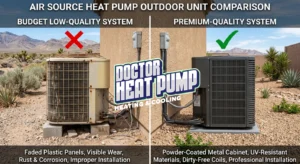
The key is choosing appropriately-rated equipment. Budget systems designed for moderate climates struggle in Las Vegas. Premium heat pumps specifically rated for extreme temperatures handle our summer heat as effectively as quality air conditioners.
Winter Heating Demands
Las Vegas winters are mild compared to northern regions, but we still experience temperatures in the 30s and occasionally below freezing on winter mornings. Heat pumps excel in these moderate heating conditions.
Modern heat pumps operate efficiently down to 25°F or lower. Since Las Vegas rarely experiences sustained cold below 40°F, heat pumps run at peak efficiency throughout our entire winter season, delivering cost-effective heating whenever needed.
For the rare occasions when temperatures drop below 25°F, heat pumps include supplementary electric resistance heat strips that provide backup heating. This failsafe ensures warmth even during unusual cold snaps.
Dust and Air Quality
Desert dust affects all HVAC systems, but heat pumps’ year-round operation means they encounter more dust exposure than AC units that sit idle in winter.
Regular filter replacement and professional maintenance address this concern. Doctor Heat Pump’s maintenance programs include appropriate service frequency for heat pumps operating year-round in dusty conditions.
Quality air filtration systems integrated with heat pump installations protect both equipment and indoor air quality from desert dust intrusion.
When AC Plus Furnace Makes More Sense
While heat pumps offer advantages for most Las Vegas homeowners, some situations favor traditional AC plus furnace systems.
Existing Functional Furnace
If you have a relatively new, well-functioning furnace (less than 8 years old) and only need to replace your air conditioner, installing a new AC unit makes economic sense short-term.
Keep the functional furnace and replace just the AC. When the furnace eventually needs replacement in 5-10 years, that’s the ideal time to convert to a complete heat pump system.
This staged approach spreads capital costs over time while avoiding premature replacement of functional equipment. Just ensure your replacement AC achieves high SEER2 ratings to maximize cooling efficiency.
Natural Gas Preference
Some homeowners prefer natural gas heating for specific reasons: lower operating costs in regions with cheap gas, faster temperature recovery during cold weather, or simply familiarity with gas systems.
If you have existing gas service and strongly prefer gas heating, combining a high-efficiency air conditioner with a quality gas furnace remains a viable option. Modern 95%+ AFUE gas furnaces deliver excellent efficiency.
However, consider that Nevada’s electricity rates are declining as renewable energy expands, while natural gas prices fluctuate unpredictably. Heat pumps’ fixed efficiency advantage becomes more valuable as electricity costs decrease.
Budget Constraints
Upfront cost differences sometimes matter despite long-term savings favoring heat pumps. If budget constraints require choosing the absolute lowest initial cost, a basic AC unit plus electric furnace combination may cost $1,000-$2,000 less than an equivalent heat pump.
Doctor Heat Pump offers financing options that make heat pumps affordable with monthly payments often offset by energy savings. Exploring financing can make heat pumps budget-friendly even for cost-conscious homeowners.
Making the Switch: Converting from AC to Heat Pump
Many Las Vegas homeowners ask whether they can replace their air conditioner with a heat pump without major renovations. The answer is usually yes.
What Conversion Requires
Your existing ductwork typically accommodates heat pump installation without modifications. If your current air conditioner adequately cools your home, a properly-sized heat pump will handle both cooling and heating through the same ducts.
Electrical service may need upgrading to accommodate heat pump requirements. Most modern homes have adequate service, but older properties occasionally need electrical panel updates. Doctor Heat Pump evaluates electrical capacity during initial consultations.
Thermostat replacement is necessary since heat pumps require thermostats designed for dual-mode operation with reversing valve controls. We include proper thermostats with every heat pump installation.
The outdoor unit pad and refrigerant lines usually remain serviceable. Heat pumps have similar footprints to air conditioners, so existing concrete pads work fine. Refrigerant line sets may be reusable depending on condition and refrigerant type compatibility.
Installation Timeline
Complete heat pump conversion typically takes 1-2 days. Doctor Heat Pump removes your old air conditioner, installs the new heat pump, updates electrical connections, installs compatible thermostats, and thoroughly tests both heating and cooling modes.
Work happens primarily outdoors or in attic/crawlspace areas where ductwork connects. You’ll be without HVAC for less than one day in most cases, and we schedule installations during mild weather whenever possible.
Best Timing for Conversion
The ideal conversion time is when your air conditioner needs replacement anyway due to age, efficiency decline, or major repair needs. Converting proactively before catastrophic failure gives you time to research options and compare quotes.
Seasonal timing matters in Las Vegas. Spring (March-May) and fall (September-November) offer mild weather for installations and better contractor availability than peak summer or winter. Doctor Heat Pump recommends planning conversions during these shoulder seasons when possible.
Frequently Asked Questions
Q: Do heat pumps cool as effectively as air conditioners during 115°F Las Vegas heat?
A: Yes, absolutely. Heat pumps use identical cooling technology to air conditioners. A 16 SEER2 heat pump cools exactly as well as a 16 SEER2 air conditioner. The heating capability doesn’t compromise cooling performance—you get the same robust cooling you’d expect from an AC unit.
Q: Will switching to a heat pump increase my electric bill?
A: Total energy costs typically decrease with heat pumps. While you’ll use more electricity for heating (if currently using gas), the efficiency advantage usually results in lower total annual costs. Compared to electric resistance heat, savings are dramatic—often $200-$400 annually.
Q: How long does a heat pump last compared to an AC unit?
A: Both systems typically last 15-20 years in Las Vegas with proper maintenance. Heat pumps operate year-round while AC units sit idle in winter, but heat pump components are engineered for extended operation. Lifespan is comparable with appropriate maintenance.
Q: Can I use my existing ductwork with a heat pump?
A: Usually yes. If your current AC adequately cools your home through existing ducts, a properly-sized heat pump will work fine with the same ductwork. Minor modifications sometimes improve efficiency, but major duct renovations are rarely necessary.
Q: What happens if my heat pump fails during a heat wave?
A: Doctor Heat Pump offers priority emergency service for maintenance plan customers. Most repairs complete same-day. For critical failures requiring parts, we can sometimes install temporary cooling solutions while awaiting repairs. Proper maintenance dramatically reduces unexpected failure risk.
Doctor Heat Pump’s Expert Recommendation
After installing thousands of HVAC systems throughout Las Vegas, Henderson, and North Las Vegas, Doctor Heat Pump’s recommendation is clear: heat pumps deliver superior long-term value for most Las Vegas homeowners.
The combination of federal tax credits, utility rebates, year-round efficiency, and simplified maintenance makes heat pumps the smart choice for anyone planning to own their home for 5+ years. The savings compound annually, and the environmental benefits align with Nevada’s clean energy future.
For homeowners with functional newer furnaces or strong natural gas preferences, quality AC units remain viable. But when replacement time arrives for either heating or cooling equipment, that’s the ideal moment to convert to heat pump technology.
Ready to explore whether a heat pump or AC unit makes more sense for your specific situation? Contact Doctor Heat Pump today at 702-467-7236 for a complimentary in-home assessment. We’ll evaluate your current equipment, calculate projected costs and savings, and provide honest recommendations tailored to your home and budget.
Don’t make this important decision based on guesswork or sales pressure. Get expert analysis from Las Vegas HVAC professionals who prioritize your long-term satisfaction over quick sales. Doctor Heat Pump is here to help you make the smart choice for your home’s comfort and your family’s budget.
References
- U.S. Department of Energy – Heat Pump Systems: https://www.energy.gov/energysaver/heat-pump-systems
- ENERGY STAR – Heat Pumps (Air-Source): https://www.energystar.gov/products/heating_cooling/air_source_heat_pumps
- ENERGY STAR – Central Air Conditioning: https://www.energystar.gov/products/heating_cooling/air_conditioning_room/key_product_criteria