

If you’ve started researching heat pumps for your Las Vegas home, you’ve probably noticed the terminology gets complicated fast. Air-source, ground-source, ductless, ducted, variable-speed, dual-fuel — the options multiply quickly, and the differences between them matter more than most homeowners realize before making a purchasing decision. At Doctor Heat Pump, we believe a well-informed homeowner makes a better decision — so this guide breaks down every major heat pump type, how each one works, and which makes the most sense in the Las Vegas desert climate.
The short version: not all heat pumps are created equal, and the type that works best in Minnesota is not necessarily the type that works best in Nevada. Las Vegas’s specific climate — extreme summer heat, mild winters, low humidity, and high utility costs — creates a distinct set of priorities that should drive the system selection decision.
What Is a Heat Pump and How Does It Work?
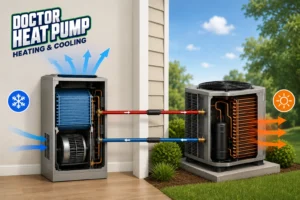
Before diving into types, it helps to understand what all heat pumps have in common. A heat pump doesn’t generate heat by burning fuel — it moves heat from one place to another using refrigerant and a compressor. In cooling mode, it moves heat from inside your home to the outside. In heating mode, it reverses the process and moves heat from the outside air — or ground, or water — into your home.
This heat-transfer approach is what makes heat pumps significantly more efficient than combustion-based heating. Moving heat requires far less energy than generating it, which translates to lower operating costs — especially in a climate like Las Vegas where heating demand is modest and the efficiency advantage of heat pump heating over gas heating is substantial during mild winter conditions.

Air-Source Heat Pumps
Air-source heat pumps are by far the most common heat pump type in Las Vegas residential applications. They extract heat from outdoor air — either moving it outside during cooling or extracting it from outside air and bringing it inside during heating.
Ducted Air-Source Heat Pumps
A ducted air-source heat pump connects to your home’s existing ductwork system, distributing conditioned air through vents in each room — the same way a traditional central AC and furnace system works. For most Las Vegas homes with existing ductwork in reasonable condition, a ducted air-source heat pump is the most straightforward replacement path.
How it works in Las Vegas: The outdoor unit sits outside — typically on a concrete pad or rooftop — and exchanges heat with the desert air. In cooling mode, it’s extracting heat from inside your home and rejecting it to the outdoor air. The challenge in Las Vegas is that outdoor air temperatures regularly exceed 110°F, which means the system has to work harder to reject heat than it would in a moderate climate. This is why SEER2 and EER2 ratings — particularly EER2, which measures efficiency at peak outdoor temperatures — matter so much in the desert.
Best for: Las Vegas homes with existing ductwork in good condition, homeowners replacing a central AC and furnace system, and applications where whole-home comfort from a single system is the priority.
Top models to consider: Lennox XP25, Lennox XP21, Carrier Infinity 20 VS, Trane XV21i
Ductless Mini Split Heat Pumps
A ductless mini split system eliminates the ductwork entirely. The outdoor unit connects directly to one or more indoor air handlers mounted on the wall, ceiling, or floor of individual rooms or zones — with no ducts required.
How it works in Las Vegas: Because there are no ducts running through a hot attic, ductless systems eliminate one of the biggest sources of energy loss in Las Vegas homes. Attic duct temperatures in Las Vegas summer can reach extreme levels, and conditioned air traveling through those ducts absorbs heat before it ever reaches the living space. A ductless system bypasses that loss completely, delivering conditioned air directly to the room being served.
Modern ductless systems achieve SEER2 ratings of 20 or higher and offer room-by-room temperature control that ducted systems can only approximate through zoning. They’re quieter, more precise, and in many applications more efficient than ducted alternatives.
Best for: Room additions, converted garages, detached casitas, older Las Vegas homes without existing ductwork, homes with significant attic duct loss issues, and applications where room-by-room control is a priority.
Top models to consider: Lennox ductless mini split systems, Carrier Performance series ductless, Mitsubishi Electric Mr. Slim
Ground-Source Heat Pumps (Geothermal)
Ground-source heat pumps — commonly called geothermal systems — exchange heat with the ground rather than the outdoor air. Below the frost line, ground temperature remains relatively stable year-round — typically in the 55°F to 70°F range — which provides a consistent heat exchange medium regardless of outdoor air temperature.
How it works in Las Vegas: A series of pipes buried in the ground — either vertically in boreholes or horizontally in trenches — circulates fluid that absorbs or rejects heat to the stable ground temperature. In cooling mode, the system rejects heat to the cooler ground rather than to 110°F outdoor air — which is significantly more efficient than air-source cooling on the hottest Las Vegas days.
The Las Vegas consideration: Geothermal installation costs are substantially higher than air-source systems — typically $15,000 to $30,000 or more depending on the ground loop configuration — and Las Vegas’s rocky desert soil can complicate drilling and trenching. The efficiency advantage is real, but the payback period in the residential market is long. Geothermal is more commonly evaluated for commercial applications in the Las Vegas market than for typical residential installations.
Best for: Commercial properties, large residential properties where installation costs can be justified, or homeowners with a strong long-term efficiency focus and budget to match.
Water-Source Heat Pumps
Water-source heat pumps exchange heat with a water loop rather than outdoor air or the ground. They’re most common in multi-unit residential and commercial buildings — including many of the high-rise condominiums and hotels on the Las Vegas Strip — where a shared water loop serves multiple units simultaneously.
How it works: Each unit in the building connects to a shared water loop maintained at a moderate temperature. Individual heat pumps in each unit exchange heat with the loop — rejecting heat to it during cooling, extracting heat from it during heating. Because the loop temperature is moderate and consistent, water-source systems can achieve very high efficiencies that would be difficult to match with air-source equipment in extreme outdoor conditions.
The Las Vegas connection: Water-source heat pump systems are the technology of choice for many of Las Vegas’s luxury high-rise buildings — including properties like the Waldorf Astoria and Veer Towers, where Doctor Heat Pump has direct commercial service experience. For individual homeowners, water-source systems are generally not applicable — but for condo owners in high-rise buildings, understanding this system type explains why their HVAC setup looks different from a single-family home.
Best for: Multi-unit residential buildings, commercial properties, high-rise condominiums, and hotel properties with shared mechanical systems. See our detailed guide on how water-source heat pumps work for a complete breakdown of this system type.
Inline Graphic Suggestion: Diagram showing a water-source heat pump loop in a multi-story building — individual units connected to a shared water loop with a cooling tower. Las Vegas high-rise building context.
Dual-Fuel Heat Pump Systems
A dual-fuel system pairs an air-source heat pump with a gas furnace backup. The heat pump handles all cooling and handles heating during mild conditions — where it’s most efficient. When outdoor temperatures drop low enough that the heat pump’s heating efficiency decreases, the gas furnace automatically takes over.
How it works in Las Vegas: In most Las Vegas winters, a dual-fuel system would operate almost entirely in heat pump mode. The heat pump is efficient for heating down to outdoor temperatures in the low-to-mid 30s — which covers nearly all of Las Vegas’s heating season. The gas furnace provides a backup for the occasional cold snap that pushes below that threshold, but it may see very limited use in a typical Las Vegas winter.
The trade-off: A dual-fuel system requires both a heat pump and a gas furnace — two pieces of equipment to install, maintain, and eventually replace. For most Las Vegas homeowners, a high-quality air-source heat pump without a gas backup handles the climate comfortably and simplifies the system. Dual-fuel makes more sense in climates with more severe winters than Las Vegas typically experiences.
Best for: Las Vegas homeowners who want the efficiency of a heat pump but have anxiety about all-electric heating performance on the coldest nights, or homeowners with an existing gas furnace in good condition who want to add heat pump cooling and heating without replacing the furnace yet.
Variable-Speed vs. Two-Stage vs. Single-Stage Heat Pumps
Regardless of the heat pump type, the compressor technology significantly affects real-world performance — especially in Las Vegas’s extreme climate.
Single-Stage
A single-stage heat pump operates at one speed — full capacity or off. It’s the simplest and least expensive option, but it’s also the least efficient and least comfortable. In Las Vegas, a single-stage system cycles on at full blast, cools quickly, then shuts off — only to cycle back on a short time later. This results in temperature swings, poor humidity control, and high energy consumption relative to the system’s capacity.
Two-Stage
A two-stage heat pump has two operating speeds — typically 65% and 100% capacity. It runs at low speed during moderate conditions and switches to full capacity when demand is high. This reduces cycling frequency, improves humidity control, and lowers energy consumption compared to single-stage — a meaningful improvement for Las Vegas homeowners.
Variable-Speed
A variable-speed heat pump adjusts its output continuously across a wide range — often from 25% to 100% capacity — in small increments. It runs almost constantly at low speed during moderate conditions, ramping up gradually as demand increases. In Las Vegas, where the cooling load varies significantly throughout the day as outdoor temperatures climb and fall, variable-speed operation delivers the best combination of efficiency, comfort, and humidity control of any compressor technology available.
For Las Vegas specifically, variable-speed is worth the premium. The long cooling season means the efficiency gains accumulate quickly, the improved humidity control makes the desert climate noticeably more comfortable indoors, and the reduced cycling extends equipment life meaningfully.
Which Heat Pump Type Is Right for Your Las Vegas Home?
Here’s a quick reference to help narrow down the right direction before talking to a contractor:
| Situation | Recommended Type |
|---|---|
| Replacing central AC + furnace, existing ducts in good shape | Ducted air-source heat pump, variable-speed |
| Room addition, casita, or garage conversion | Ductless mini split |
| Older home with poor or no ductwork | Ductless mini split or new ducted system |
| Two-story home with uneven temperatures | Ducted variable-speed with zoning, or dual ductless |
| High-rise condo unit | Water-source heat pump (building system) |
| Large property, long-term efficiency focus | Geothermal — evaluate cost vs. payback carefully |
| Aging furnace + aging AC, want one system | Ducted air-source heat pump |
| Want heat pump efficiency but nervous about cold nights | Dual-fuel system |
Why Las Vegas Homeowners Choose Doctor Heat Pump
Doctor Heat Pump is a local, family-owned HVAC company serving Las Vegas, Henderson, and North Las Vegas. We specialize in heat pump installation, heat pump service, and AC replacement across the Las Vegas Valley — and we have direct experience with every heat pump type covered in this guide, from residential ductless installations to commercial water-source systems in Las Vegas high-rise properties.
We work primarily with Lennox systems for residential applications because of their efficiency leadership and reliability in desert climates — but we’re experienced with Carrier, Trane, and Mitsubishi as well and will always recommend the system type and brand that’s genuinely right for your home and budget.
Frequently Asked Questions
What is the most common type of heat pump in Las Vegas homes? Ducted air-source heat pumps are by far the most common type in Las Vegas single-family residential applications. They replace central AC and furnace systems using existing ductwork and provide whole-home heating and cooling from a single outdoor unit.
Do heat pumps work in Las Vegas summer heat? Yes — modern high-efficiency heat pumps are engineered to perform in extreme heat conditions. In cooling mode, a heat pump operates the same way as a central air conditioner. The key is choosing a system with a strong EER2 rating, which measures efficiency at peak outdoor temperatures rather than averaging across the whole season.
Are ductless mini splits better than ducted heat pumps for Las Vegas homes? It depends on the application. Ductless systems eliminate attic duct losses — a significant efficiency advantage in Las Vegas — and provide room-by-room control. But for whole-home replacement in a house with existing ductwork in good condition, a ducted system is typically more cost-effective to install. Both approaches can deliver excellent results with the right equipment and installation.
How long do heat pumps last in Las Vegas? With proper annual maintenance, a quality heat pump typically lasts 15 to 20 years. Las Vegas systems run more hours per year than systems in moderate climates, which can push toward the lower end of that range — making consistent heat pump service and maintenance especially important.
Can a heat pump replace both my AC and furnace? Yes — and for most Las Vegas homeowners, that’s exactly what a heat pump does. A single air-source heat pump handles all cooling and all heating, eliminating the need for a separate furnace. Given Las Vegas’s mild winters, a quality heat pump handles the full heating season comfortably without a gas backup in the vast majority of cases.
Ready to Find the Right Heat Pump for Your Las Vegas Home?
Understanding the different types of heat pumps is the first step — the second is talking to a contractor who can evaluate your specific home and recommend the right system with confidence. Every Las Vegas home is different, and the right heat pump type depends on your existing ductwork, your home’s layout, your efficiency goals, and your budget.
Doctor Heat Pump is here to help. Call us at 702-467-7236 or contact us online to schedule a consultation. We’ll walk you through your options, answer your questions honestly, and make sure you end up with the right system for your home — whatever type that turns out to be.
References
- U.S. Department of Energy — Heat Pump Systems
- ENERGY STAR — Heat Pump Certified Products
- Lennox — Heat Pump Systems and Technology
- Carrier — Heat Pump Products
- Trane — Heat Pump Systems