

When Las Vegas homeowners think about their heat pump, they usually picture the outdoor unit — the compressor sitting on a pad or mounted on the roof. But half of the system lives inside your home. The air handler is the indoor component that actually delivers conditioned air through your ductwork. It’s just as important as the outdoor unit, and when it fails or becomes incompatible with a new system, the consequences show up immediately in your comfort and your energy bill. At Doctor Heat Pump, air handler questions come up constantly — especially when homeowners are replacing one component and discovering the other needs attention too.
This guide covers what the heat pump air handler does, how to know when it needs replacement, what sizing and compatibility mean in practice, and what Las Vegas homeowners should expect when they need air handler work done.
What Is a Heat Pump Air Handler?
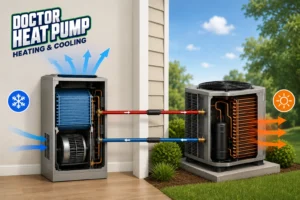
The air handler is the indoor unit of a split heat pump system. It contains the evaporator coil, the blower motor, the air filter, and — in many systems — the electric auxiliary heat strips that provide backup heating when outdoor temperatures drop low enough to reduce heat pump efficiency.
In cooling mode, warm indoor air is pulled across the evaporator coil inside the air handler. The refrigerant flowing through the coil absorbs the heat. The now-cooled air is blown through your ductwork and distributed to each room. In heating mode, the process reverses — the coil releases heat into the airflow rather than absorbing it.
The air handler also houses the electric heat strips that serve as auxiliary heat in most Las Vegas systems. When outdoor temperatures dip into the low 30s and the heat pump alone can’t meet demand, these strips activate automatically to supplement heating output. Your thermostat controls when they kick in.
Without a properly functioning air handler, the outdoor unit has nothing to work with. The two components operate as a system — and when one underperforms, the other compensates by working harder.
Signs Your Air Handler Needs Attention
Air handlers are generally reliable, but they do develop issues — especially in Las Vegas homes where systems run heavily for months at a time. Watch for these warning signs.
Weak or uneven airflow
If some rooms get adequate airflow while others barely feel the system running, the blower motor may be losing capacity. Weak overall airflow from all vents points to a blower issue, a severely clogged filter, or a restricted evaporator coil.
Ice on the indoor unit
Ice forming on the evaporator coil inside the air handler indicates restricted airflow, low refrigerant, or a dirty coil. A frozen coil blocks airflow completely and stops conditioning entirely. If you notice ice on or around the air handler, turn the system off and call for service — running a frozen system can damage the compressor.
Unusual noises from inside the unit
Squealing typically indicates a worn blower motor bearing. Banging or rattling suggests a loose component inside the cabinet. Persistent humming at a different pitch than normal can signal electrical issues. None of these sounds are normal and all warrant a call to your technician.
Higher energy bills without a usage change
A declining blower motor draws more current to move the same amount of air. A dirty evaporator coil forces the outdoor compressor to work harder to achieve the same heat transfer. Either issue shows up as an unexplained increase in your NV Energy bill before it becomes an obvious performance problem.
Moisture or water around the unit
The condensate drain system removes moisture that the evaporator coil collects from indoor air during cooling. A clogged drain line causes water to overflow from the drain pan — potentially damaging ceilings, walls, and flooring below the unit. If you notice moisture around the air handler, check the drain pan and line immediately.
Age over 15 years
Air handlers last roughly as long as the outdoor unit — 15 to 20 years with proper maintenance. An air handler approaching or past 15 years of Las Vegas service may still be functioning but is approaching the end of its reliable service life. When the outdoor unit needs replacement, it’s worth evaluating the air handler’s condition at the same time.
Air Handler Sizing: Why It Matters
An air handler must be properly matched to the outdoor unit in capacity. Mismatched equipment — a 3-ton air handler paired with a 4-ton outdoor unit, for example — creates performance problems that no amount of adjustment can fix.
Oversized air handler
An air handler larger than the outdoor unit’s capacity pushes more air than the coil can properly condition. Cooling is inconsistent. Humidity control suffers. The system may short cycle trying to compensate.
Undersized air handler
An air handler smaller than the outdoor unit restricts the system’s ability to deliver its rated capacity. The outdoor unit works harder than it should. Efficiency drops. The compressor experiences additional stress.
Proper sizing isn’t just about matching the tonnage number. It also involves confirming that the coil configuration, refrigerant type, and electrical specifications are compatible. This is why air handler replacement should always involve a professional assessment — not just ordering the same size as what’s being removed.
For new installations, proper sizing starts with a Manual J load calculation that accounts for your home’s square footage, ceiling height, insulation levels, window orientation, and local design temperatures. In Las Vegas, those design temperatures are among the highest in the country — which affects load calculations significantly compared to moderate climates.
Air Handler Compatibility: What to Know Before Replacing
This is where many Las Vegas homeowners get caught off guard. Not every air handler is compatible with every outdoor unit — and compatibility involves more than just matching the brand.
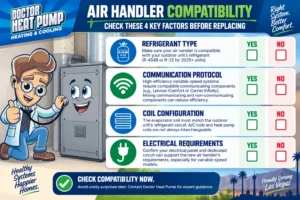
Refrigerant type
New outdoor units manufactured from 2025 onward use R-454B or R-32 refrigerant rather than R-410A, which is being phased out. An older air handler designed for R-410A may not be compatible with a new outdoor unit using the newer refrigerant. This is one of the most common compatibility issues in 2026 replacement projects.
Communication protocol
High-efficiency variable-speed heat pump systems use communicating technology — the outdoor unit, air handler, and thermostat exchange data continuously to optimize performance. A communicating outdoor unit paired with a non-communicating air handler loses most of its variable-speed efficiency benefits. The system defaults to basic single-stage operation regardless of the outdoor unit’s capabilities.
For Lennox systems, this means pairing a communicating outdoor unit with a compatible communicating air handler and the iComfort thermostat. For Carrier systems, the Infinity series components need to work together. Mixing communicating and non-communicating components from the same brand — or mixing brands — typically results in a system that underperforms its rated efficiency significantly.
Coil configuration
The evaporator coil inside the air handler must match the outdoor unit’s refrigerant circuit configuration. A/C coils and heat pump coils are not always interchangeable. Always confirm coil compatibility before purchasing a replacement air handler.
Electrical requirements
High-efficiency air handlers — particularly those with variable-speed blower motors — have specific electrical requirements that older units didn’t have. Confirm your electrical panel and the dedicated circuit serving the air handler can support the new unit’s requirements before installation.
Should You Replace the Air Handler and Outdoor Unit Together?
This is one of the most common questions we get at Doctor Heat Pump — and the honest answer is: usually yes, with some exceptions.
Replace both when:
- The outdoor unit is being replaced due to compressor failure or end of life
- The existing air handler is more than 12 years old
- The new outdoor unit uses a different refrigerant than the existing air handler
- You’re upgrading to a communicating variable-speed system
- The existing air handler has known issues or deferred maintenance
Consider keeping the existing air handler when:
- It’s relatively new — less than 5 to 7 years old — and in good condition
- The refrigerant type is compatible with the new outdoor unit
- It’s a non-communicating system and you’re replacing with non-communicating equipment
- A professional assessment confirms it’s in excellent condition
The financial temptation to keep the existing air handler when replacing the outdoor unit is understandable — it reduces the upfront cost. But mismatched equipment, refrigerant incompatibility, or a declining air handler can undercut the efficiency and reliability of a brand-new outdoor unit. In many cases the savings aren’t worth the trade-off.
When in doubt, ask your contractor to assess the air handler’s condition as part of any outdoor unit replacement quote. A good contractor gives you an honest recommendation either way — not a default recommendation to replace everything.
Air Handler Replacement Cost in Las Vegas
Air handler replacement costs vary based on capacity, efficiency rating, and whether it’s being replaced as a standalone unit or as part of a full system replacement.
| Air Handler Type | Estimated Installed Cost |
|---|---|
| Standard efficiency air handler | $1,200 – $2,500 |
| High-efficiency variable-speed air handler | $2,500 – $4,500 |
| Air handler as part of full system replacement | Typically bundled — ask for itemized quote |
These ranges include the air handler unit and installation labor. They don’t include any ductwork modifications, electrical upgrades, or auxiliary heat strip replacement that may be identified during the installation.
Why Las Vegas Homeowners Trust Doctor Heat Pump
Doctor Heat Pump is a local, family-owned HVAC company serving Las Vegas, Henderson, and North Las Vegas. We handle the full range of heat pump work — from emergency repair calls to complete system replacements — and air handler assessment is part of every outdoor unit replacement conversation we have with homeowners.
When you call us about air handler service or replacement, we start with an honest assessment of your existing equipment. We check compatibility, evaluate condition, and give you a clear picture of whether replacement makes sense for your specific situation — without pushing you toward a decision that benefits us more than you.
Frequently Asked Questions
How long does a heat pump air handler last in Las Vegas?
With proper maintenance, most air handlers last 15 to 20 years. Las Vegas systems run more hours per year than systems in moderate climates, which can push toward the lower end of that range. Annual professional service that includes coil cleaning and blower motor inspection helps maximize air handler lifespan. For a full maintenance checklist, see our guide on heat pump maintenance in Las Vegas.
Can I replace just the air handler without replacing the outdoor unit?
Yes — if the outdoor unit is in good condition and the two units are compatible. This is more common when the air handler has a specific failure — a burned-out blower motor, a damaged coil — while the outdoor unit still has useful life remaining. Always confirm compatibility before proceeding.
Does the air handler brand have to match the outdoor unit brand?
For basic non-communicating systems, mismatched brands can sometimes work — but it’s not recommended and may affect warranty coverage. For communicating variable-speed systems, matched brands are essentially required to achieve the efficiency ratings the system is designed for.
What maintenance does an air handler need?
Monthly filter changes are the most important homeowner task. Professional service should include annual evaporator coil cleaning, blower motor inspection, condensate drain flushing, and electrical connection checks. These are typically included in a standard HVAC service visit.
Where is the air handler located in a Las Vegas home?
Most Las Vegas homes have the air handler in a utility closet, garage, or attic. Some older homes have them in a dedicated mechanical room. Rooftop package units — common in Las Vegas — combine the air handler and outdoor unit in a single cabinet on the roof.
Have Questions About Your Heat Pump Air Handler?
Whether you’re dealing with a specific air handler problem or trying to figure out whether yours needs replacement alongside a new outdoor unit, Doctor Heat Pump can help you get to the right answer.
Call us at 702-467-7236 or contact us online to schedule an assessment across Las Vegas, Henderson, and North Las Vegas. We’ll evaluate your existing equipment honestly and give you the information you need to make a smart decision.

References
- U.S. Department of Energy — Heat Pump Systems and Components
- ENERGY STAR — Heat Pump Efficiency and Maintenance
- Lennox — Air Handler Systems
- Carrier — Air Handler Products