


You have a bedroom that never cools down, a power bill that keeps climbing, or an old system that is about to quit. Now you are stuck on one question: mini split vs central air, which one should you actually buy?
Most comparisons list pros and cons and then tell you “it depends.” That is true, but it isn’t helpful. What it depends on is usually just three things: the condition of your ductwork, how many rooms need help, and how you use your home.
This guide starts with the problem you are trying to fix and gives you a straight answer for each one, along with real cost ranges, the drawbacks nobody mentions, and the situations where the best answer is both.
Quick Answer: Mini Split vs Central Air, Which Is Better?
Central air is usually the better choice if your home already has ductwork in good condition and you want to cool the whole house. A mini split is usually better if you have no ducts, ducts in poor condition, or one or two problem rooms.
- Good ducts, whole house to cool: Central air or a ducted heat pump
- No ducts: Mini split
- One hot room, casita, garage, or addition: Single-zone mini split
- Bad ducts that can be repaired: Compare the duct repair cost with a mini split quote
- Good central system with one stubborn room: Keep it and add a mini split for that room
What Is the Difference Between a Mini Split and Central Air?
The main difference is ductwork. Central air cools air in one place and pushes it through ducts to every room. A mini split sends refrigerant to one or more indoor units, and each unit cools the room it is in.
According to Lennox, a mini split’s indoor and outdoor units connect through a single 3-inch hole in the outside wall, and one outdoor unit can support up to five indoor units. Central air needs a full duct system, but the equipment stays out of sight and one thermostat runs the house.
A Common Mix-Up: Central Air Can Be a Heat Pump Too
People often compare “a heat pump” with “central air” as if they were opposites. They aren’t. A central system can use either an air conditioner or a heat pump as its outdoor unit. Many mini splits are heat pumps as well. So the real choice is ducted or ductless, not heat pump or no heat pump. Our guide Is a mini split a heat pump? clears this up.
Mini Split vs Central Air: Side-by-Side Comparison
Mini splits win on room-by-room control and avoiding duct losses. Central air wins on hidden equipment, whole-home filtration, and replacement cost when good ducts already exist.
| What Matters | Mini Split | Central Air |
|---|---|---|
| Ductwork | Not needed | Required |
| Temperature control | Each room or zone | Whole home, unless zoning is added |
| Top efficiency | Very high, with no duct losses | High, but depends on duct condition |
| Look inside the home | Visible wall or ceiling units | Only vents are visible |
| Filtration | Small washable filters in each unit | One larger filter, with whole-home air cleaning options |
| Cleaning | Every indoor unit needs it | One filter and one indoor coil |
| Cost for one room | Usually lower | Usually not practical |
| Cost for a whole home with good ducts | Often higher | Often lower |
| Best fit | Additions, casitas, no ducts, problem rooms | Homes with sound ductwork |
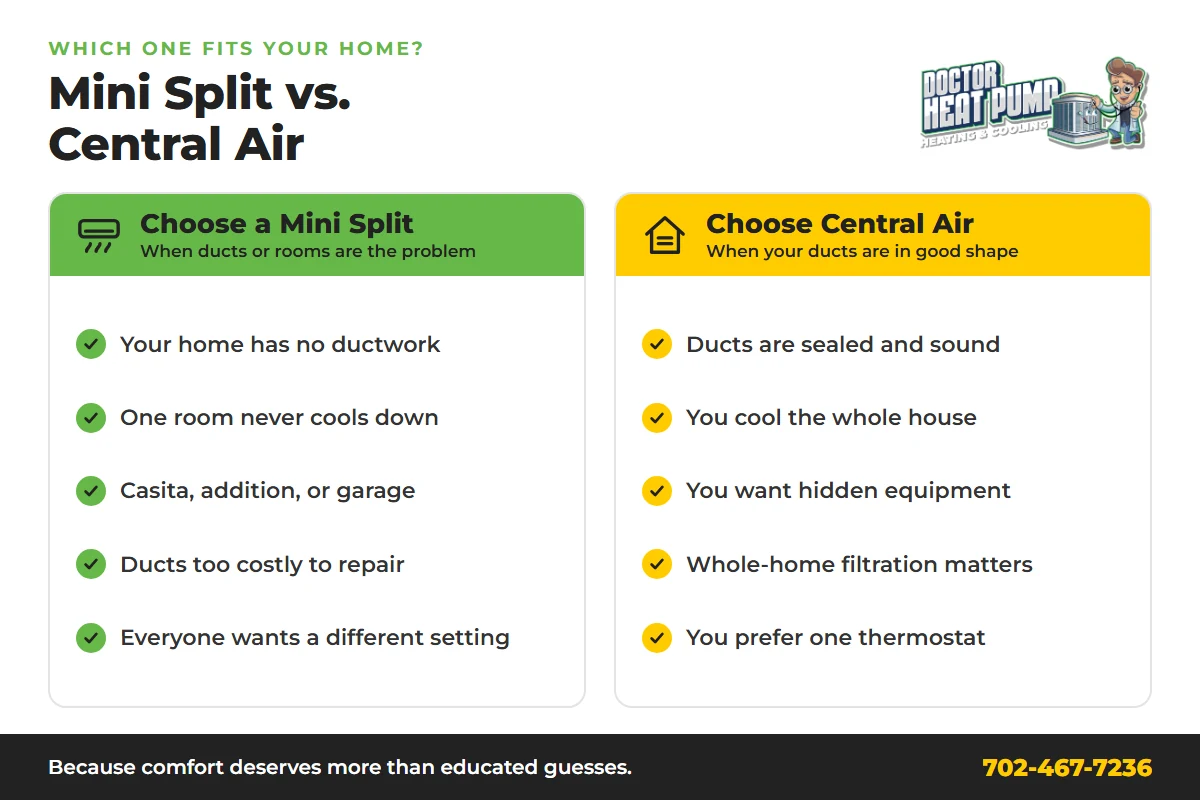
Which System Solves Your Problem?
Match the system to the problem you want to fix, not to the product you saw advertised. Here are the most common reasons homeowners compare the two, with a direct answer for each.
“One Room Is Always Too Hot”
Try the cheap fixes first, then consider a single-zone mini split. A hot room is often an airflow problem, such as a disconnected duct, a closed damper, a crushed flex line, or a missing return. Have the airflow measured before you buy anything. If the ducts are fine and the room still can’t keep up because of sun exposure or its location, a mini split for that room is usually simpler than replacing the whole system.
“My Power Bill Is Too High”
Check your ducts and your current system’s condition before assuming you need a different type of system. Duct leaks, dirty coils, and a wrong refrigerant charge can make a good central system look bad. If your ducts are leaking badly and can’t be fixed at a reasonable cost, going ductless removes that loss completely. Mini splits can also save energy when you only cool the rooms you use.
“I Am Adding a Room, Casita, or Converting the Garage”
A mini split is usually the right answer. Extending ducts from a central system that wasn’t sized for the extra space can leave the whole house short on air. A mini split cools and heats the new space without touching the existing system. ENERGY STAR lists additions and outbuildings among the best uses for mini splits.
“My Home Has No Ductwork”
Go ductless in most cases. Adding ducts to a finished home can mean opening walls and ceilings. Carrier notes that construction costs can be significant when you add central air to an older house without ducts.
“My Central AC Died and the Ducts Are Fine”
Replace it with central air or a ducted heat pump. Carrier says that if your home already has ductwork, a new central AC is typically more affordable than a multi-zone mini split. A ducted heat pump is worth a look here, since it can heat the home too. See whether heat pumps can use your existing ductwork.
“We All Want Different Temperatures”
Mini splits do this best. Each indoor unit has its own setting. Central air can offer zoning too, but it needs dampers and extra controls. One limit to know: on a standard multi-zone mini split, every room has to be in the same mode, so one room can’t heat while another cools.
“Someone Has Allergies, or We Fight Dust All the Time”
Central air has the edge for whole-home filtration. Carrier notes that mini split filters may not offer the same whole-home filtration as a central system with an advanced media filter. If dust is your main complaint, ask about filtration and duct sealing first. Learn more about our indoor air quality services.
“I Don’t Want a Box on My Wall”
Choose central air, or ask about less visible mini splits. Ceiling cassettes, floor-mounted units, and ducted mini splits are all available. They can cost more, so ask for both options in your quote.
“The System Is Too Loud at Night”
A mini split can be very quiet, but so can a well-designed central system. Lennox says its mini split indoor units can run as low as 20 decibels. If your central system roars, undersized return ducts may be the real cause.
Mini Split vs Central Air Cost: How Much Is Each?
A single-zone mini split usually costs less than a central system, but a whole-home multi-zone mini split often costs more than replacing central air on existing ducts. These are general 2026 Las Vegas ranges for installed systems, not quotes.
| System | General Installed Range |
|---|---|
| Single-zone mini split | $3,000 – $5,500 |
| Two-zone mini split | $5,500 – $9,000 |
| Three-zone mini split | $8,000 – $13,000 |
| Four-zone mini split | $10,000 – $16,000 |
| Standard central AC, existing ducts | $4,500 – $7,500 |
| High-efficiency central AC, existing ducts | $7,000 – $12,000 |
| Ducted heat pump, existing ducts | $5,500 – $10,000 |
Three things can move these numbers a lot:
- Ductwork. New ducts or major duct repairs add to the cost of central air and should be quoted separately.
- Electrical work. Some homes need a new circuit or a panel upgrade.
- Number of indoor units. Every zone adds equipment, labor, and future maintenance.
Is There Still a Federal Tax Credit?
Not for systems installed in 2026 under the Energy Efficient Home Improvement Credit. The IRS says that credit can be claimed for improvements made through December 31, 2025. Some older articles and product pages still show a later date, so check with the IRS or your tax professional. Ask NV Energy and your contractor about current utility rebates before you sign.
Mini Split vs Central Air Efficiency: Which Saves More?
A mini split is usually more efficient, mainly because it has no ducts to leak. ENERGY STAR says that in a typical house, about 20 to 30 percent of the air that moves through the duct system is lost to leaks, holes, and poorly connected ducts.
In Las Vegas, ducts often run through the attic, one of the hottest places in the house in summer. Cool air that leaks there is money you never feel.
Still, the rating on the box is only part of the story:
- Ratings overlap. Carrier lists mini splits up to 35.1 SEER2 and central air up to 21. Lennox lists up to 28.1 for its mini splits and 25.8 for its central AC. Compare the exact models you are quoted.
- Multi-zone ratings can be lower. The highest numbers usually belong to single-zone models.
- Sealed ducts narrow the gap. A good central system on tight, insulated ducts can perform very well.
- Installation decides the result. Wrong size or wrong charge can erase the advantage of either system.
Not sure about your ducts? Check these signs your ductwork needs repair or replacement.

Mini Split vs Central Air in Las Vegas Heat: Can Both Keep Up?
Yes, both can handle Las Vegas summers when they are sized correctly, but you need to check the capacity at high outdoor temperatures. Every air conditioner, ducted or ductless, loses some cooling capacity as it gets hotter outside. The number on the brochure isn’t always what you get on the hottest afternoon of the year.
Before you choose either system, ask your contractor three questions:
- What is this model’s rated outdoor operating range for cooling?
- How much cooling does it deliver at our summer design temperature, not just at the standard test temperature?
- Where will the outdoor unit sit, and will it get shade and enough open space?
Dust matters too. Outdoor coils and mini split filters collect it quickly here, so plan on regular cleaning whichever system you pick.
What Are the Downsides of a Mini Split?
The main downsides of a mini split are visible indoor units, more pieces to clean, and a higher price when you need many zones. Know these before you commit:
- More maintenance points. Four indoor units mean four sets of filters, four coils, and four drains.
- Drain problems. Each indoor unit makes water in cooling mode. A blocked drain can drip down the wall.
- Closed doors block cooling. A unit in the hallway won’t reliably cool a bedroom with the door shut.
- Multi-zone oversizing. If a large outdoor unit serves one small room at a time, it can turn on and off too often. Learn why short cycling is hard on equipment.
- One outdoor unit, several rooms. If a multi-zone outdoor unit fails, every room connected to it loses cooling.
What Are the Downsides of Central Air?
The main downsides of central air are duct losses, limited room control, and the high cost of adding ducts where none exist.
- It is only as good as the ducts. New equipment on leaky ducts can still mean hot rooms and high bills.
- You cool empty rooms. Without zoning, the whole house follows one thermostat.
- Two-story homes can be uneven. One thermostat downstairs can’t see how hot it is upstairs.
- One system for the whole home. If it fails in July, the whole house gets hot.
Can You Have Both a Mini Split and Central Air?
Yes, and for many homes it is the smartest choice. If your central system is healthy and only one area is a problem, adding a single-zone mini split can fix that area without replacing everything.
A combined setup often makes sense when:
- An upstairs bedroom or bonus room never cools, even after airflow is corrected
- You work from home and want to cool one office during the day
- You have a casita, workshop, or converted garage
- Your central system has years left and you don’t want to replace it early
If your system is aging, read about heat pump lifespan before you decide how much to invest in it.
How Do You Decide on Mini Split vs Central Air? A 5-Step Checklist
Work through these steps in order, and the right choice usually becomes clear.
- Name the problem. Is it the whole house, one room, the bill, or a dead system?
- Test the ducts. Ask for measured airflow and leakage, not a quick look.
- Get a load calculation. ENERGY STAR says your contractor should verify the size with Manual J. Read more on what size heat pump you need.
- Compare two written quotes. One ducted, one ductless, each with model numbers, duct work, electrical work, and warranty terms.
- Ask for proof. How will the installer show the system meets manufacturer specification when the job is done?
Our guide to choosing among HVAC companies in Las Vegas shows how to check a license and spot red flags. You can also avoid the most common installation problems by knowing what to look for.
Want to go deeper on one option? See our guides to how a mini split heat pump works, ductless mini split vs. central heat pump, and Las Vegas AC installation.
Why Las Vegas Homeowners Choose Doctor Heat Pump
Doctor Heat Pump is a family-owned company of certified heat pump specialists. We work on ducted and ductless systems, so we aren’t trying to push your home toward one answer.
Through our Clinical Comfort Method™, we start with a Comfort Exam and take your system’s vitals before we recommend anything. You receive a Treatment Plan with clear options, and we recommend what your home needs, never the biggest sale.
When the work is done, you receive a Comfort Diagnosis with the findings, results, and photos. Every system we install or service is verified to manufacturer specification. If it doesn’t meet the standard, we make it right. Already have a quote for a mini split or a new central system? Ask us for a Second Opinion.

Frequently Asked Questions
Is it cheaper to install a mini split or central air?
For one room, a mini split is usually cheaper. For a whole home that already has good ductwork, replacing central air is often cheaper than installing a multi-zone mini split.
Are mini splits cheaper to run than central air?
Often, yes. Carrier says mini splits are generally cheaper to run because they avoid duct losses and let you turn off cooling in empty rooms. Sealed ducts and a high-efficiency central system can narrow the difference.
Can a mini split cool an entire house?
Yes, with multiple indoor units. Most rooms with a closed door need their own unit, so the cost rises with the number of rooms.
Should I replace my central air with a mini split?
It makes sense if your ducts are in poor condition and costly to fix, or if you want room-by-room control. If your ducts are sound, a new central system or ducted heat pump is often the more affordable upgrade.
Do mini splits work when it is over 110 degrees?
Many models are designed to, but capacity drops as outdoor temperature rises. Check the model’s rated operating range and its cooling capacity at high temperatures before you buy.
Can a mini split heat one room and cool another?
Not with a standard multi-zone system. All rooms share one outdoor unit and must be in the same mode. Separate single-zone systems can run in different modes.
How often should mini split filters be cleaned?
Check them about once a month, and more often in dusty conditions. Professional cleaning of the coils and drains should be part of your yearly maintenance. See whether an HVAC maintenance plan is worth it for you.
Still Deciding Between a Mini Split and Central Air?
The right answer is in your ducts, your rooms, and your measurements. We can test all three and show you the numbers before you spend anything on new equipment.
Call Doctor Heat Pump at 702-467-7236 or contact us online to schedule a Comfort Exam or a Second Opinion. Explore our heat pump installation and AC replacement services.
Because comfort deserves more than educated guesses.