
Most Las Vegas homeowners run their heat pump every single day — for months at a time — without ever thinking about what’s actually happening inside the equipment. That’s fine. You don’t need to understand your heat pump to use it. But when something goes wrong, when a technician mentions refrigerant pressure or a reversing valve, or when you’re trying to decide between systems, understanding the basics helps you make smarter decisions. At Doctor Heat Pump, we believe a well-informed homeowner is always a better customer — for us and for every contractor they work with.
This guide explains how the heat pump refrigeration cycle works in plain English. No engineering degree required.
The Core Idea: Moving Heat, Not Making It
Before diving into the cycle itself, one concept makes everything else easier to understand. A heat pump doesn’t generate heat by burning fuel. It doesn’t create cold air either. It moves heat from one place to another using refrigerant and a compressor.
In summer, it moves heat from inside your home to the outside. In winter, it reverses and moves heat from the outside air into your home. That’s it. Everything else — the components, the pressures, the refrigerant states — is just the mechanics of how that heat movement happens.
This is why heat pumps are significantly more efficient than systems that generate heat through combustion or electrical resistance. Moving heat requires far less energy than creating it. In Las Vegas, where your system runs heavily for months, that efficiency advantage translates directly into a lower NV Energy bill.
The Four Key Components
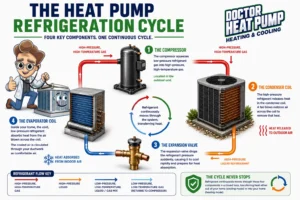
The heat pump refrigeration cycle relies on four main components working in sequence. Understanding what each one does makes the full cycle much easier to follow.
The Compressor
The compressor is the engine of the system. It takes low-pressure refrigerant gas and compresses it into high-pressure, high-temperature gas. This compression is what makes heat transfer possible. The compressor is located in the outdoor unit and is the most mechanically complex — and most expensive — component in the system.
The Condenser Coil
The condenser coil is a network of copper or aluminum tubing where the high-pressure refrigerant releases its heat. In cooling mode, this coil is outside — the heat extracted from your home is released into the outdoor air here. A fan moves air across the coil to speed up the heat release process.
The Expansion Valve
After the condenser coil, the refrigerant is still in liquid form but under high pressure. The expansion valve dramatically reduces that pressure, which causes the refrigerant to cool rapidly. This is where the refrigerant becomes capable of absorbing heat from your home.
The Evaporator Coil
The evaporator coil is inside your home — in the air handler. The cold, low-pressure refrigerant flowing through it absorbs heat from the air being blown across the coil. That air is then circulated through your ductwork as cooled air. The refrigerant, now carrying the heat it absorbed, travels back to the compressor to start the cycle again.
The Refrigeration Cycle Step by Step
Now that the components are clear, here’s the full cycle from start to finish.
Step 1: Compression
The cycle begins at the compressor. Low-pressure refrigerant gas enters the compressor from the evaporator coil. The compressor squeezes that gas to a much higher pressure. Compressing gas generates heat — so the refrigerant exits the compressor as a high-pressure, high-temperature gas. Think of it like a bicycle pump getting warm when you use it.
Step 2: Condensation
The hot, high-pressure gas travels to the condenser coil. A fan blows air across the coil. The refrigerant releases its heat to that air and condenses from a gas into a liquid — still under high pressure. In cooling mode, this heat release happens outside your home. In Las Vegas, the outdoor unit is working against extremely hot ambient air during summer. This is why EER2 ratings — which measure efficiency specifically at high outdoor temperatures — matter more here than in moderate climates.
Step 3: Expansion
The high-pressure liquid refrigerant passes through the expansion valve. The sudden pressure drop causes the refrigerant to cool dramatically — it becomes a cold, low-pressure mixture of liquid and vapor. This is the state it needs to be in to absorb heat from your home.
Step 4: Evaporation
The cold refrigerant enters the evaporator coil inside your home. Warm indoor air is blown across the coil. The refrigerant absorbs the heat from that air and evaporates — converting back from liquid to gas. The now-cooled air is distributed through your ductwork. The refrigerant, carrying the heat it absorbed, travels back to the compressor — and the cycle repeats.
This cycle runs continuously while the system is operating. In a variable-speed heat pump, the compressor modulates its speed to run the cycle faster or slower based on how much cooling or heating is needed. In a single-stage system, the cycle runs at the same speed every time — full capacity or nothing.
How the Reversing Valve Changes Everything
Here’s what makes a heat pump different from a standard air conditioner. A heat pump can reverse the refrigeration cycle — running it in the opposite direction to provide heating instead of cooling.
The component that makes this possible is the reversing valve. It’s a four-way valve located in the outdoor unit that changes the direction refrigerant flows through the system. In cooling mode, the outdoor coil acts as the condenser — releasing heat outside. In heating mode, the valve reverses the flow so the outdoor coil acts as the evaporator — absorbing heat from the outside air — and the indoor coil acts as the condenser, releasing that heat inside your home.
This is the concept that surprises most people. Even in cold weather, there’s heat energy in outdoor air — heat pumps can extract it down to surprisingly low temperatures. In Las Vegas, where winter overnight temperatures typically stay in the 35°F to 50°F range, a heat pump extracts outdoor heat efficiently for virtually the entire heating season.
The reversing valve is controlled by your thermostat — specifically the O or B terminal wire that heat pump thermostats use. This is why using a standard AC thermostat with a heat pump causes problems. The standard thermostat has no way to control the reversing valve.
What Refrigerant Actually Is
Refrigerant is the working fluid that carries heat through the cycle. It’s engineered to change states — from liquid to gas and back — at the specific temperatures and pressures the system operates at. Without refrigerant, the cycle can’t happen.
R-410A has been the standard refrigerant in residential heat pumps for the past two decades. It’s being phased out under EPA regulations due to its global warming potential. New systems are transitioning to R-454B and R-32, which have significantly lower environmental impact. If you’re buying a new heat pump in 2026, confirm which refrigerant it uses — this affects future service costs and parts availability.
R-22 is the older refrigerant used in systems manufactured before 2010. It was phased out of production in 2020. If your system still uses R-22 and develops a refrigerant leak, recharging it is extremely expensive due to limited supply. A system old enough to use R-22 is almost always a replacement candidate.
Refrigerant doesn’t get used up in normal operation. A properly sealed system holds its charge indefinitely. Low refrigerant always means a leak somewhere in the system — not normal depletion.
Why the Refrigeration Cycle Matters for Maintenance
Understanding the cycle helps you understand why certain maintenance tasks matter.
Clean coils are essential
Both the condenser coil and the evaporator coil need to be clean to transfer heat efficiently. A dirty condenser coil can’t release heat effectively — the refrigerant stays hotter, the compressor works harder, and efficiency drops. In Las Vegas, desert dust coats condenser coils rapidly. Annual professional cleaning is essential.
Airflow restrictions hurt the whole cycle
The evaporator coil depends on adequate airflow to absorb heat from indoor air. A clogged filter restricts that airflow. Less air across the coil means less heat absorption. The refrigerant doesn’t absorb enough heat, returns to the compressor too cold, and the system runs at abnormal pressures. Over time this damages the compressor. Monthly filter checks in Las Vegas are not optional.
Refrigerant charge must be correct
Too little refrigerant and the system can’t absorb enough heat — performance drops and the compressor runs hot. Too much refrigerant and pressures climb dangerously — the system can shut down on safety or sustain damage. Refrigerant charge should only be checked and adjusted by a licensed technician with the right equipment.
The compressor needs proper lubrication
Refrigerant carries the oil that lubricates the compressor’s internal components. Low refrigerant means low lubrication. Over time, a system running low on refrigerant damages its own compressor from the inside. This is why addressing refrigerant leaks promptly matters — it protects the most expensive component in the system.
For a complete look at what professional maintenance should include, see our guide on heat pump service in Las Vegas.
Why Las Vegas Homeowners Choose Doctor Heat Pump
Doctor Heat Pump is a local, family-owned HVAC company serving Las Vegas, Henderson, and North Las Vegas. We specialize in heat pump installation, heat pump repair, and service across the Las Vegas Valley.
When something goes wrong with your heat pump, you deserve a technician who can explain what happened and why — not just hand you a repair quote. That’s the standard we hold ourselves to with every service call. We want every Las Vegas homeowner we work with to understand their system well enough to make confident decisions about it.
Frequently Asked Questions
Does refrigerant get used up over time?
No. Refrigerant circulates in a closed loop and isn’t consumed during normal operation. A system that’s low on refrigerant has a leak somewhere. Topping off refrigerant without finding and fixing the leak is a short-term fix that delays a bigger problem.
What happens if my heat pump runs low on refrigerant?
Performance drops, the system runs inefficiently, and the compressor is at risk of damage from inadequate lubrication. The indoor coil may ice over. If you notice reduced cooling, higher bills, or ice on the unit, call for service — don’t run the system and hope it improves.
How do I know what refrigerant my heat pump uses?
Check the data plate on the outdoor unit — it lists the refrigerant type and the required charge amount. Your technician can also confirm this during a service visit. If your system uses R-22, a replacement conversation is worth having given the refrigerant’s phase-out status.
Can I add refrigerant to my heat pump myself?
No. Refrigerant handling requires EPA 608 certification. Purchasing refrigerant without this certification is illegal for most refrigerant types. Incorrect refrigerant charge — in either direction — can damage the compressor and other components. Always use a licensed technician for refrigerant service.
Why does my heat pump blow warm air briefly at startup in heating mode?
This is normal. At startup, the refrigerant in the system hasn’t fully pressurized yet. It takes a minute or two for the cycle to stabilize and the indoor coil to begin releasing heat effectively. If warm air continues for more than a few minutes in heating mode, that’s worth investigating.
Have Questions About Your Heat Pump System?
Understanding how your heat pump works is the first step toward maintaining it well and making smart decisions when something goes wrong. If you have questions about your specific system — or if you’re noticing signs that something isn’t right — Doctor Heat Pump is here to help.
Call us at 702-467-7236 or contact us online to schedule a diagnostic visit or service call across Las Vegas, Henderson, and North Las Vegas. We’ll explain exactly what we find — in plain English (or Spanish!).
References
- U.S. Department of Energy — How Heat Pumps Work
- ENERGY STAR — Heat Pump Systems
- Lennox — Heat Pump Technology and Components