

When you invest $7,000 to $15,000 in a new heat pump or air conditioning system, the warranty is one of the most important parts of that purchase — and one of the least understood. Most Las Vegas homeowners know their new system comes with some kind of warranty, but very few know exactly what it covers, what voids it, and what they need to do to keep it in force. The difference between a covered compressor replacement and a $2,000 out-of-pocket bill often comes down to paperwork and maintenance records. At Doctor Heat Pump, we help homeowners understand their HVAC warranty before they need to use it — because by the time something fails, it’s too late to fix a documentation gap.
This guide covers how HVAC warranties work, what the major brands actually cover, what voids coverage, and what Las Vegas homeowners need to do to protect their investment.
How HVAC Warranties Work: The Basics
Most HVAC systems come with multiple overlapping warranties that cover different components and different parties.
Manufacturer’s warranty covers the equipment itself — the parts that make up the heat pump or air conditioning system. This is the warranty from Lennox, Carrier, Trane, or whichever brand you purchased. It runs for a specified period from the installation date and covers defective parts.
Labor warranty covers the cost of the technician’s time to diagnose and replace a covered component. This is separate from the parts warranty and is typically provided by the installing contractor rather than the manufacturer. Labor warranties are usually shorter than parts warranties — often one to two years — and vary significantly between contractors. Always ask specifically what labor warranty the contractor provides.
Extended warranty or service agreement is optional additional coverage available from the manufacturer, the contractor, or a third-party provider. These programs extend the coverage period, sometimes add labor coverage, and may include additional benefits like priority service.
Understanding which warranty covers what — and who to call when something fails — prevents frustration at the worst possible time.
What the Major Brands Cover
Lennox Warranty
Lennox offers tiered warranty coverage that depends on product registration and the specific product line purchased.
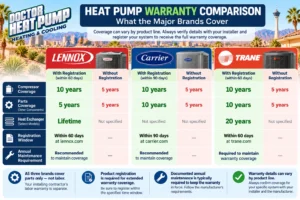
With registration within 60 days of installation:
- Limited warranty on the compressor: 10 years
- Limited warranty on covered components: 5 years
- Heat exchanger (on applicable products): Lifetime
Without registration:
- Compressor: 5 years
- Covered components: 5 years
The registration requirement is important and often overlooked. Lennox requires the homeowner to register the product at lennox.com within 60 days of installation to activate the extended warranty period. Without registration, coverage reverts to the shorter base warranty. Your installer should register the product on your behalf at installation — but confirm this happened and get the registration confirmation number.
Lennox’s warranty covers parts only — not labor. The installing contractor’s labor warranty is separate.
Carrier Warranty
Carrier’s warranty structure is similar to Lennox with registration as a key factor.
With registration:
- Compressor: 10 years
- Covered components: 10 years
Without registration:
- Compressor: 5 years
- Covered components: 5 years
Carrier requires registration within 90 days of installation. Registration is completed at carrier.com or through the installing dealer. As with Lennox, the warranty covers parts only — labor is the contractor’s responsibility.
Carrier’s Infinity series products — their premium variable-speed line — carry the same warranty structure but with additional performance guarantees tied to the Infinity system components being used together. Mixing Infinity outdoor units with non-Infinity air handlers or thermostats may affect both performance and warranty coverage.
Trane Warranty
Trane’s base warranty is somewhat more generous without registration than Lennox and Carrier, but registration still extends coverage significantly.
With registration:
- Compressor: 10 years
- Covered components: 10 years
- Heat exchanger (on applicable products): 20 years
Without registration:
- Compressor: 5 years
- Covered components: 5 years
Trane requires registration within 60 days of installation. Registration is completed at trane.com. Trane’s warranty, like the others, covers parts only and requires documented annual maintenance to remain in force.
What HVAC Warranties Do NOT Cover
Understanding exclusions is just as important as understanding coverage. Most HVAC warranties explicitly exclude the following.
Labor costs. Manufacturer warranties cover replacement parts — not the technician’s time to diagnose and install them. Labor costs on a compressor replacement can run $500 to $1,000 even when the part itself is covered under warranty. This is why the contractor’s labor warranty and optional extended warranties matter.
Refrigerant. Refrigerant is typically not covered under standard manufacturer warranties. If a refrigerant leak repair requires recharging the system, the refrigerant cost is usually the homeowner’s responsibility even if the leak repair itself is covered.
Normal wear and maintenance items. Filters, belts, and other consumable components that require regular replacement are not covered. Neither is cleaning of coils or drain lines — these are maintenance items.
Damage from improper installation. If the system was installed incorrectly — wrong refrigerant charge, improperly sized ductwork, incorrect electrical connections — resulting damage is typically not covered. This is one of the strongest arguments for choosing a qualified, licensed installer. A poorly installed premium system may have its warranty voided by the installation errors.
Damage from lack of maintenance. This is the most consequential exclusion for Las Vegas homeowners. All major HVAC manufacturers require documented annual professional maintenance as a condition of warranty coverage. A compressor that fails after years without professional service may not be covered — even if it’s within the warranty period — if you can’t provide maintenance records.
Damage from improper use or acts of nature. Power surges, flooding, physical damage, and similar events are not covered under standard equipment warranties. Homeowner’s insurance may cover some of these scenarios — HVAC warranties do not.
The Maintenance Documentation Requirement
This is the warranty provision that Las Vegas homeowners most frequently overlook — and the one that most often results in denied claims.
Lennox, Carrier, and Trane all require documented annual professional maintenance as a condition of their warranties. The specific language varies by manufacturer and product, but the practical requirement is the same: if a covered component fails and you cannot produce records showing the system was professionally maintained annually, the manufacturer may deny the warranty claim.
What counts as documentation:
- Written service reports from each professional maintenance visit
- The technician’s name and company
- The date of service
- What was inspected and performed
What doesn’t count:
- Your own recollection of having the system serviced
- A receipt showing you paid for service without a detailed report
- Manufacturer or installer communications that don’t document the actual service performed
Keep every service report in a dedicated folder — physical or digital. Date them and file them in order. If you’ve had the same contractor service the system for multiple years, ask them whether they maintain service records you can access.
For Las Vegas homeowners, this documentation requirement makes consistent annual service — spring and fall for heat pumps — not just a maintenance best practice but a financial obligation tied to a warranty worth thousands of dollars.
Contractor Labor Warranties: What to Ask
The manufacturer’s warranty covers parts. The contractor’s warranty covers labor. Both matter — and labor costs on a covered repair can be significant.
When evaluating contractors for a new installation, ask specifically:
- What labor warranty do you provide on this installation?
- Does your labor warranty cover diagnostic time as well as replacement labor?
- Is the labor warranty transferable if I sell the home?
- What documentation do I receive that confirms the labor warranty terms?
A reputable contractor provides labor warranty terms in writing as part of the installation contract. One to two years is common. Some contractors offer extended labor coverage as part of a maintenance plan.
Be cautious of verbal labor warranty commitments. If it’s not in writing, it’s not enforceable.
Extended Warranties: Are They Worth It?
Extended warranty programs — sometimes called service agreements or protection plans — extend coverage beyond the manufacturer’s standard warranty period and often add labor coverage. The value depends on the specific program and your situation.
When extended coverage makes sense:
- You plan to stay in the home for the full coverage period
- The program includes labor coverage, not just parts
- The annual cost is reasonable relative to potential repair costs
- The provider has a reliable track record and clear claims process
When it may not be worth it:
- You’ve already registered your system and have full 10-year parts coverage
- The program duplicates coverage you already have
- The annual cost is disproportionate to the coverage provided
- The program has exclusions that effectively eliminate the scenarios you’re most concerned about
Read the fine print before purchasing any extended coverage. The most important thing to confirm is whether the program covers labor in addition to parts — because parts-only extended coverage on top of an existing manufacturer warranty adds limited value.
Warranty Considerations Specific to Las Vegas
Las Vegas’s climate creates a few warranty considerations worth noting specifically.
High operating hours accelerate component wear. A heat pump in Las Vegas runs more hours per year than the same system in a moderate climate. More hours means more wear — and potentially more warranty claims over the life of the coverage period. This makes the full 10-year registered warranty more valuable here than in a city where the system runs half as many hours.
Maintenance documentation is non-negotiable. Las Vegas’s extreme operating conditions make it more likely that components will experience wear-related failures during the warranty period. Maintaining documentation that proves annual professional service protects your ability to make those claims when needed.
Refrigerant phase-out affects older systems. Systems installed before 2025 using R-410A refrigerant are no longer being manufactured with that refrigerant. If a refrigerant leak occurs on a system under warranty, the repair — including the refrigerant charge — is worth understanding in terms of cost allocation. Ask your technician about refrigerant availability and cost for your specific system.
Why Las Vegas Homeowners Choose Doctor Heat Pump
Doctor Heat Pump is a local, family-owned HVAC company serving Las Vegas, Henderson, and North Las Vegas. We specialize in heat pump installation, heat pump service, and repair across the Las Vegas Valley.
Every installation we complete includes product registration, written documentation of the installation, and a service report that begins your maintenance record from day one. We provide written labor warranty terms with every installation and service every major brand — so if your system is under warranty and needs repair, we can work within that framework regardless of who originally installed it.

Frequently Asked Questions
What happens if I didn’t register my heat pump within the required window?
Your coverage reverts to the shorter base warranty period — typically 5 years on parts rather than 10. Some manufacturers offer a grace period or an appeal process, so it’s worth contacting the manufacturer directly if you missed the window. Going forward, document all maintenance visits carefully, as this becomes even more important with reduced coverage.
Does selling my home transfer the HVAC warranty?
It depends on the manufacturer and the product. Some warranties are transferable to a subsequent homeowner — sometimes with a transfer fee and a time limit. Others are non-transferable and void upon sale. Check your specific warranty documentation or contact the manufacturer directly. A transferable warranty can be a selling point worth documenting when listing your home.
My heat pump failed and I can’t find my maintenance records. What do I do?
Contact the contractor who serviced the system and ask whether they maintain service records you can obtain. Contact the manufacturer with the system serial number and explain the situation. Some manufacturers will work with homeowners who can demonstrate good-faith maintenance even without complete records — but this is never guaranteed. Going forward, start and maintain a dedicated records file for every service visit.
Does a heat pump warranty cover the thermostat?
Thermostats are typically covered under a separate, shorter warranty — often one year. Communicating thermostats that are part of a manufacturer’s system — like Lennox iComfort — may have different coverage. Check the documentation for your specific thermostat.
What is the difference between a warranty claim and a service call?
A warranty claim is a request to have a covered part replaced under the manufacturer’s warranty at no cost for the part. A service call is a request for diagnosis and repair that you pay for. To make a warranty claim, you typically need proof of purchase, the system serial number, installation date, and maintenance documentation. Your contractor handles the claim process with the manufacturer on your behalf.
Protect Your HVAC Warranty Before You Need It
The best time to understand your HVAC warranty is before something goes wrong — not during a repair conversation when you discover a coverage gap. Register your system if you haven’t. Start a maintenance records folder today. Confirm your labor warranty terms in writing.
Doctor Heat Pump is here to help Las Vegas, Henderson, and North Las Vegas homeowners get the most from their equipment investment. Call us at 702-467-7236 or contact us online with warranty questions, maintenance scheduling, or repair needs. We’ll make sure you have the documentation you need when it matters most.

References
- U.S. Department of Energy — HVAC Equipment and Warranties
- ENERGY STAR — Heat Pump Products and Coverage
- Lennox — Warranty Information and Registration
- Carrier — Warranty Terms and Registration
- Trane — Warranty Coverage and Registration