

Las Vegas gets more sunshine than almost any other major city in the United States — over 300 days of sun per year, with solar irradiance levels that make rooftop solar one of the most financially compelling home upgrades available in the valley. Pair that with a heat pump system, and you have the foundation for a home that heats and cools itself almost entirely on free energy from the sun. At Doctor Heat Pump, we’re seeing more Las Vegas homeowners make this combination work — and the results on their NV Energy bills speak for themselves.
This guide covers everything you need to know about solar heat pumps — how solar and heat pump systems work together, what makes a heat pump solar-compatible, which systems perform best in the Las Vegas desert climate, and what the real numbers look like when you run the two together.
Why Solar and Heat Pumps Are a Natural Fit
A heat pump and a solar panel system complement each other in a way that no other home energy pairing does. Here’s why.
A heat pump runs on electricity — it doesn’t burn gas or generate its own energy. It moves heat using a refrigerant cycle powered by your electrical panel. That means every kilowatt-hour your solar panels produce can directly offset the electricity your heat pump consumes.
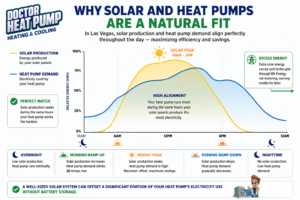
In a moderate climate, this pairing is efficient. In Las Vegas, it’s exceptional. The desert sun peaks during the same hours your heat pump works hardest — mid-morning through late afternoon when outdoor temperatures climb toward 110°F and your system runs at or near full capacity. Solar production and heat pump demand align almost perfectly throughout the Las Vegas cooling season, which means a well-sized solar array can cover a significant portion of your cooling costs without requiring battery storage.
The combination also works in the opposite direction. On mild spring and fall days when solar production is high but cooling demand is low, excess solar energy can be exported back to the grid through NV Energy’s net metering program — earning credits that offset your bill during peak summer months when demand exceeds solar production.
What Makes a Heat Pump Solar-Compatible?
Technically, any electric heat pump is solar-compatible in the sense that solar panels produce electricity and heat pumps consume it. But not all heat pumps work equally well in a solar-integrated home. Several features make a meaningful difference.
Variable-speed compressor
A variable-speed heat pump adjusts its output continuously to match demand rather than cycling on and off at full capacity. This matters for solar integration because variable-speed systems draw a more consistent and manageable electrical load — easier for a solar inverter to supply cleanly than the hard starts and stops of a single-stage system.
Smart grid and demand response compatibility
Some modern heat pumps and their control systems can communicate with the grid or with home energy management systems to shift demand based on solar availability. When solar production is high, the system can pre-cool the home — storing cooling energy in the thermal mass of the structure before peak heat arrives. This is sometimes called solar pre-cooling and it’s particularly effective in Las Vegas.
High SEER2 and EER2 ratings
The more efficiently the heat pump uses electricity, the further your solar production goes. A 20 SEER2 system requires roughly 25% less electricity to produce the same cooling output as a 15 SEER2 system — which means a smaller solar array can cover the same cooling load.
Compatibility with home energy management systems
Platforms like Lennox’s iComfort ecosystem, or third-party systems like Sense or Emporia, allow homeowners to monitor and manage heat pump energy consumption in real time alongside solar production. This visibility helps optimize when and how hard the system runs relative to available solar energy.
How Many Solar Panels Do You Need to Power a Heat Pump in Las Vegas?
This depends on several variables — your heat pump’s efficiency rating, your home’s size and insulation, and your solar system’s output. But here are some general reference points for Las Vegas:
| Home Size | Estimated Annual Heat Pump kWh | Approx. Solar Panels Needed |
|---|---|---|
| 1,500 sq ft | 8,000 – 10,000 kWh | 8 – 10 panels |
| 2,000 sq ft | 11,000 – 14,000 kWh | 11 – 14 panels |
| 2,500 sq ft | 14,000 – 18,000 kWh | 14 – 18 panels |
| 3,000 sq ft | 17,000 – 22,000 kWh | 17 – 22 panels |
These estimates assume a 400-watt panel producing approximately 1,800 to 2,000 kWh annually in the Las Vegas climate — which is conservative given the valley’s exceptional solar resource. A properly oriented south-facing array with minimal shading will typically exceed these estimates.
Important: These numbers represent the solar capacity needed to offset heat pump energy specifically — not total home energy consumption. A whole-home solar system would need to account for all electrical loads including lighting, appliances, water heating, and EV charging if applicable.
Solar Pre-Cooling: The Las Vegas Strategy Worth Knowing
One of the most effective strategies for solar-powered heat pump operation in Las Vegas is solar pre-cooling — running the heat pump harder during peak solar production hours to cool the home below the thermostat setpoint, then allowing the temperature to drift upward slightly during the late afternoon when solar production dips and grid rates peak.
Here’s how it works in practice:
Between 9 AM and 1 PM, solar panels are producing at or near peak output. During this window, the thermostat is set lower than the normal daytime setpoint — say 72°F instead of 76°F — running the heat pump on essentially free solar energy and building a thermal buffer in the home’s structure, furniture, and air.
As the afternoon peak heat arrives between 2 PM and 6 PM — the same window when NV Energy’s peak electricity rates apply — the thermostat setpoint rises back to the normal level. The home’s thermal mass absorbs the heat gradually, and the heat pump runs less during the most expensive and most grid-stressed hours of the day.
The result is a home that stays comfortable throughout the day while shifting most of its energy consumption to the hours when solar production is highest and grid electricity is cheapest or free.
A smart thermostat — particularly one with time-of-use scheduling like the Lennox iComfort S30 or Ecobee SmartThermostat — can automate this strategy completely once it’s configured.
Top Solar-Compatible Heat Pump Systems for Las Vegas
Lennox XP25 with iComfort S30
The Lennox XP25 is our top recommendation for Las Vegas homeowners integrating solar. Its variable-speed compressor achieves SEER2 ratings up to 23.5 — one of the highest available in residential equipment — which maximizes the cooling output per kilowatt-hour of solar electricity consumed. Paired with the iComfort S30 thermostat, it supports solar pre-cooling scheduling and real-time energy management through the iComfort app.
Carrier Infinity 20 VS
The Carrier Infinity 20 VS uses Greenspeed Intelligence variable-speed technology and achieves SEER2 ratings up to 20. Its compatibility with Carrier’s home energy management controls makes it a strong choice for solar-integrated homes, and its proven reliability in hot-climate markets makes it a dependable long-term partner for a rooftop solar investment.
Trane XV21i
The Trane XV21i’s TruComfort variable-speed technology maintains temperature within half a degree of the thermostat setpoint — which matters for solar pre-cooling because precise temperature control maximizes the thermal buffer without overcooling. Its SEER2 ratings reach up to 20 and it’s compatible with Trane’s ComfortLink II smart controls.
Mitsubishi Electric Hyper-Heating Series (Ductless)
For Las Vegas homeowners adding solar to a home with ductless zones — casitas, converted garages, room additions — Mitsubishi’s Hyper-Heating INVERTER ductless systems are among the most efficient ductless options available, with SEER2 ratings reaching into the mid-20s on select models. Their inverter-driven compressors are particularly well-suited to variable solar supply.
Federal Tax Credits for Solar Heat Pump Combinations
Installing both a solar system and a qualifying heat pump in the same year creates a compelling federal tax credit opportunity. In 2026 both technologies qualify for separate credits under the Inflation Reduction Act:
Solar Investment Tax Credit (ITC): 30% of the total solar installation cost with no dollar cap. On a $20,000 solar installation, that’s a $6,000 federal tax credit.
Heat Pump Tax Credit: 30% of the qualifying heat pump installation cost, capped at $2,000 per year.
These credits are separate and can both be claimed in the same tax year, making 2026 a particularly favorable year to make both upgrades simultaneously. For a full breakdown of the heat pump credit specifically, see our guide on the federal heat pump tax credit 2026.
Additionally, NV Energy offers periodic rebates for high-efficiency heat pump systems — stacking these with the federal credits can reduce the combined net cost of the solar plus heat pump package significantly.
Is a Solar Heat Pump Combination Right for Your Las Vegas Home?
The combination makes the most financial sense when:
- Your current electricity bills are high — $200 per month or more during summer is a strong indicator
- You own your home and plan to stay for at least 7 to 10 years to recapture the investment
- Your roof has adequate south or west-facing area without significant shading
- Your current AC or heat pump system is aging and due for replacement anyway
- You’re interested in reducing your dependence on grid electricity long term
The combination makes less sense when your home is already very well insulated and your bills are low, when your roof isn’t well-positioned for solar, or when you’re planning to sell within a few years before the investment pays back.
The honest answer is that for most Las Vegas homeowners with aging HVAC equipment and meaningful summer electricity bills, the math works — especially with the federal tax credits currently available.
Why Las Vegas Homeowners Choose Doctor Heat Pump
Doctor Heat Pump is a local, family-owned HVAC company serving Las Vegas, Henderson, and North Las Vegas. We specialize in heat pump installation, heat pump service, and energy-efficient system design across the Las Vegas Valley.
When you work with Doctor Heat Pump, we take the time to understand your home’s energy profile, your existing or planned solar setup, and your long-term efficiency goals — then recommend the heat pump system that integrates best with your clean energy investment. We work primarily with Lennox for residential installations because of their efficiency leadership and smart control compatibility, and we’re experienced with Carrier, Trane, and Mitsubishi systems as well.
Frequently Asked Questions
Can any heat pump run on solar power?
Yes — any electric heat pump can run on electricity generated by solar panels. However, variable-speed heat pumps with smart thermostat controls extract significantly more value from a solar integration because they can modulate demand to match solar availability and automate pre-cooling strategies.
Do I need battery storage to run my heat pump on solar in Las Vegas?
Not necessarily. In Las Vegas, solar production and heat pump demand align well during daytime hours, so a grid-tied system without batteries can cover a large portion of cooling costs. Battery storage adds the ability to use solar energy after dark and provides backup power during outages — valuable but not required for the basic solar heat pump combination to work well.
Will adding a heat pump increase my solar system size requirement?
>>>>>>>>>>>>>>If you’re adding a heat pump to a home that already has solar, yes — you’ll likely need additional panels to cover the increased electricity consumption. If you’re installing both at once, size the solar system to account for the heat pump load from the start.
How long does it take for a solar heat pump combination to pay for itself in Las Vegas?
>>>>>>>>>>>>>>Payback periods vary based on system costs, available incentives, and electricity rates — but the combination of federal solar and heat pump tax credits, NV Energy rebates, and Las Vegas’s high electricity consumption during summer typically produces payback periods of 7 to 12 years for most households. After payback, the system generates essentially free heating and cooling for its remaining life.
Does Doctor Heat Pump install solar panels?
We specialize in heat pump systems specifically. For the solar panel installation side, we recommend working with a licensed Nevada solar contractor and coordinating the two installations to ensure the systems are properly sized and compatible.
Ready to Explore a Solar Heat Pump for Your Las Vegas Home?
Las Vegas is one of the best places in the country to run a heat pump on solar power. And 2026 is one of the best years to make the investment with federal tax credits still fully available. If you’re replacing an aging system or planning a solar installation, it’s worth having the conversation about how the two work together before making either decision independently.
Doctor Heat Pump is here to help with the heat pump side of the equation. Call us at 702-467-7236 or contact us online to schedule a consultation. We’ll help you choose a system that gets the most out of your solar investment — today and for years to come.

References
- U.S. Department of Energy — Solar Energy and Heat Pumps
- ENERGY STAR — Most Efficient Heat Pump Products
- Lennox — Variable Speed Heat Pump Systems
- National Renewable Energy Laboratory — Residential Solar and HVAC Integration