
In most cities, a broken air conditioner or heater is an inconvenience. In Las Vegas, it can be a health emergency. Summer temperatures that regularly exceed 110°F can make an un-cooled home dangerous within hours — particularly for elderly residents, young children, and anyone with a health condition. Winter nights that drop into the 30s aren’t life-threatening in the same way, but a failed heating system is still urgent when you’re dealing with young children or pets in a cold house.
At Doctor Heat Pump, emergency HVAC repair is something we take seriously — because in this climate, the stakes are different than anywhere else. This guide tells you exactly what to do when your system fails, how to stay safe while you wait for service, and what to expect from an emergency repair call.
What Counts as an HVAC Emergency in Las Vegas?
Not every HVAC problem requires an emergency service call. Understanding the difference helps you make the right decision — and helps you avoid unnecessary emergency premiums when a next-day appointment would serve you just as well.
Genuine emergencies — call immediately:
- System failure during summer when indoor temperatures are climbing toward 90°F or above
- System failure when vulnerable people are in the home — elderly, infants, people with medical conditions
- System failure during a Las Vegas heat advisory or extreme heat event
- System failure accompanied by burning smells, electrical smells, or visible smoke
- A breaker that trips repeatedly when reset — this is a potential fire hazard
- Carbon monoxide detector activation in a home with a gas furnace
Urgent but not emergency — same-day or next-day service:
- System failure during mild Las Vegas weather — spring or fall when indoor temperatures aren’t dangerous
- Significantly reduced performance rather than complete failure
- Unusual noises without other symptoms
- Higher than normal energy bills without comfort impact
Can wait for scheduled service:
- Minor comfort variations between rooms
- System that’s working but running longer cycles than usual
- Thermostat display issues without system impact
Making this distinction before you call helps you communicate clearly with the dispatcher — and potentially saves you the emergency after-hours premium when standard scheduling would work just as well.
What to Do Immediately When Your System Fails
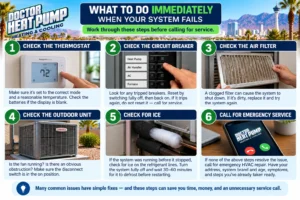
The first few minutes after a system failure matter. Work through these steps before calling for service.
Step 1 — Check the thermostat
Confirm the thermostat is set correctly — right mode, reasonable setpoint, fan on Auto. Check the batteries if the display is blank or unresponsive. A dead thermostat battery is one of the most common causes of apparent system failure — and the fix is a $5 battery, not an emergency service call.
Step 2 — Check the circuit breaker
Go to the electrical panel and look for any tripped breakers associated with the HVAC system — typically labeled as heat pump, air handler, AC, or furnace. A tripped breaker looks different from an on breaker — the switch is in a middle position or visibly moved from the on position. Reset it by switching it fully off and then back on. If it holds, run the system. If it trips again immediately, do not reset it again — call for service.
Step 3 — Check the air filter
A severely clogged filter can cause a system to shut down on safety. Pull the filter and inspect it. If it’s heavily restricted, replace it and try the system again.
Step 4 — Check the outdoor unit
Go outside and look at the outdoor unit. Is the fan running? Is there ice on the unit? Is there an obvious obstruction? Is the disconnect box near the unit in the on position? A disconnect that’s been accidentally switched off — often during yard work or landscaping — is an easy fix.
Step 5 — Check for ice
If the system was running before it stopped, check the refrigerant lines near the indoor unit for ice. A frozen system needs to defrost before it can be restarted. Turn the system off — not to fan only, but fully off — and wait 30 to 60 minutes before attempting a restart.
Step 6 — Call for emergency service
If none of the above steps resolve the issue, call for emergency HVAC repair. Have the following information ready: your address, the system brand and approximate age if you know it, what symptoms you observed before the failure, and what steps you’ve already taken.
Staying Safe While You Wait for Emergency Service
In Las Vegas summer, the time between your call and the technician’s arrival can be critical. These steps help manage indoor temperatures and protect vulnerable household members.
Close blinds and curtains immediately. Direct sun through windows is one of the fastest ways indoor temperatures climb. Close all window coverings — particularly on south and west-facing windows that receive afternoon sun. This alone can slow temperature rise significantly.
Move to the lowest level of the home. Heat rises. The ground floor of a two-story home stays cooler longer than the upper floor. If you have a basement, it will stay even cooler.
Use portable fans strategically. Fans don’t lower air temperature — but they increase evaporative cooling from the skin and make a hot room feel several degrees more comfortable. Position fans to move air across occupied spaces.
Open windows if outdoor temperature is lower than indoor. In the evening and early morning — typically after 9 PM and before 8 AM during Las Vegas summers — outdoor temperatures may be lower than indoor temperatures. Open windows to let cooler air in and push hotter indoor air out.
Identify a cooling center or alternative location. Las Vegas has designated cooling centers that operate during extreme heat events — libraries, community centers, and similar facilities. If indoor temperatures are climbing to genuinely dangerous levels while waiting for service, relocating vulnerable household members is the right call. A hotel room with working AC is a reasonable option for a night.
Hydrate. Heat stress begins with dehydration. Drink water regularly — more than you think you need. Avoid alcohol and caffeine, which accelerate dehydration.
Watch for signs of heat illness. Heavy sweating, rapid pulse, dizziness, confusion, and nausea are signs of heat exhaustion. Confusion, hot dry skin, and loss of consciousness are signs of heat stroke — a medical emergency. If anyone in the home shows these symptoms, call 911, not the HVAC company.
What to Expect From an Emergency HVAC Repair Call
Knowing what happens when the technician arrives helps you make good decisions under pressure.
Expect a diagnostic fee. Most Las Vegas HVAC companies charge a service call or diagnostic fee for emergency visits — typically $75 to $200 for standard business hours, and higher for after-hours, weekend, and holiday calls. This fee covers the technician’s time to diagnose the problem. Ask about this fee before authorizing the visit so there are no surprises.
Expect an after-hours premium. Emergency calls outside normal business hours — evenings, weekends, holidays — typically carry an additional premium on labor rates. This is standard across the industry. Get a clear quote before authorizing repairs.
Get the diagnosis in writing before authorizing repairs. A reputable technician documents what they found and what they’re recommending before any repair work begins. You should understand what failed, why it failed, what the repair involves, and what it will cost — in writing — before saying yes.
Know your right to a second opinion. For major repairs — compressor replacement, coil replacement, full system recommendations — you have the right to get a second opinion before committing. A trustworthy contractor understands this. One who pressures you to decide immediately on an expensive repair in an emergency situation warrants caution.
Ask about the repair vs. replace question. If the failed component is expensive and the system is aging, the emergency is also a forced decision point about the system’s future. A technician who only offers to fix the immediate problem without giving you the full picture isn’t serving your best interests.
Emergency HVAC Repair Costs in Las Vegas
Emergency repair costs vary based on the problem, the time of day, and the contractor. Here are general ranges for common emergency scenarios in 2026:
| Scenario | Typical Cost Range |
|---|---|
| Diagnostic / service call fee (standard hours) | $75 – $150 |
| After-hours emergency premium | $75 – $200 additional |
| Capacitor replacement | $150 – $350 |
| Contactor replacement | $150 – $400 |
| Refrigerant recharge (after leak repair) | $300 – $800 |
| Blower motor replacement | $400 – $700 |
| Compressor replacement | $1,200 – $2,800 |
| Emergency full system replacement | $4,500 – $15,000 |
The most effective way to reduce emergency repair costs isn’t to shop for the cheapest emergency rate — it’s to avoid emergencies through consistent maintenance. Systems that receive annual professional service fail at dramatically lower rates than systems that only get attention when something breaks. For more on what preventive maintenance covers, see our guide on HVAC maintenance plans in Las Vegas.
How to Avoid the Next Emergency
Most HVAC emergency calls aren’t truly random. They develop from small issues that went unaddressed — a capacitor that was borderline during the spring service visit, a refrigerant level that was slightly low, a filter that nobody changed. Consistent maintenance catches these before they become 10 PM emergency calls in July.
Schedule spring and fall maintenance visits. Spring service prepares the system for the cooling season. Fall service prepares it for heating. For heat pumps running year-round, two visits annually is the right standard. For more on fall maintenance specifically, see our guide on fall HVAC maintenance in Las Vegas.
Replace filters monthly. A restricted filter is one of the most common contributors to system failure. Monthly checks during the Las Vegas cooling season take two minutes and prevent a category of failures entirely.
Know your system’s age and condition. A 14-year-old heat pump that’s had intermittent repairs is a system that’s likely to fail at the worst possible time. Having an honest conversation with your technician about system life expectancy — and planning a replacement before the emergency — is one of the highest-value things a Las Vegas homeowner can do.
Have your contractor’s number saved. When an emergency happens, you shouldn’t be searching for an HVAC company at 11 PM with the house at 95°F. Know who you’re going to call before you need to.
Why Las Vegas Homeowners Choose Doctor Heat Pump
Doctor Heat Pump is a local, family-owned HVAC company serving Las Vegas, Henderson, and North Las Vegas. We specialize in heat pump repair, AC repair in Las Vegas, and emergency service across the Las Vegas Valley.
When you call Doctor Heat Pump for emergency service, you get a licensed technician who knows the Las Vegas climate and what it does to HVAC equipment — not a seasonal hire reading from a checklist. We diagnose accurately, quote honestly, and give you the information you need to make a good decision even under pressure.

Frequently Asked Questions
How quickly can I get emergency HVAC repair in Las Vegas?
Response times vary by company and season. During peak summer demand, even emergency calls may have wait times of several hours. Contact us directly at 702-467-7236 for current availability. Having a contractor relationship established before an emergency — rather than searching for anyone available — typically results in faster service.
Is it safe to run my heat pump if it’s making a strange noise?
It depends on the noise. A grinding or screeching sound suggests mechanical failure — turn the system off and call for service. A clicking sound at startup or shutdown is often normal. A new sound that wasn’t there before warrants a call, but you don’t necessarily need to turn the system off while you arrange service unless the noise is severe.
My breaker keeps tripping when I reset it. What should I do?
Do not keep resetting it. A breaker that trips repeatedly is protecting the circuit from an electrical fault — overriding that protection by repeatedly resetting it can cause damage to the equipment or create a fire hazard. Call for emergency service and leave the breaker off until the technician arrives.
Can I get emergency HVAC service on weekends and holidays in Las Vegas?
Many Las Vegas HVAC companies offer emergency service availability outside normal business hours, including weekends and holidays. After-hours calls typically carry a premium on labor rates. Contact Doctor Heat Pump directly at 702-467-7236 for current emergency availability.
What should I do if my carbon monoxide detector goes off and I have a gas furnace?
Leave the home immediately with everyone inside — including pets. Do not stop to open windows or investigate. Call 911 from outside. Do not re-enter until emergency services have cleared the home. Contact your gas utility and an HVAC technician after the home has been cleared.
System Failure Doesn’t Have to Mean a Crisis
A failed HVAC system in Las Vegas is stressful — but knowing what to do, staying safe while you wait, and working with a contractor you trust makes the difference between a manageable situation and a genuine crisis. The best emergency plan is the one you make before you need it.
Doctor Heat Pump is ready to help when you need us most. Save our number now — 702-467-7236 — so you have it when you need it. You can also contact us online for non-emergency scheduling across Las Vegas, Henderson, and North Las Vegas.
References
- U.S. Department of Energy — Staying Safe During HVAC Failures
- ENERGY STAR — Heat Pump Maintenance and Emergency Preparedness
- Lennox — Emergency HVAC Service and Repair