

When Las Vegas homeowners start thinking about heating season, one question comes up consistently: is a heat pump actually cheaper to run than electric heat? It’s a fair question — both systems run on electricity, both are common in the Las Vegas market, and the difference between them isn’t always obvious from the outside. The answer matters a lot on your NV Energy bill. At Doctor Heat Pump, we help Las Vegas homeowners understand this comparison clearly — because choosing the right heating system, or understanding the one you already have, directly affects what you pay every month from December through February.
This guide breaks down how heat pumps and electric resistance heating work, why their operating costs differ so dramatically, and what that means for Las Vegas homeowners specifically.
The Fundamental Difference: Moving Heat vs. Making Heat
The cost difference between a heat pump and electric resistance heating comes down to one core distinction.
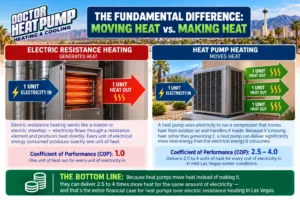
Electric resistance heating generates heat. It works the same way a toaster or an electric stovetop does — electricity flows through a resistance element and produces heat directly. Every unit of electrical energy consumed produces exactly one unit of heat. This is 100% efficient by definition — but that ceiling is also its limitation.
A heat pump moves heat. It doesn’t generate heat by consuming electricity directly. Instead, it uses electricity to run a compressor that moves heat from one place to another — extracting heat from outdoor air and transferring it inside. Because it’s moving heat rather than generating it, a heat pump can deliver significantly more heat energy than the electrical energy it consumes.
The ratio of heat delivered to electricity consumed is called the Coefficient of Performance, or COP. An electric resistance heater has a COP of 1.0 — one unit of heat out for every unit of electricity in. A modern heat pump in mild Las Vegas winter conditions typically achieves a COP of 2.5 to 4.0 — delivering 2.5 to 4 units of heat for every unit of electricity consumed.
That difference is the entire financial case for heat pumps over electric resistance heating.
Types of Electric Resistance Heating in Las Vegas Homes
Electric resistance heating appears in Las Vegas homes in several forms. Understanding which type you have affects how you evaluate the comparison.
Electric furnace or air handler with heat strips. The most common form of electric resistance heating in Las Vegas is the heat strip array inside the air handler of a heat pump system. These strips serve as auxiliary or emergency heat — supplementing the heat pump when outdoor temperatures drop low enough to reduce heat pump efficiency, or serving as emergency backup if the heat pump fails. Running these strips as the primary heat source is significantly more expensive than running the heat pump itself.
Baseboard heaters. Older Las Vegas homes — particularly condos and apartments built in the 1970s and 1980s — sometimes have individual electric baseboard heaters in each room. These are pure resistance heating with no efficiency advantage over the electrical energy they consume.
Portable electric space heaters. Common as supplemental heating in rooms that don’t get adequate heat from the central system. These are resistance heaters — efficient at converting electricity to heat in a small space, but expensive to run as a primary heating source.
Electric wall heaters. Similar to baseboard heaters, these are resistance devices commonly found in older construction and individual rooms in multi-unit buildings.
The Cost Comparison: Running the Numbers for Las Vegas
To make this concrete, here’s a realistic cost comparison for heating a typical Las Vegas home through a winter month.
Assumptions:
- 2,000 square foot Las Vegas home
- December average overnight low: 38°F
- NV Energy residential rate: approximately $0.12 per kWh
- Heating system runs approximately 6 hours per day in December
Electric resistance heating (heat strips / electric furnace)
A 5-ton system with 10kW of heat strips running at full capacity consumes 10 kWh per hour. At 6 hours per day for 30 days, that’s 1,800 kWh per month. At $0.12 per kWh, that’s approximately $216 per month in heating electricity.
Heat pump heating at COP 3.0
The same heat output from a heat pump operating at a COP of 3.0 requires one-third the electrical input. The same 6-hour daily runtime consumes approximately 600 kWh per month. At $0.12 per kWh, that’s approximately $72 per month in heating electricity.
The difference: $144 per month. Over a three-month Las Vegas heating season, that’s $432 in savings from running the heat pump rather than electric resistance heating for the same home.
These are illustrative numbers — actual costs vary based on home size, insulation, outdoor temperatures, and system efficiency. But the direction is consistent: heat pump heating costs roughly one-third what electric resistance heating costs for the same output in Las Vegas winter conditions.
When Electric Resistance Heat Makes Sense in Las Vegas
Despite being more expensive to operate, electric resistance heating isn’t without a legitimate role in a Las Vegas home.
As auxiliary heat on very cold nights. Heat pump efficiency decreases as outdoor temperatures drop. In Las Vegas, when overnight temperatures fall below approximately 35°F, the heat pump’s COP drops enough that electric heat strips activating automatically to supplement output is both normal and appropriate. The heat strips run briefly and intermittently — not as the primary heat source, but as a boost when the heat pump needs help.
As emergency backup. If the heat pump fails, the electric heat strips in the air handler provide backup heating that keeps the home livable until repair service arrives. This is the purpose of the Emergency Heat setting on your thermostat — it bypasses the heat pump entirely and runs only the strips. Use it only when the heat pump has actually failed. Running Emergency Heat as a routine heating mode can triple your electricity bill.
In small supplemental applications. A portable heater in a room that doesn’t receive adequate heat from the central system, or a bathroom heater for immediate morning warmth, is a reasonable use of electric resistance heating in a targeted way. The cost is proportional to the size of the space and the runtime — manageable for supplemental use, expensive as a primary system.
Why Las Vegas Is Ideal for Heat Pump Heating
Las Vegas winter conditions are actually close to ideal for heat pump heating performance — which makes the cost advantage even more pronounced here than in most markets.
Heat pump heating efficiency decreases as outdoor temperatures drop. In very cold climates — Minnesota, upstate New York, northern Nevada — outdoor temperatures regularly drop below 0°F, where heat pump efficiency drops significantly and cold-climate specific models are required.
Las Vegas overnight lows in December, January, and February typically range from the mid-30s to the upper 40s. That temperature range is exactly where conventional heat pumps perform at strong efficiency levels — COP values of 2.5 to 3.5 are realistic and common. The heat pump doesn’t need to work against extreme cold. It simply extracts abundant heat from mildly cool outdoor air and delivers it inside.
Furthermore, Las Vegas’s mild winters mean the heating season is short — three to four months versus six to eight months in cold-climate markets. The heat pump doesn’t need to sustain heating performance through prolonged extreme cold. It handles the mild Las Vegas winter comfortably, efficiently, and for a relatively short period before the cooling season reasserts itself.
Heat Pump vs Electric Heat: Side-by-Side Comparison
| Factor | Heat Pump | Electric Resistance |
|---|---|---|
| Operating efficiency | 250–400% (COP 2.5–4.0) | 100% (COP 1.0) |
| Monthly heating cost (typical Las Vegas home) | ~$72 | ~$216 |
| Upfront equipment cost | Higher | Lower |
| Provides cooling as well | Yes | No |
| Suitable for Las Vegas winters | Excellent | Yes, but expensive |
| Auxiliary heat in extreme cold | Built-in strips | N/A |
| Federal tax credit eligible (new installation) | Up to $2,000 | No |
| Best application | Primary heating system | Supplemental or backup |
Already Have Electric Resistance as Your Primary Heat? What to Do
If your Las Vegas home currently relies on electric resistance heating as the primary heat source — baseboard heaters, wall heaters, or running the heat strips as primary heat — switching to a heat pump is one of the highest-return home upgrades available given the operating cost difference.
The upfront cost of a heat pump installation runs $5,000 to $15,000 depending on system type, efficiency rating, and installation complexity. At $144 per month in heating savings for a typical Las Vegas home, the payback period from heating savings alone runs three to eight years — before considering the added benefit of highly efficient cooling during Las Vegas summers. For more on installation costs and available incentives, see our guides on heat pump installation cost in Las Vegas and the federal heat pump tax credit.
Why Las Vegas Homeowners Choose Doctor Heat Pump
Doctor Heat Pump is a local, family-owned HVAC company serving Las Vegas, Henderson, and North Las Vegas. We specialize in heat pump installation, heat pump service, and repair across the Las Vegas Valley — and we help homeowners understand the real operating cost implications of their system choices before they commit.
When you work with Doctor Heat Pump, we size the system correctly for your home, explain the efficiency trade-offs honestly, and help you take advantage of available incentives. We work primarily with Lennox because of their efficiency leadership in the desert climate — but we’re experienced with Carrier and Trane as well and always recommend the right system for your specific situation.

Frequently Asked Questions
Does a heat pump use more electricity than electric heat?
A heat pump uses significantly less electricity than electric resistance heating to produce the same amount of heat. A heat pump delivering the equivalent of 10,000 BTUs of heat might consume 1,000 to 1,500 watts of electricity. An electric resistance heater delivering the same 10,000 BTUs consumes approximately 3,000 watts. The heat pump uses one-third the electricity for the same output.
Why does my heat pump sometimes switch to heat strips?
Heat strips activate automatically when the heat pump alone can’t meet heating demand — typically when outdoor temperatures drop below approximately 35°F to 40°F, or when the thermostat setpoint is raised significantly at once. Brief, intermittent heat strip activation is normal and expected. Continuous heat strip operation in mild weather suggests a heat pump problem worth investigating.
Is it cheaper to run a gas furnace or a heat pump in Las Vegas?
In Las Vegas, a high-efficiency heat pump typically costs less to operate than a gas furnace for heating, given the city’s mild winters and the heat pump’s high COP in those conditions. The comparison depends on current gas and electricity rates. For a detailed breakdown, see our guide on heat pump vs gas furnace in Las Vegas.
Can a heat pump replace all my electric baseboard heaters?
Yes — a properly sized ducted or ductless heat pump system can replace electric baseboard heaters as the primary heating system for a Las Vegas home. The upfront installation cost is significant, but the operating cost savings typically justify the investment over the system’s lifetime.
My heat pump is running but my heat strips keep coming on. Is that normal?
Brief, intermittent heat strip activation on cold nights is normal. Continuous heat strip operation in mild weather — 50°F or above outdoors — is not normal and suggests the heat pump isn’t heating effectively. Check the filter, confirm the thermostat is in Heat mode, and call for service if the problem continues.
The Choice Is Clear for Las Vegas Winters
For primary heating in Las Vegas, a heat pump outperforms electric resistance heating on operating cost by a factor of two to three — every month of the heating season, every year the system runs. The mild Las Vegas winter is exactly the climate where heat pump heating shines most.
Doctor Heat Pump helps Las Vegas homeowners make the switch and get the most from their investment. Call us at 702-467-7236 or contact us online to discuss heat pump options for your Las Vegas home. We’ll show you the real numbers and help you make the decision that makes the most sense for your budget.

References
- U.S. Department of Energy — Heat Pump vs Electric Resistance Heating
- ENERGY STAR — Heat Pump Efficiency and Operating Costs
- Lennox — Heat Pump Heating Technology
- National Renewable Energy Laboratory — Residential Heat Pump Performance