
Las Vegas winters are mild — but they’re real. When overnight temperatures drop into the 30s and 40s, a heat pump that isn’t heating properly makes for a genuinely uncomfortable night. The frustrating part is that heat pump heating problems are often misunderstood. Homeowners assume the system is broken when it’s actually doing something normal. Or they wait too long on a problem that needed attention weeks ago. At Doctor Heat Pump, heating calls in the Las Vegas winter follow predictable patterns. This guide helps you understand what’s actually happening, what you can check yourself, and when to call a technician.
First: Understand How Heat Pump Heating Works
Before troubleshooting, one concept helps everything else make sense. A heat pump doesn’t generate heat by burning fuel. Instead, it extracts heat energy from outdoor air — even cold outdoor air — and transfers it inside. This surprises many homeowners who assume a heat pump can’t heat effectively when it’s cold outside.
In reality, modern heat pumps extract heat efficiently down to outdoor temperatures well below freezing. In Las Vegas, where winter overnight lows rarely drop below the mid-20s, a quality heat pump handles the full heating season comfortably without backup heat in most conditions.
Understanding this also explains why heat pump heating feels different from gas furnace heating. A furnace blasts hot air — typically 120°F to 140°F — in short intense cycles. A heat pump delivers warm air more consistently — typically 85°F to 95°F — over longer run cycles. If your heat pump is blowing air that feels warm but not hot, that’s often normal operation, not a problem.
Is the Heat Pump Actually in Heating Mode?
This sounds obvious — but it’s the first thing to check. Several scenarios cause a heat pump to run without heating.
Check the thermostat setting
Confirm the thermostat is set to Heat — not Cool, Fan Only, or Auto with a temperature setting the system has already reached. Also confirm the setpoint is actually above the current indoor temperature. A thermostat set to 68°F in a 70°F home won’t call for heat.
Check for a mode switching delay
Heat pump systems have a built-in time delay — typically 5 minutes — between mode changes. If you recently switched from cooling to heating, the system may be in a delay cycle. Wait 10 minutes and check again before concluding there’s a problem.
Check the reversing valve setting
Some thermostats have an O/B switch setting that controls the reversing valve — the component that switches the heat pump between heating and cooling mode. If this is set incorrectly, the system may be running in cooling mode when you’ve called for heat. Check your thermostat manual or call your technician to verify the setting.
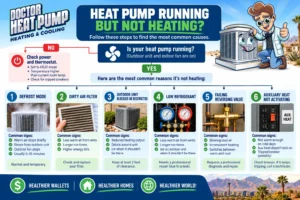
Common Reasons a Heat Pump Isn’t Heating
Once you’ve confirmed the system is actually calling for heat and the mode settings are correct, these are the most likely causes of a heating problem.
Defrost Mode
This is the most common cause of temporary heating interruption — and it’s completely normal. When outdoor temperatures drop and humidity is present, frost can form on the outdoor unit’s coil. The heat pump periodically enters a defrost cycle to melt this frost. During defrost, the system temporarily reverses to cooling mode to warm the outdoor coil.
During a defrost cycle you may notice:
- Warm air stops coming from vents briefly
- Steam or vapor rising from the outdoor unit
- The outdoor fan stopping while the compressor continues running
- The auxiliary heat strips activating to maintain indoor comfort
Defrost cycles typically last 5 to 15 minutes. After the cycle completes, the system returns to normal heating operation. If your heat pump seems to be in defrost constantly — running defrost cycles back to back without returning to normal heating — that’s a problem worth investigating.
Low Refrigerant
Refrigerant is what carries heat through the system. Low refrigerant — always caused by a leak, never normal depletion — reduces the heat pump’s ability to extract heat from outdoor air. In heating mode, low refrigerant causes the system to run without delivering adequate warmth. The auxiliary heat strips may compensate, but your energy bill will climb significantly as a result.
Signs of low refrigerant in heating mode include reduced heating output, longer run times, and ice forming on the outdoor unit during conditions where frost shouldn’t be present. Low refrigerant requires a licensed technician to locate the leak, make the repair, and recharge the system properly.
Dirty Air Filter
A clogged air filter restricts airflow across the indoor coil. In heating mode, restricted airflow means less air is being warmed and distributed through the home. The system runs but can’t meet the heating demand. In Las Vegas, where dust accumulates quickly, monthly filter checks during both cooling and heating seasons are essential.
Check the filter before calling for service. A severely restricted filter is one of the most common causes of reduced heating performance — and one of the easiest fixes.
Outdoor Unit Blocked or Restricted
The outdoor unit extracts heat from outdoor air. It needs adequate airflow on all sides to do this effectively. After a wind event or dust storm, debris can accumulate around or on the outdoor unit — restricting the airflow it needs for efficient heat extraction.
Check the outdoor unit for debris, leaves, or anything blocking the coil fins. Maintain at least two feet of clearance on all sides. Never cover the outdoor unit in winter — heat pumps operate in winter and need airflow year-round.
Failing Reversing Valve
The reversing valve switches the heat pump between heating and cooling mode. When it fails — either getting stuck in cooling mode or failing to switch cleanly — the system may run without heating or may heat inconsistently. A reversing valve failure requires a technician to diagnose and replace. It’s not a common failure but it does happen, particularly on older systems.
Signs of a failing reversing valve include the system blowing cold air in heating mode despite correct thermostat settings, or the system switching between warm and cool air erratically during a heating cycle.
Auxiliary Heat Not Activating
Most Las Vegas heat pump systems include electric auxiliary heat strips that automatically supplement heating output when outdoor temperatures drop low enough to reduce heat pump efficiency. If these strips have failed — a burned-out element, a tripped breaker, or a faulty control — the heat pump may be running but unable to maintain the setpoint on cold nights.
Check the electrical panel for any tripped breakers associated with the air handler or auxiliary heat. A tripped breaker is easy to reset — but if it trips again immediately, that signals an electrical problem that needs a technician.
What Your Heat Pump Is Telling You: Warning Signs Worth Acting On
Some heating problems are minor and self-correcting. Others signal developing issues that get worse if ignored. Here’s how to tell the difference.
Call for service if:
- The system runs constantly without reaching the thermostat setpoint on a moderately cold night
- The outdoor unit is iced over and not clearing after a defrost cycle
- You hear new sounds — grinding, clicking, or banging — during heating operation
- The auxiliary heat is running continuously rather than supplementing periodically
- Your heating bills are significantly higher than the same period last year
- The system switches between heating and cooling mode on its own
Monitor but don’t panic if:
- The system blows air that feels warm but not hot — this is normal heat pump operation
- Steam rises from the outdoor unit briefly — this is the defrost cycle working correctly
- The system runs longer cycles than a furnace would — heat pumps are designed to run longer at lower output
- The outdoor unit fan stops briefly while the compressor continues — again, this is defrost mode
Auxiliary Heat vs. Emergency Heat: What’s the Difference?
Most heat pump thermostats have both an auxiliary heat mode and an emergency heat mode. These are not the same thing.
Auxiliary heat activates automatically when the heat pump alone can’t meet heating demand. The thermostat manages this without any homeowner input. In Las Vegas, you may see the Aux Heat indicator light on your thermostat on cold nights — this is normal.
Emergency heat bypasses the heat pump entirely and runs only the electric heat strips. It should only be used if the heat pump itself has failed. Running emergency heat as a regular heating mode is extremely expensive — electric resistance heating is significantly less efficient than heat pump heating. If your emergency heat is on and the heat pump isn’t functioning, call for service.
Heat Pump Heating Performance: What’s Normal in Las Vegas
Setting realistic expectations prevents unnecessary service calls — and helps you recognize when something genuinely isn’t right.
Normal heat pump heating behavior in Las Vegas:
- Supply air temperature of 85°F to 100°F at the vents — warm but not hot
- Longer run cycles than a gas furnace — the system runs more consistently rather than in short bursts
- Defrost cycles every 30 to 90 minutes in cold, humid conditions — brief interruptions of 5 to 15 minutes
- Auxiliary heat activating when outdoor temperatures drop below approximately 35°F to 40°F
- The outdoor unit operating continuously including during winter
Not normal — worth a call:
- Supply air that feels cool or room temperature in heating mode
- The system running constantly without any progress toward the setpoint
- Outdoor unit completely encased in ice that isn’t clearing
- Auxiliary heat running 100% of the time in mild winter weather
- Any new noise from either the indoor or outdoor unit
For a full breakdown of heat pump system components and how they work together, see our guide on how the heat pump refrigeration cycle works.
Preventive Steps for Las Vegas Homeowners Before Winter
Las Vegas winters are short — but a little preparation before the season switches makes a difference. Here’s what to do in October and November before heating demand arrives.
Schedule a fall service visit
A professional fall heat pump service visit confirms the reversing valve is working correctly, checks refrigerant levels, tests auxiliary heat operation, and cleans the coils after the heavy summer cooling season. Catching a developing issue in October is far better than discovering it during a cold snap in January.
Switch your thermostat to heating mode and test it
Before you need the heat, run a test cycle. Set the thermostat to Heat, raise the setpoint above the current indoor temperature, and confirm the system delivers warm air within a few minutes. This takes two minutes and confirms the system is ready before you actually need it.
Replace the air filter
Start the heating season with a fresh filter. Good airflow is just as important for heating efficiency as it is for cooling.
Clear the outdoor unit
Check for any debris accumulation around the outdoor unit from the summer and fall. Make sure nothing has been placed around or on top of the unit during the off-season.
Why Las Vegas Homeowners Trust Doctor Heat Pump
Doctor Heat Pump is a local, family-owned HVAC company serving Las Vegas, Henderson, and North Las Vegas. We specialize in heat pump repair, installation, and service across the Las Vegas Valley — including the full range of heating and cooling issues that Las Vegas’s unique climate creates.
When you call us about a heat pump not heating, we diagnose accurately and explain clearly what we find. We don’t recommend unnecessary repairs — and we don’t leave you with a vague answer. Our goal is always for you to understand exactly what’s happening with your system and what your options are.
Frequently Asked Questions
Why is my heat pump blowing cold air in winter?
Several causes are possible — the system may be in defrost mode temporarily, the reversing valve may be stuck in cooling position, refrigerant may be low, or the auxiliary heat strips may have failed. If the system consistently blows cold or room-temperature air in heating mode outside of a brief defrost cycle, call for service.
How cold does it need to be before a heat pump struggles in Las Vegas?
Modern high-efficiency heat pumps maintain strong heating performance down to outdoor temperatures of 25°F to 30°F. In Las Vegas, where winter overnight lows rarely drop below the mid-20s, a quality heat pump handles the full heating season effectively. Auxiliary heat supplements on the coldest nights.
Why does my heat pump run constantly in winter?
Longer run cycles are normal for heat pump heating — the system delivers heat at a lower temperature than a furnace but runs more continuously. However, if the system runs non-stop without reaching the setpoint even in mild winter weather, that suggests an efficiency problem worth investigating.
Should I switch to emergency heat when it’s cold?
No — not unless the heat pump itself has failed. Emergency heat runs only the electric resistance strips, which are significantly less efficient than heat pump heating. Running emergency heat as a regular mode will dramatically increase your electricity bill.
How do I know if my auxiliary heat is working?
On most thermostats, an Aux Heat indicator appears when the strips are actively running. You can also feel a noticeably warmer supply air temperature when auxiliary heat is active — typically 110°F to 120°F vs. 85°F to 95°F in heat pump-only mode. If you never see the Aux indicator on very cold nights, the strips may not be functioning correctly.
Heat Pump Not Heating? Don’t Wait on It.
Las Vegas winters are short — but a heat pump that isn’t working correctly makes every cold night more uncomfortable and more expensive than it needs to be. Most heating problems have straightforward solutions when caught early. Waiting until the coldest night of the year to address a developing issue turns a simple fix into an emergency call.
Doctor Heat Pump is ready to help across Las Vegas, Henderson, and North Las Vegas. Call us at 702-467-7236 or contact us online at the first sign of a heating problem. We’ll diagnose it accurately and get your system back to full heating performance before the next cold night arrives.

References
- U.S. Department of Energy — Heat Pump Heating Performance
- ENERGY STAR — Heat Pump Systems and Efficiency
- Lennox — Heat Pump Heating Technology
- Carrier — Heat Pump Troubleshooting and Service