Last updated: November 2026
It is over 100 degrees outside, the system is running, and the house keeps getting warmer. An AC not cooling in Las Vegas is stressful, and it is hard to know whether you are looking at a five-minute fix or an expensive repair.
The good news is that your AC usually gives you clues. Air that feels warm, air that barely moves, ice on a pipe, or a system that cools at night but not in the afternoon each point to a different cause.
This guide helps you match what you are seeing to the most likely problem, shows which checks are safe to do yourself, and explains when to shut the system off and call a professional.
Quick Answer: Why Is My AC Not Cooling?
An AC that runs but doesn’t cool most often has a wrong thermostat setting, a dirty air filter, a blocked or dirty outdoor unit, a frozen indoor coil, low refrigerant from a leak, or a failed electrical part. Check these first:
- Thermostat: Set to Cool, fan on Auto, and the temperature set below the room temperature
- Air filter: Replace it if it looks dirty
- Breakers: Check both the indoor and outdoor unit breakers
- Outdoor unit: Make sure the fan is spinning and nothing is blocking the coil
- Ice or water: If you see either one, turn cooling off and call for service
AC Not Cooling Symptoms: Match What You See to the Cause
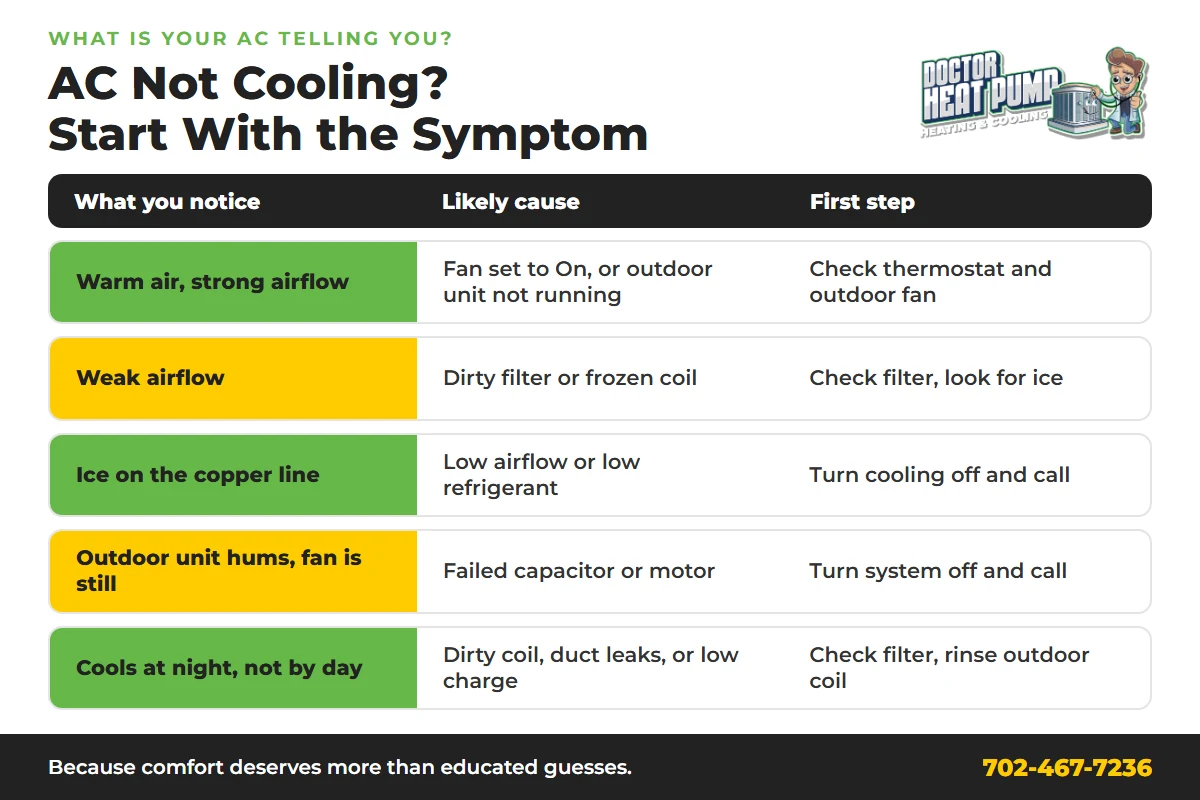
Start with the symptom, because it narrows the list quickly. Find the line that matches your home.
| What You Notice | Most Likely Causes | First Step |
|---|---|---|
| Strong airflow, but the air is warm | Fan set to On, outdoor unit not running, low refrigerant | Check the thermostat, then see if the outdoor fan is spinning |
| Weak airflow from every vent | Dirty filter, frozen coil, blower problem | Check the filter and look for ice |
| Ice on the copper line or indoor coil | Low airflow or low refrigerant | Turn cooling off and call |
| Outdoor unit hums, but the fan won’t spin | Failed capacitor or fan motor | Turn the system off and call |
| Nothing turns on | Tripped breaker, dead thermostat batteries, full drain pan | Check batteries and the breaker once |
| Cools at night, falls behind in the afternoon | Dirty outdoor coil, duct leaks, low charge, undersized system | Rinse the outdoor coil and check the filter |
| One or two rooms stay hot | Duct leak, closed damper, poor return air | Open vents and check for blocked returns |
| Starts and stops every few minutes | Dirty filter, oversized system, electrical fault | Check the filter, then call |
What Should You Check First When Your AC Is Not Cooling?
If your AC is not cooling, work through these safe checks in order before you call. None of them require opening the equipment.
- Check the thermostat. Set it to Cool and the fan to Auto. Trane explains that a fan set to On blows unconditioned air even when the AC isn’t running. If the screen is blank, replace the batteries.
- Replace a dirty filter. ENERGY STAR recommends inspecting, cleaning, or changing it once a month. Dust can make that even more important here.
- Look at the breakers. A split system usually has one breaker for the indoor unit and one for the outdoor unit. Reset a tripped breaker once. If it trips again, leave it off and call.
- Look at the outdoor unit from a safe distance. The fan should spin while the system is cooling. Clear away leaves, trash, and stored items.
- Rinse the outdoor coil gently. Turn the power off first. Use a garden hose on low pressure, never a pressure washer.
- Look for ice and water. Check the larger copper line near the indoor unit and the area around the drain pan.
- Open vents and returns. Move furniture and rugs that block them.
- Wait and watch. If you found and fixed something simple, give the system time to catch up. A hot house can take hours to cool.
What You Should Not Do
- Don’t keep resetting a breaker that trips again
- Don’t open the electrical panel on either unit. Capacitors can hold a dangerous charge even with the power off
- Don’t chip at ice on a coil
- Don’t add refrigerant yourself. The EPA requires certification for technicians who work on refrigerant equipment
- Don’t bypass a drain safety switch
Why Is My AC Running But Not Cooling the House?
If your AC runs but the house doesn’t cool, the fan is moving air but the system isn’t removing enough heat. These are the most common reasons.
Dirty or Blocked Outdoor Coil
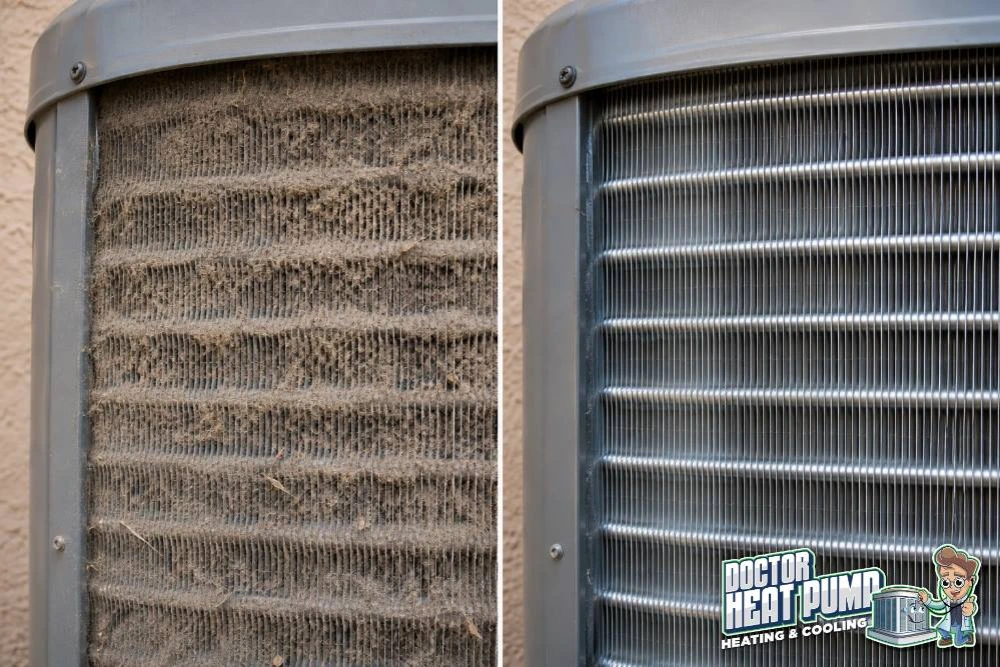
The outdoor unit releases the heat collected from your home. Carrier says a dirty coil leads to reduced efficiency, lack of cool air, or even compressor damage. Desert dust makes this an easy problem to miss, because the unit can look fine from a few feet away.
Frozen Indoor Coil
It sounds backward, but an AC can freeze in July. When airflow is too low or refrigerant is low, the indoor coil can ice over and block air. If you see ice, turn cooling off and let it thaw. Running it longer can damage the compressor.
Low Refrigerant
Refrigerant doesn’t get used up, so a low charge usually means a leak or a wrong charge at installation. Adding more without finding the leak only buys time. Learn how the system works in our guide to refrigerants.
Failed Capacitor, Contactor, or Motor
These electrical parts start and run the compressor and fans, and heat is hard on them. A humming outdoor unit with a fan that won’t spin is a common sign. This is a repair for a professional.
Clogged Drain Line
Your AC removes moisture from the air, and that water has to drain. Trane notes that some indoor units have a safety switch that shuts the system down when water rises in the drain pan. If you see water, read our guide to a leaking system.
Leaky Ducts
Your AC may be making cold air that never reaches your rooms. ENERGY STAR says that in a typical house, about 20 to 30 percent of the air moving through the ducts is lost to leaks, holes, and poor connections. See the signs your ductwork needs repair.
Wrong System Size
Carrier says an undersized unit will struggle to keep up as outdoor temperatures rise. If your system has never kept up, even when it was new, the size or the ductwork may be the real issue. Read about choosing the right size.
Why Does My AC Cool at Night but Not During the Day?
An AC that cools at night but not in the afternoon is usually losing capacity when it needs it most. Outdoor heat makes every air conditioner work harder, so a small problem that stays hidden at night can show up at 4 p.m.
Common reasons include a dirty outdoor coil, a low refrigerant charge, attic duct leaks, weak airflow, poor insulation, or a system that is too small. Afternoon sun on west-facing windows adds to the load.
Is My AC Broken, or Is It Just Too Hot?
You may have heard that an AC can only cool your home 20 degrees below the outdoor temperature. That isn’t a hard limit, and it mixes up two different measurements. Technicians compare the air going into the system with the air coming out of it. That is not the same as comparing indoor and outdoor temperatures.
On the most extreme days, a healthy system may run nearly nonstop and slip a few degrees. These signs point to a real problem instead:
- It kept up in the same heat last summer, but not now
- The house stays warm late into the evening
- Air from the vents doesn’t feel cool
- Your power bill jumped without a change in how you use the AC
- You see ice, water, or hear new noises
Why Is My Upstairs Hot When the AC Is Running?
An upstairs that won’t cool is usually an airflow problem, not a bad AC. Heat rises, the attic radiates heat down, and one thermostat downstairs can’t feel how warm the bedrooms are.
- Open all upstairs vents and keep bedroom doors open when you can
- Check that the return grille isn’t blocked
- Close blinds on west-facing windows in the afternoon
- Ask for measured airflow at the vents and a duct inspection
- If one room still can’t keep up, compare options in mini split vs central air
When Should You Turn the AC Off and Call a Professional?
Turn the system off and call if you see ice, smell burning, or find a breaker that trips again. Continuing to run it can turn a small repair into a big one.
- Ice on the refrigerant line or indoor coil
- A burning smell, buzzing, or sparks. If you see smoke or fire, leave and call 911
- A breaker that trips a second time
- Water leaking through a ceiling or around the indoor unit
- Grinding, screeching, or banging
- An outdoor fan that won’t spin
- Warm air after you have checked the thermostat and filter
Frequent on-and-off cycling also deserves a call. See our guide to short cycling. If you have a heat pump, our post on a heat pump running but not cooling covers the parts that differ.
How Do You Stay Safe While the AC Is Down?
In Las Vegas, an AC not cooling in summer can become a health risk, so protect people first. The Southern Nevada Health District says infants, young children, older adults, people with chronic health conditions, and people without working air conditioning face a higher risk of heat illness.
- Move to an air-conditioned place early, such as a relative’s home, library, mall, or cooling station
- Drink water and avoid heavy activity
- Close blinds and stay on the lowest floor
- Check on older neighbors and pets
- Never leave anyone, or any pet, in a parked car
The Health District lists heavy sweating, nausea or vomiting, dizziness, and muscle cramps as signs of heat exhaustion. Heat stroke is more severe, with signs such as a temperature of 103 degrees, headache, red, hot, dry skin, a strong pulse, or loss of consciousness. If you suspect heat stroke, call 911.
Our guide to emergency HVAC repair in Las Vegas explains what to do while you wait.
AC Not Cooling Repair Cost: What Should You Expect?
The cost depends on the cause, and the cheapest fixes are often the ones you can check yourself. These are general 2026 Las Vegas ranges, not quotes.
| Repair | General Cost Range |
|---|---|
| Air filter or thermostat batteries | Usually a small DIY cost |
| Diagnostic or service call, standard hours | $75 – $150 |
| Capacitor replacement | $150 – $350 |
| Contactor replacement | $150 – $400 |
| Condenser coil cleaning | $150 – $350 |
| Evaporator coil cleaning | $150 – $400 |
| Thermostat replacement | $150 – $400 |
| Refrigerant leak repair and recharge | $300 – $1,500+ |
| Blower motor replacement | $400 – $700 |
| Compressor replacement | $1,200 – $2,800 |
Check your coverage before paying for a major part. Our HVAC warranty guide explains what to look for. For more detail, see what AC repair costs in Las Vegas.
Should You Repair or Replace It?
A newer system with one failed part is usually worth repairing. An older system with a failed compressor or a major leak deserves a closer look. Our guide to AC replacement and the $5,000 rule can help you decide. Before you agree to a new system, ask to see the readings and photos.
What Should You Tell the Technician?
A few details can save time and help the technician arrive prepared. Write these down before you call:
- When the problem started and whether it is constant or only in the afternoon
- Whether the outdoor fan is spinning
- Whether airflow is strong, weak, or missing
- Any ice, water, smell, or noise
- What you already checked, such as the filter or breaker
- The age of the system and any recent repairs
- Whether anyone at home is at higher risk from heat
Not sure whom to call? Use our checklist for choosing among HVAC companies in Las Vegas.
How Can You Prevent AC Not Cooling Problems Next Summer?
The best prevention is clean airflow and a professional check before the first stretch of triple-digit heat.
- Check the filter every month
- Keep plants and stored items at least two feet from the outdoor unit
- Rinse the outdoor coil gently after dusty or windy weather, with the power off
- Watch for slow changes, such as longer run times or higher bills
- Schedule a spring visit. See what an AC tune-up in Las Vegas includes
- Consider whether an HVAC maintenance plan makes sense for you
Why Las Vegas Homeowners Choose Doctor Heat Pump
Doctor Heat Pump is a family-owned company of certified heat pump specialists, and we bring the same care to air conditioners and furnaces. When your AC isn’t cooling, we don’t guess and we don’t start by selling you a new one.
Through our Clinical Comfort Method™, we begin with a Comfort Exam and take your system’s vitals. You get a clear Treatment Plan with options, and we recommend what your home needs, never the biggest sale.
When the work is finished, you receive a Comfort Diagnosis with the findings, results, and photos. If the work doesn’t meet the manufacturer’s specification, we make it right. If another company told you the system is finished, ask us for a Second Opinion.
Frequently Asked Questions
Why is my AC not cooling but still running?
The most common causes are a wrong thermostat setting, a dirty filter, a dirty or blocked outdoor coil, a frozen indoor coil, low refrigerant, or a failed electrical part in the outdoor unit.
Should I turn off my AC if it is not cooling?
Turn cooling off if you see ice, smell burning, hear loud noises, or the outdoor fan isn’t spinning. Running it in those conditions can cause more damage.
Can a dirty filter stop my AC from cooling?
Yes. A clogged filter restricts airflow, which can reduce cooling, freeze the indoor coil, and even cause the system to shut down.
How long should it take for an AC to cool a hot house?
It depends on the home, the system, and the outdoor temperature. A very warm house can take several hours. If the temperature isn’t dropping at all, something is likely wrong.
Why is my AC blowing warm air after I changed the filter?
The filter may not have been the only problem. Check that the thermostat is on Cool and the outdoor fan is spinning. If the coil was frozen, it needs time to thaw. If air stays warm, call for service.
Can low refrigerant fix itself?
No. A low charge usually means a leak. It has to be found, repaired, and recharged by a certified technician.
Is an AC not cooling an emergency?
It can be in Las Vegas summer heat, especially with infants, older adults, or anyone with a health condition at home. Move to a cool place and call right away.
AC Not Cooling? Get a Real Answer
You shouldn’t have to guess, and neither should your technician. We can measure what your system is doing and show you the cause before you spend money on parts.
Call Doctor Heat Pump at 702-467-7236 or contact us online. Learn more about our AC repair and AC maintenance services, or read our list of reasons an AC isn’t blowing cold air.
Because comfort deserves more than educated guesses.